


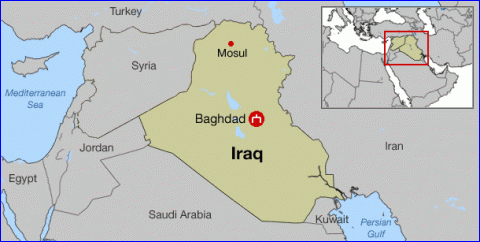
Political and security indicators suggest attempts by influential Kurdish actors, particularly those linked to the Barzani leadership, to involve Iraq in regional conflicts beyond its borders, including the Syrian arena. Any effort to deploy Iraqi armed forces in conflicts unrelated to defending national sovereignty drains state capacity, diverts attention from urgent domestic priorities, and exposes Iraq to strategic risks, while serving narrow regional ambitions rather than national defense.
Undermining federal authority and creating political and security fragmentation opens the door for parallel authorities and unilateral decision-making outside constitutional frameworks. This situation benefits actors seeking to expand their influence, consolidate control over disputed territories, and manage natural resources, particularly oil, independently and outside fair national distribution mechanisms.
Collectively, these policies indicate a long-term trajectory aimed at weakening Iraq's cohesion and creating conditions to impose new political and geographic realities on the ground. This path is seen as supporting unacknowledged separatist ambitions, potentially leading to the de facto partition of the country or at least significantly undermining its unity and sovereignty over the long term.
Indigenous and minority communities in northern Iraq, particularly Assyrians, bear the heaviest burden of these policies. Declining security, political marginalization, land encroachment, and the absence of effective state protection have accelerated forced migration, emptying historical regions of their original inhabitants and permanently altering Iraq's demographic composition.
Destabilization in Iraq is not only a security threat but also a political tool that grants additional influence to internal regional powers at the expense of the federal state and national unity. Accordingly, the report recommends:
Restricting the role of Iraqi armed forces to defending national sovereignty within the country's borders. Strengthening federal authority and enforcing the constitution, particularly regarding the management of natural resources. Protecting the rights of minorities and indigenous communities to ensure their continued presence in historical lands. Rejecting any policies or practices that institutionalize division or push toward partition.
Maintaining a strong and unified Iraq requires a comprehensive approach to address policies of weakening and fragmentation and prioritizing the national interest above narrow partisan or regional ambitions.
Guest Editorial Policy
or register to post a comment.