


Furthermore, the discovery was made by professors Alex Mazzanti, from the Federal University of Rio de Janeiro (UFRJ), and Matheus Treuk, from the State University of Rio de Janeiro (Uerj).
Thus, the content officially became part of the history of the Assyrian Hall, one of the most emblematic spaces of the building, precisely at a time when the theater celebrates another anniversary.
Mystery remained unanswered since the theater's inauguration Since the building's opening on July 14, 1909, a cuneiform inscription remained engraved on one of the walls of the Assyrian Hall.
However, for decades, the text had never been translated.
According to information from the educational team of the Theatro Municipal, this lack of interpretation always represented a gap in guided tours.
Moreover, curiosity arose when Alex Mazzanti participated in a visit to the space.
On the occasion, when asked about the meaning of the inscription, he received the response that no one knew its translation.
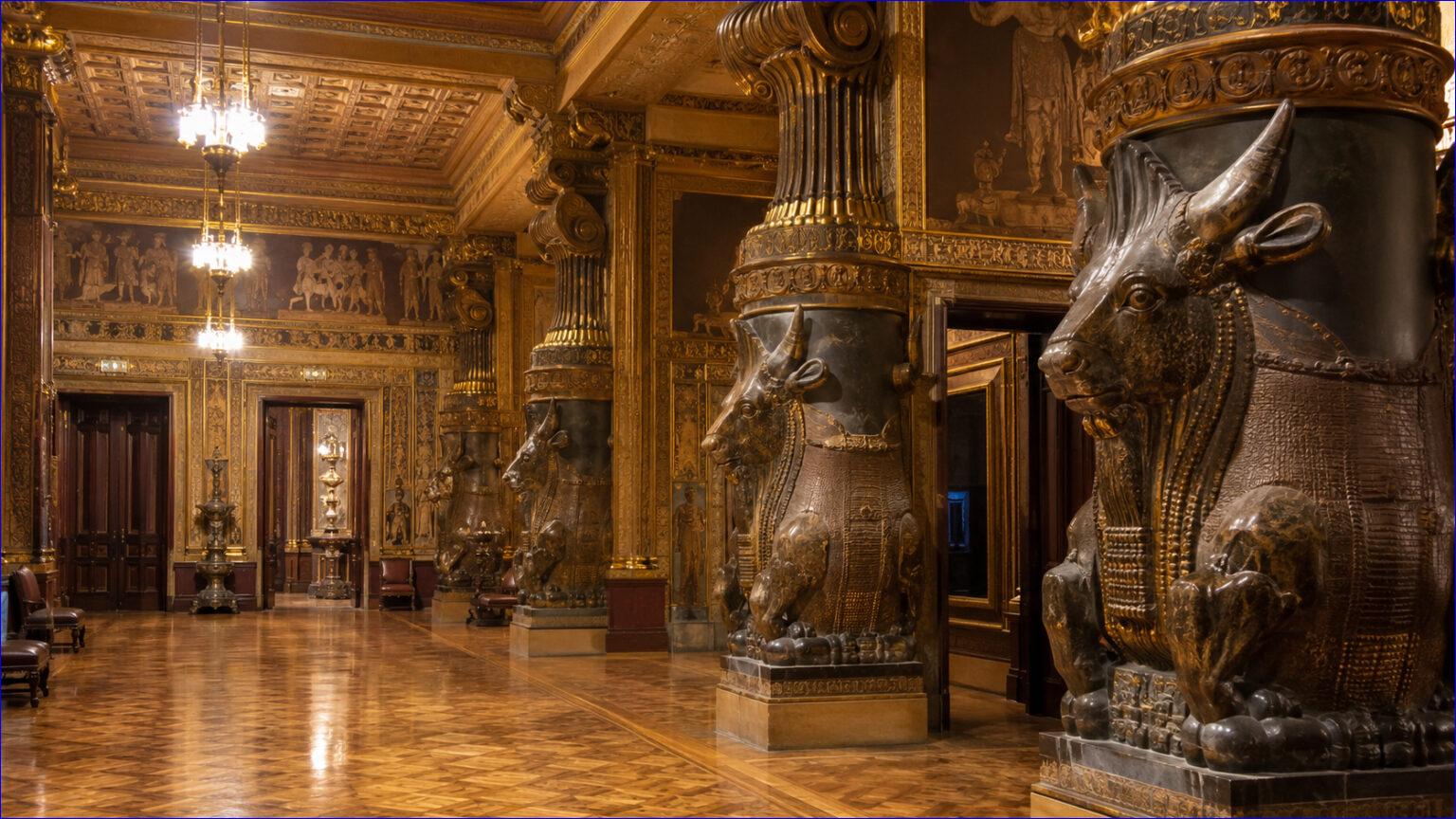
Assyrian Hall gathers references from ancient Persia While the facade of the Theatro Municipal was inspired by the Paris Opera, the Assyrian Hall received a completely different aesthetic proposal.
In this sense, the environment was designed during the Belle Époque, a period marked by European interest in Eastern civilizations.
As explained by Clara Paulino, president of the Theatro Municipal Foundation, the space gathers elements from different ancient peoples to create a monumental atmosphere.
Even so, experts claim that the hall has much more characteristics of the Persian Empire than of Assyria.
Among the main elements are:
- Columns inspired by the Apadana, the great audience hall of the Persian kings;
- Capitals in the shape of bulls;
- Reliefs with lions, archers, and historical figures;
- Ornamentations inspired by the archaeological excavations conducted in the Middle East at the end of the 19th century.
Therefore, as highlighted by archaeologist Matheus Treuk, the space can be understood as an architectural reinterpretation of an ancient Persian palace.
Translation revealed direct reference to King Artaxerxes After the visit, Alex Mazzanti resumed his studies of ancient Persian and began the translation.
Subsequently, the hypothesis was confirmed with the assistance of Matheus Treuk, a specialist in Ancient Near Eastern archaeology and cuneiform writing.
According to the researcher, the reading was facilitated by the fact that Persian cuneiform has a relatively accessible structure for specialists.
Thus, the inscription revealed the following message:
"From the Apadana of Artaxerxes, great king, king of kings, son of King Darius."
Furthermore, the inscription was identified as an adaptation inspired by ancient Persian inscriptions, and not as a known literal reproduction.
Origin of the inscription refers to 19th-century archaeological discoveries After the translation, the researchers investigated the origin of the phrase.
During the studies, it was found that, in 1886, excavations conducted in the ancient Persian city of Susa revealed reliefs, sculptures, and inscriptions that sparked great interest in Europe.
Subsequently, these pieces were taken to the Louvre Museum.
Moreover, reproductions inspired by these discoveries were presented during the 1889 Paris Universal Exposition, an event that also marked the inauguration of the Eiffel Tower.
According to Matheus Treuk, the French company responsible for the decoration of the Assyrian Hall participated in these exhibitions.
Therefore, they mastered the techniques of reproducing Persian ceramics and reliefs used in the theater environment.
Heritage preserved for over a century While many constructions inspired by ancient Persia were dismantled after world expositions, the Assyrian Hall remained preserved.
For this reason, researchers consider that the space represents a unique heritage.
Furthermore, for the management of Theatro Municipal, the translation broadens the understanding of the building's own history.
According to Clara Paulino, the partnership between heritage, university, and research allowed for the recovery of both the meaning of the inscription and the historical context that motivated its creation.
Finally, as highlighted by Alex Mazzanti, contributing to understanding the connections between Rio de Janeiro, France, and ancient Persia represents an important advancement for the preservation of historical memory.
or register to post a comment.