


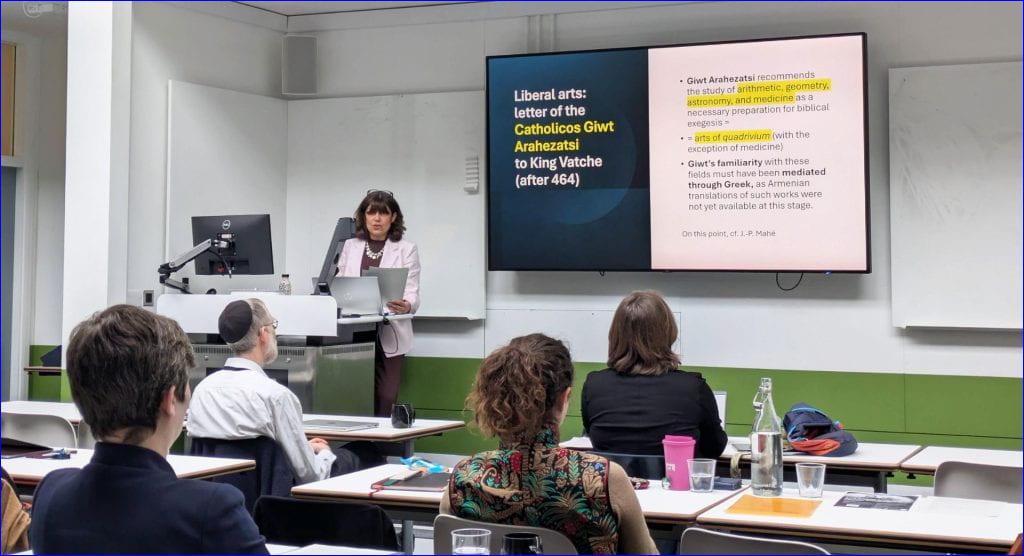
In her talk 'The introduction of the liberal arts in Armenia and their transmission in medieval Armenian manuscript collections', Valentina Calzolari Bouvier (University of Geneva) looked at late antique Armenian translation centres and medieval monastic schools as sites of reception and diffusion of Greek philosophical writings. By analysing the choice of texts translated into Armenian between the sixth and eighth centuries, Calzolari Bouvier demonstrated the indebtedness of the Armenian philosophical tradition to the works of the Neoplatonic school of Alexandria. She also uncovered a significant overlap between the works translated into Armenian and those translated into Syriac. This suggests that similar corpora of Greek texts circulated in these parts of the Near East. Aristotelian logic began to be integrated into Armenian educational curricula from the eighth century at the latest. However, it was only in the Middle Ages that Armenians started to comment on the Neoplatonic works translated in Late Antiquity. The commenting activity, driven by a desire to clarify and preserve concepts and specialist terminology, was part of the teaching programme of medieval monastic schools. This is reflected in medieval manuscript compendia, where late antique translations of Greek originals coexist with medieval Armenian commentaries on them.
Stephanie Pambakian's (UCL) talk, 'The world in a codex: Astronomy andnatural philosophy in Armenian manuscripts', was dedicated to the scientific legacy of the famous seventh-century Armenian scholar and polymath Anania Shirakac'i. Anania is said in later sources to have composed works on astronomy, astrology, cosmology, calendar, meteorology, arithmetic, religious feasts, and more, but the validity of many such attributions is difficult to ascertain, and reconstructing Anania's corpus presents a major challenge. In the course of her work on catalogues of Armenian manuscripts, especially those housed in the Monastery of St. James in Jerusalem and the Matenadaran Institute of Ancient Manuscripts in Yerevan, Pambakian observed that many manuscripts preserve thematically organised groups of texts on astronomy, meteorology, calendars, and time-reckoning--subjects that closely align with Anania's scholarly activities. Where some texts in such groups are attributed to Anania, it is possible that others copied in close proximity with them are also by him, or date from his time and reflect his scientific legacy. In the current absence of methodological tools in Armenian studies for identifying late antique scientific works in medieval compendia, looking for stable recurring text sequences, alongside in-depth conceptual analysis, may offer a useful way forward. Reflecting on how late antique Armenian scientific corpora may have been formed and transmitted in the Middle Ages, Stephanie Pambakian hypothesised that the educational needs of monasteries may have played an important role and asked whether the patronage of political and religious leaders likewise ensured the copying and preservation of scientific works.
Christine Roughan (Princeton University) spoke about 'Diverging echoes of a late antique astronomical curriculum in medieval Greek and Arabic manuscripts'. By the fourth century CE, a corpus of ancient Greek treatises arranged for the study of astronomy was circulating, titled collectively the Middle Works or Little Astronomy. Examining the later medieval manifestations of this collection, in the original Greek and in Arabic translations, Roughan presented suggestive evidence that the contents and organisation of this corpus were largely fossilised. This is shown, among other ways, by intra-curricular links within the marginalia of many manuscripts that provide references to exact numbered sections of works in the corpus. Despite this, argued Roughan, the fate of the Little Astronomy corpus in Greek and Arabic medieval manuscripts differed. The Arabic tradition saw a continued use of these works as a curriculum, which both preserved the late antique core and contributed new material to the corpus. Conversely, the Greek tradition ultimately saw interference with other didactic arrangements, which led to fragmentation and shuffling of the component treatises in later manuscripts.
Both speakers in the Syriac panel, Abigail Pearson (UCL) and Emilie Villey (CNRS), addressed the question of identifying late antique astronomical and astrological texts in medieval Syriac compendia. Many of these texts are anonymous, pseudepigraphic, or incorrectly attributed, and establishing their chronology requires a combination of methodological approaches. In her talk 'Dating a late antique Syriac astronomical text', Emilie Villey evaluated the main tools available to researchers. Explicit dates provided within a text offer the most straightforward evidence. Descriptions of astronomical phenomena--such as solar eclipses, the position of stars within the zodiac, or comet observations--can also help establish a date, provided that the author claims to have witnessed the event or to be reporting a contemporary observation. Linguistic analysis constitutes a further valuable tool. Because the Syriac language evolved through sustained contact with Greek, particularly during the sixth and seventh centuries, and later with Arabic from the ninth century onward, features such as connective particles, astronomical terminology, and the formation of scientific neologisms can provide important clues for dating anonymous texts.
Complementing Villey's broad methodological overview, Abigail Pearson applied astronomical and lexical dating methods to one manuscript as a test case. Her talk 'Dating the Chronicon in a late medieval Syriac manuscript: Astronomical and lexical analysis' focused on British Library (BL) Add. 14713, a twelfth to thirteenth-century West Syriac manuscript comprising a composite collection that includes hymns, a list of saints' days, and a section on calendrical and astronomical calculations titled the Chronicon. Pearson examined two prognostic texts within the Chronicon--one on the annual horoscope and one known as the Revelation of Ezra. An annual horoscope is determined by the moon's position in the zodiac on the night before the heliacal rising of Sirius. While this can be established by yearly ocular observations, BL Add. 14713 provides an algorithm for working out the annual horoscope for any given year. By using lunar ephemeris data and comparing the results of the algorithm with the moon's real position, Pearson demonstrated that the algorithm works best for years in the eighth century. She then turned to the Revelation of Ezra, a prognostic text offering agricultural, meteorological, and political predictions for the four seasons of a given year. Through careful lexical analysis, Pearson showed that the Syriac term for 'spring' used in this copy of the Revelation of Ezra was used in the eighth and ninth centuries and possibly earlier but had dropped out of usage by the tenth century. Both findings suggest that the Chronicon in the late medieval compilation BL Add. 14713 contains prognostic texts that can be identified as late antique and dated to approximately the eighth century.
Sacha Stern and Nadia Vidro's (UCL) shared presentation 'Early astronomical texts in Cairo Genizah compilations' was dedicated to fragmentary compendia of Hebrew texts of astronomy, astrology, and calendar science. While the discussed fragments themselves are medieval, some of their texts are datable to the seventh and eighth centuries. This dating can be deduced, for example, from the mentioned dates or from the use of Jewish calendar schemes that predate the widespread adoption of the rabbinic calendar calculation by the early tenth century. The bulk of Stern and Vidro's talk focused on one compilation, T-S Misc.36.112 housed in the Cambridge University Library. This three-folio fragment, paleographically datable to the first half of the eleventh century, contains two texts--a work titled Baraita de-Shemuel and an otherwise unknown astronomical-calendar treatise. Stern presented the results of his analysis of the astronomical-calendar treatise, which includes unexpectedly high-level astronomical calculations alongside a crude algorithm for predicting new moon visibility. One of its components is an ephemeris for the 28 August 706 CE, dated according to the Jewish, Coptic and Hijri calendars. This combination of dating methods suggests that the ephemeris, and possibly the whole treatise, was put together by an early eighth-century Egyptian Jew. Other elements of the treatise bear evidence of the author's familiarity with Sassanian astronomical traditions. The treatise attests to Jewish astronomical activity before the Abbasid scientific renaissance in the early ninth century and raises important questions about the historical context of this activity and the transfer of knowledge between the Iranian world and Egypt.
Vidro's contribution focused on Baraita de-Shemuel as it is attested in T-S Misc.36.112. Baraita de-Shemuel is a Hebrew work of cosmology, astronomy and theoretical astrology with a complicated textual history. While often mentioned by medieval authors, Baraita de-Shemuel remained unknown to modern scholars until its first publication in Salonika in 1861, based on a now-lost manuscript. As early as 1900, it was noted that the text of the Salonika 1861 edition is not uniform, with its style and terminology changing significantly in the middle of chapter five out of nine. On this basis, it has been proposed that Salonika 1861 was not a cohesive work but a compilation. Vidro set out to test this hypothesis through a codicological study of T-S Misc.36.112. A reconstruction of the quire, of which only three folios have survived, together with an estimate of the amount of text per page, makes it unlikely that T-S Misc.36.112 contained the whole text of Salonika 1861. It would, however, have had enough space for the first four to five chapters. This finding confirms the proposed division of Baraita de-Shemuel in its Salonika 1861 rendition into two independent parts. While the first part, chapters one--mid five, is most probably late antique or early medieval, the rest of the text may be later.
In her final remarks, Abigail Pearson spoke for the whole team when she said how much we valued the opportunity to hear about relevant research happening in other universities, share our ideas with the audience and receive their expert comments and critiques. It has been a fruitful day, and we look forward to future workshops in the next academic year.
or register to post a comment.