


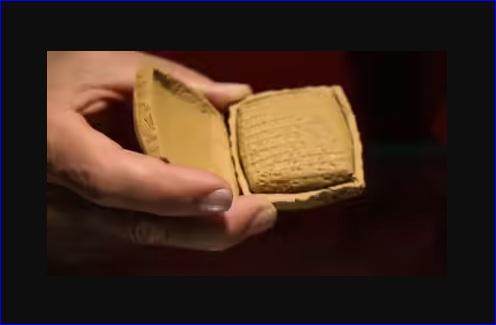
How scientists read the 4,000-year-old sealed Turkish clay tablet without opening it
The tablet was discovered during excavations at Kültepe Kanesh-Karum, an archaeological site near Kayseri that has yielded more than 23,500 cuneiform documents since excavations began in 1948. The research volume titled Current Research at Kültepe-Kanesh: An Interdisciplinary and Integrative Approach to Trade Networks, Internationalism, and Identity was edited by Levent Atici, Fikri Kulakoğlu, Gojko Barjamovic, and Andrew Fairbairn. Published in 2014 by Lockwood Press in Atlanta, Georgia, employed advanced non-invasive imaging technology to examine the artefact while keeping its clay envelope intact.
As noted in a recent research presentation, 'Transition from Early Bronze Age to Middle Bronze Age at Kültepe: Architecture, Figurines and Seals,' by Professor Fikri Kulakoğlu, head of the Kültepe excavations, the scanning process is so precise that it can reveal tiny objects trapped within the clay.
"These scans are so sensitive that, for example, you can even see a barley grain, a leaf, a stone or sometimes a small fly trapped inside the clay or the tablet."
The technology effectively provides archaeologists with a digital view inside sealed artefacts, eliminating the need for destructive examination and allowing researchers to preserve fragile historical objects for future generations.
Ancient Assyrian merchants recorded contracts much like modern businesses
The decoded text documents a trade agreement between two individuals, Sawidasu, son of Sarapunuwa, and Enisar, concerning wheat and barley transactions. While the contract itself may appear simple, it forms part of a much larger archive that illustrates the complexity of ancient commerce in Anatolia.
Kültepe served as the principal trading hub of Assyrian merchants who travelled from the city of Ashur and established commercial networks throughout the region around 4,000 years ago. Business records included debts, payments, contracts, orders and inventories, all carefully documented on clay tablets.
Kulakoğlu drew a striking comparison between ancient and modern administration:
"Today, whatever exists in the accounting office of any company, similar records existed in the merchant archives at Kültepe."
The extensive archive discovered at Kültepe has become so significant that it has been recognised by UNESCO's Memory of the World Programme as the Old Assyrian Merchant Archives of Kültepe.
The centre of this network was the ancient city of Kanesh, from which incoming Assyrian goods were redistributed further into Anatolia. Kültepe-Kanesh is the longest -and the most intensely- excavated site belonging to the period of Assyrian colonies; it remains the principal source on the Assyrian Kingdom at this time.
Why the Kültepe clay tablet is rewriting our understanding of early civilisation
The Kültepe tablets are considered transformative to our understanding of early civilisation because they provide a "unique textual corpus in world history" that allows for the reconstruction of a "dense social and commercial history" comparable to any other known records from the ancient world.
These archives, numbering over 23,000, reveal a "sophisticated market economy" and represent "one of the best documented historical cases of ancient trade in the world," fundamentally shifting the site's status to "the place where Anatolian history began."
The tablet highlights the importance of cuneiform, one of humanity's earliest writing systems. Developed in Mesopotamia and widely adopted across the ancient Near East, cuneiform enabled societies to manage trade, administration and legal agreements on an unprecedented scale. Archaeological evidence shows that clay tablets became one of history's most durable information-storage technologies, surviving thousands of years where papyrus and parchment often perished.
Specifically, the tablets have rewritten historical narratives in the following ways:
- First Recorded Private Partnerships: Recent discoveries include a 4,000-year-old tablet that serves as the "first declaration of the first company in Anatolia," effectively a company deed detailing 12 partners and their financial stake.
- International Trade Networks: The texts reveal how Kültepe-Kanesh functioned as a vibrant hub where "International Trade Networks" originated, involving the exchange of Anatolian copper, silver, and gold for Mesopotamian tin and textiles
- Civil and Social Insight: Beyond commerce, the archives document daily life through records of "marriages, inheritances, and other civil procedures," offering an exceptional window into the culture and social structure of the 19th and 18th centuries BCE
- Archaeological and Textual Integration: The research integrates these texts with physical evidence, such as "metal workshops" and "archaeometallurgical data," to show that ancient Anatolian society possessed a highly specialised and organised craft economy that was more advanced than previously believed
Equally fascinating is the tablet's clay envelope. Ancient scribes often enclosed important contracts within an outer clay casing that carried witness seals and a summary of the contents. The system functioned much like a tamper-proof legal document. If the seal remained unbroken, the agreement had not yet been formally activated. According to researchers, the newly displayed tablet appears to have been prepared and sealed but never opened by its intended recipient.
As archaeological technology continues to advance, countless unopened tablets stored in museums and collections may soon reveal new details about trade, law and daily life in the ancient world without suffering any damage. The Kültepe tablet is therefore more than a museum exhibit; it is a reminder that some of humanity's oldest stories are still waiting to be read.
or register to post a comment.