


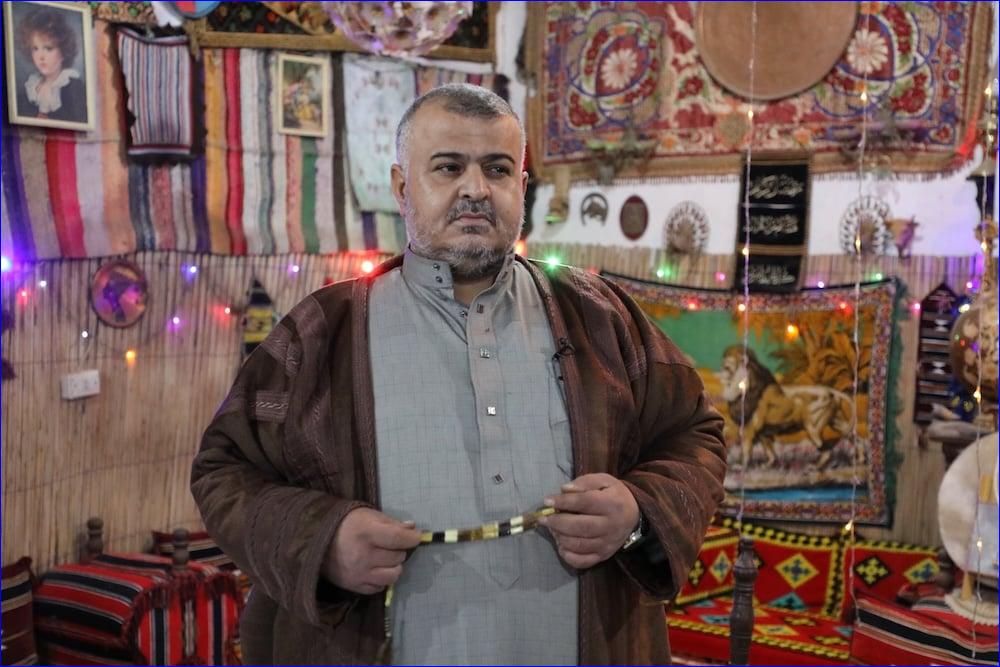
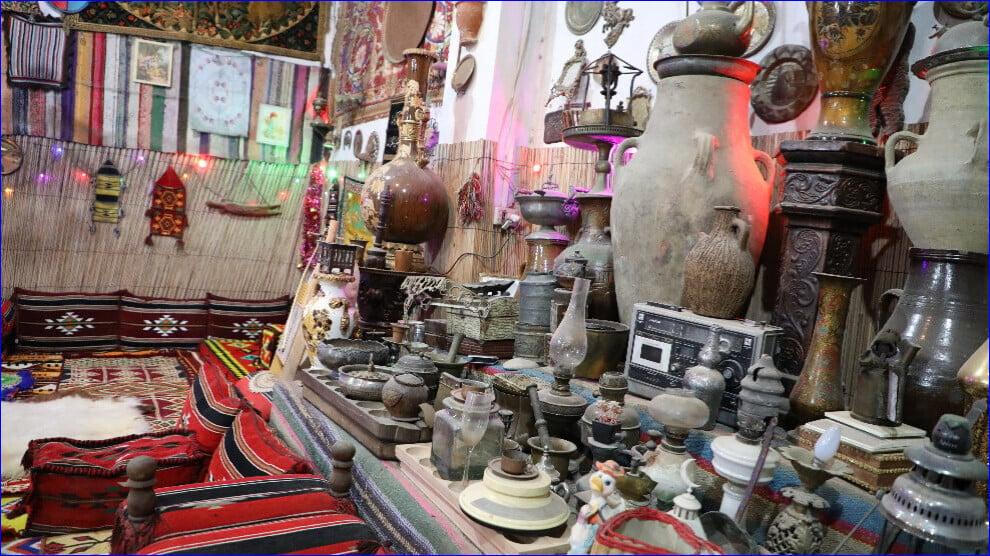
Mihemed Hac Xıdır has transformed a childhood fascination into an extensive collection and, eventually, into a space that now reflects the cultural memory of the region. His shop feels like a living fragment of Syria's multi-layered heritage, surviving in the shadow of war. From the outside it may look like a modest storefront, but crossing the threshold feels like entering a home from a century ago. Clay pitchers, copper ewers, coffee pots, old chests, handwoven kilims, decorative swords, copper plates bearing Nefertiti's image and countless other pieces from the area's rich and diverse past fill the room.
Hac Xıdır stated he has been collecting old items since he was about ten or twelve years old. Hac Xıdır said, "I used to gather small things. One day my friends asked me, 'You have collected so many beautiful pieces, why don't you open a shop?' Their encouragement pushed me to open a small place at first, and later I expanded it into what it is now."
He saw each piece as something entrusted to him
The shop contained items belonging to Assyrian, Armenian, Syriac, Kurdish, Arab, Yazidi and Circassian communities, some dating back fifty, eighty, a hundred or even more than one hundred twenty years. Hac Xıdır had emphasised that he built his collection not around a single group but around the region's shared culture of life. He said, "Every object had a story and a soul. People here once lived together, held weddings together, mourned together. These objects carried that shared spirit. You could not draw lines between them."
Much of the collection had come from villages and rural areas. Some owners had wanted to sell their pieces, while others had entrusted items to him saying they could not bear to throw them away. Hac Xıdır saw himself not as a merchant but as a guardian of cultural heritage. He said, "I did not approach this as a business. This was my passion. I brought pieces from Aleppo, Damascus, Qamishlo, Raqqa and Idlib, and even from Southern Kurdistan (Başur)."
One of the oldest items in the shop was an Assyrian garlic mortar more than a century old. Hac Xıdır recalled, "An Assyrian man who was preparing to travel wanted to sell it. He did not know its value. I bought it so it would not disappear. Many people have tried to buy it from me, but I could not sell it."
His greatest dream had been to open a museum
Hac Xıdır had said that a shop like this could never have been opened during the Baath regime and that he was able to realise his dream thanks to the relative stability established in North and East Syria. When speaking about the future, he expressed his determination clearly: "If the war ends, I will open a larger place. My greatest dream is to establish a museum and pass this heritage on to the children of our children."
or register to post a comment.