


 (AINA) -- In recent meetings held in Washington, Mr. Hassan Abdel Rahman of the Palestinian National Authority attempted to reassure Mr. Barham Salih of the Patriotic Union of Kurdistan (PUK) and its Sorani leadership that the Palestinian Authority has no intention of supporting the settlement of 500,000 Palestinian refugees in Karkuk, northern Iraq. Having been locked in an often savage battle with the central government over the oil rich region of historic Assyria in northern Iraq, the Soranis and Behdananis are now terrified that such an influx of Arabic-speaking Palestinians will further threaten their claim to the area while, tragically, the refugee Palestinian population remains a pawn in a wider regional conflict. All the while, Assyrians remain irritated and perplexed that Mr. Rahman feels the need to assuage those very political parties that have themselves continued a policy of ethnic cleansing of Assyrians from historically Assyrian cities and villages. Mr.Abdel Rahman apparently has declared that the Palestinians do not in turn plan to displace these same illegal Sorani and Behdanani settlers.
As for Mr. Barham Salih, this spokesman for the PUK had earlier gained notoriety in the Assyrian Diaspora community in the aftermath of the May 12, 1996 murder of two Assyrian members of the Assyrian Democratic Movement (ADM) by Sorani PUK militants in Ankawa. Mr. Samir Moshe Murad and Mr. Peris Mirza Salyu were murdered by PUK militants as the unarmed Assyrians attempted to intervene and negotiate an end to the culmination of a series of attacks by PUK supporters against Assyrian college students peacefully protesting the Kurdification of their college curriculum in 1996. Sensing a worldwide Assyrian outcry and increasing anger, Mr. Salih attempted to dampen Assyrian furor over the murders by conducting a "town hall" meeting in Chicago following the murders. Designed to improve Assyrian-PUK relations, this meeting, however, backfired when Mr. Salih feigned ignorance about the Assyrian Holocaust perpetrated by the Turks and Kurdish tribes in 1915-1918 - a fact central to any understanding of today's Assyrian-Kurdish relations.
The initially hospitable audience became increasingly exasperated and irritated with Mr. Salih. One participant, Ms. Pauline Jasim, then secretary of the Assyrian American National Federation (AANF), explained to Mr. Salih that his constant reference to the heartland of Assyria in northern Iraq as Kurdistan was perceived by Assyrians as a blatant insult. Another participant, Mr. Pierre Chamoun, a member of the Assyrian Universal Alliance (AUA), mockingly asked for geographical clarification asking "You speak of Assyrian areas as being Kurdistan; tell me then where is Ashuristan (Assyria)?" The meeting ended shortly thereafter with Mr. Salih being unable to appease the mostly Assyrian audience and they in turn walking away without a sense of satisfaction or the feeling that justice will finally prevail in northern Iraq.
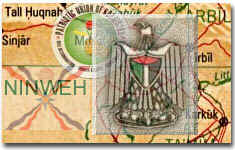
While continuing to feign ignorance over repeated attacks against Assyrians, the Sorani and Behdanani leadership of northern Iraq continue to confiscate Assyrian lands and expel Assyrians from historic Assyria. Moreover, having succeeded in ethnically cleansing some areas of Assyrians, the Soranis and Behdananis now refer to these areas as Kurdistan because, as they say, their tribes live there. Ironically, having established the precedent of ethnically cleansing the indigenous population of the land, these same Sorani and Behdanani Kurds are now ostensibly alarmed that they may in turn face the same fate in Karkuk. Assyrians continue to shudder at the thought of Assyrian cities and lands being referred to as Kurdistan all the while rhetorically asking if Karkuk is Kurdistan, then where is Assyria? If Arbil too is Kurdistan, then where is Assyria? If even Nineveh is Kurdistan, then where is Assyria? The Sorani and Behdanani leadership must clarify if Kurdistan is where the Kurds live today, then ten years hence will Karkuk be known as Palestine? For Assyrians the answer is clear- whether illegally occupied by Soranis, Behdananis, or Palestinians, their homeland will forever remain Assyria in their collective hearts and minds.
While the brutal ethnic cleansing campaigns of the Iraqi central government are well reported by the media, the Sorani and Behdanani Kurds have been portrayed, in the media, only as victims of the government. Also, while the media reports every single incident involving the Palestinians and Israelis, the proposed settlement of 500,000 Palestinians in Karkuk by the Iraqi central government has gone largely unnoticed by them. Having already been branded as victims of the Iraqi central government by world media, the Kurds have calculated that their own role in the ethnic cleansing of the indigenous Assyrians of northern Iraq will be overlooked by the media. So far, the Kurds have calculated correctly. The media turns a blind-eye to the atrocities committed by Kurds against the indigenous Assyrians of northern Iraq apparently because, in the surrealistic world of the media, the Kurds cannot be portrayed as both victims and aggressors, even if that is what they truly are.
or register to post a comment.