


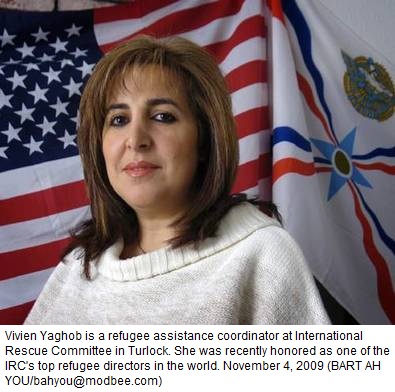
 Vivien Yaghobsalmasi saw the makings for a surge of Middle Eastern refugees moving to Stanislaus County well before the flood hit.
It was just a matter of waiting until two trends converged to quintuple the number of refugees coming to the county over just three years.
One was a rising number of Assyrian families in Turlock and Modesto with Iranian roots filing papers to help their relatives move to California through refugee resettlement programs.
The second was the war in Iraq, which was bound to draw Assyrian refugees from that country.
They came in dozens in 2004, and then in the hundreds by 2006. Last year, 505 refugees settled in Stanislaus County, nearly all of them from Iran or Iraq.
They came just like Yaghobsalmasi, who arrived in San Jose as a refugee from Tehran in 1990: Few possessions, few friends and facing difficult job prospects in a weak economy.
This time, Yaghobsalmasi, 42, was ready to help the new refugees as the director of the International Rescue Committee's Turlock office, which increased its staff two years ago with a grant that would wait until government funding could catch up to the surge of Assyrian refugees moving to Stanislaus County.
This week, the Stanislaus County Board of Supervisors steered $662,500 in federal funds to two refugee assistance programs, including Yaghobsalmasi's.
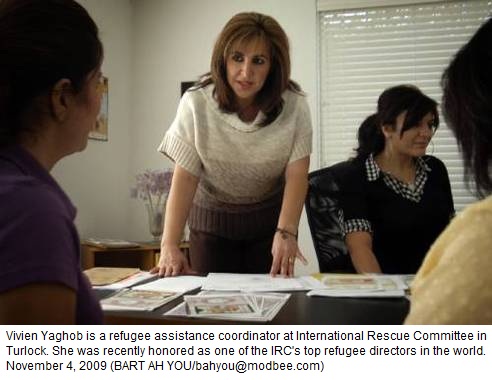 The money reflects Stanislaus County's draw for Assyrian Christian refugees fleeing persecution in Iran or violence in Iraq, because of that community's nearly 100-year-old ties to Turlock.
"Imagine that you are in a war and you lost your family, your mother, your sister, your son, and you don't have anyone to depend on," Yaghobsalmasi said. "How are you going to survive? We have to help people who are really in need. We have to take them from harm to home."
One of top 5 aid workers
Yaghobsalmasi recently was singled out as one of five top aid workers from around the world at the International Rescue Committee's annual humanitarian awards dinner in San Francisco.
IRC President George Rupp said she has "propelled the IRC's reputation for excellence by forging relationships with public and private agencies to help refugees both build new lives and revitalize their communities."
Yaghobsalmasi didn't even know she was nominated. She called it an honor to be recognized by the very group that helped her settle here 19 years ago.
She spoke with The Bee about the trying journeys refugees face on their routes to California, and what residents can do to help some of the world's most vulnerable people.
Q: You're generally helping Iranians and Iraqis. Do refugees from those countries have different needs?
A: Iraqis are more in need, especially because they were out of their country for many years fleeing the war. (Iraqis tend to apply for asylum in the United States through Jordan, Syria or Turkey.) Their children were not in school. They're coming here and the emotional toll is hard on them.
Q: What do you tell refugees who come here and find that things aren't as easy as they might have hoped?
A: I had a family where it was hard on them. They ran away to get to freedom, but then it was really hard on them because the money they're getting is not enough. We try to get them to work and encourage them to try to survive for a while.
(The economy is) not going to stay the same way it is right now. I've been in this kind of situation before. ... When you live in those countries, you think America is a big country, and you think everything is going to be easy. But it's not. It's not going to be like picking apples off a tree.
Q: What kind of help do you offer refugees?
A: We help them resettle. We inform them about the U.S. culture, the process they need to take to get benefits. We take them to health care. We also have some coordination with apartment complexes. We have a fund available to the refugees, like a grant for them to get occupational licenses.
Q: What should people know about the conditions Assyrians are trying to escape in Iraq and Iran?
A: They are basically discriminated against all the time. You're not free. Assyrians are one of the oldest nations. They're not recognized for that. I just want people to know that there are Assyrians out there. They die, their churches are bombed, and there is no mention of them.
Q: You must hear heart- wrenching stories every day. What is it that makes your job worthwhile?
A: When you see that you can help people. I'm Assyrian myself, and I like to help my community and my nation. When I started here it was good for me, because I knew that I could help people because I could speak their language. I'm still close with friends I was helping nine years ago. Basically, we are a 4-1-1 for refugees.
By Adam Ashton
www.modbee.com
or register to post a comment.