THE BLIGHT OF ASIA
An Account of the Systematic Extermination of Christian
Populations by Mohammedans
and of the Culpability of Certain Great Powers; with the True Story of
the Burning of Smyrna
By
GEORGE HORTON
For Thirty Years Consul and Consul-General of the United States in the
Near East
With a Foreword by
JAMES W. GERARD
Former Ambassador to Germany
PUBLISHERS THE BOBBS-MERRILL COMPANY, INDIANAPOLIS
COPYRIGRT 1926
BY THE BOBBS-MERRILL COMPANY
Printed In the United States of America
PRINTED AND BOUNDBY BRAUNWORTH & CO. INC. BROOKLYN N.Y.
Assyrian International News Agency
Books Online
www.aina.org
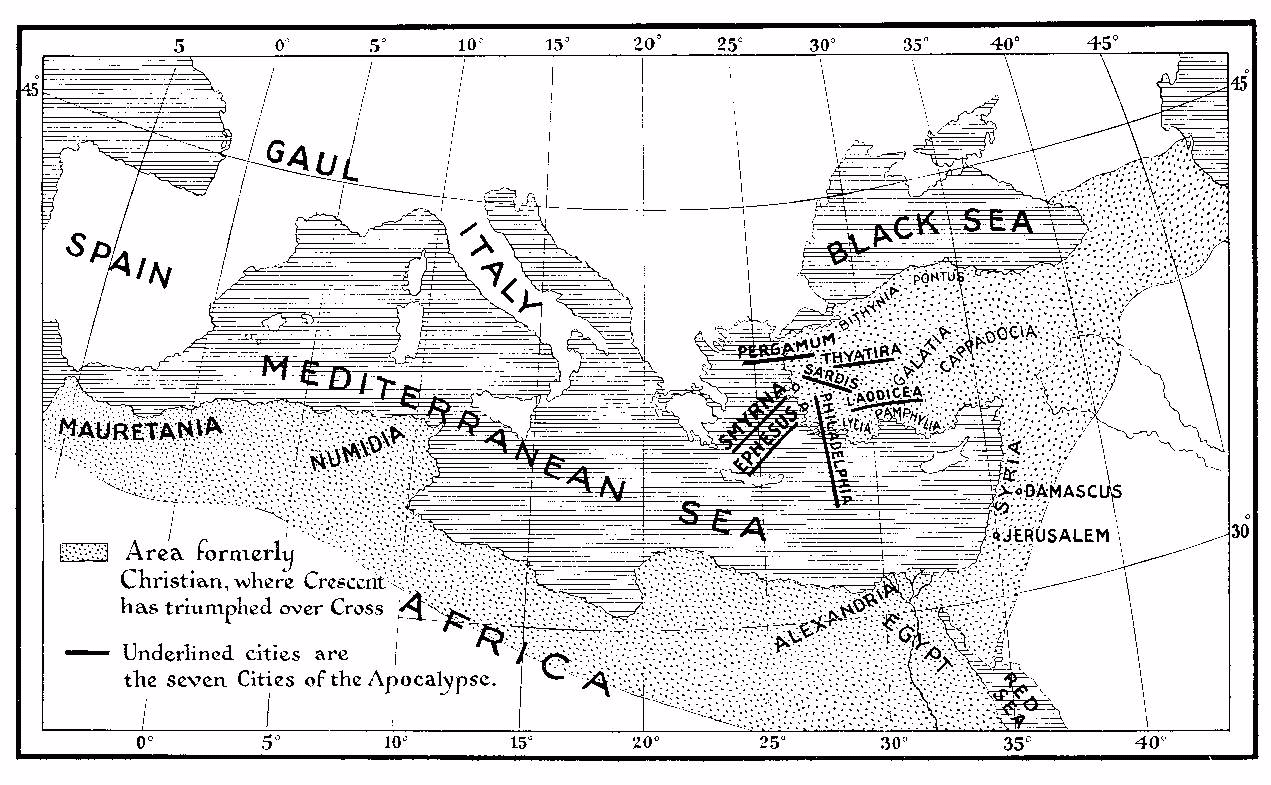
“What thou seest, write in a book, and send it unto churches which are
in Asia; unto Ephesus, and unto Smyrna, and unto Pergamos, and unto
Thyatira, and unto Sardis, and unto Philadelphia, and unto Laodicea.”
-- REVELATIONS, I:11
THE MARTYRED CITY
Glory and Queen of Island Sea
Was Smyrna, the beautiful city,
And fairest pearl of the Orient she—
O Smyrna the beautiful city!
Heiress of countless storied ages,
Mother of poets, saints and sages,
Was Smyrna, the beautiful city!
One of the ancient, glorious Seven
Was Smyrna, the sacred city,
Whose candles all were alight in Heaven—
O Smyrna the sacred city!
One of the Seven hopes and desires,
One of the seven Holy Fires
Was Smyrna, the Sacred City.
And six fared out in the long ago-
O Smyrna, the Christian city!
But hers shone on with a constant glow—
O Smyrna, the Christian city!
The others died down and passed away,
But hers gleamed on until yesterday—
O Smyrna, the Christian city!
Silent and dead are churchbell ringers
Of Smyrna, the Christian city,
The music silent and dead the singers
Of Smyrna, the happy city;
And her maidens, pearls of the Island seas
Are gone from the marble palaces
Of Smyrna, enchanting city!
She is dead and rots by the Orient’s gate,
Does Smyrna, the murdered city,
Her artisans gone, her streets desolate—
O Smyrna, the murdered city!
Her children made orphans, widows her wives
While under her stones the foul rat thrives—
O Smyrna, the murdered city!
They crowned with a halo her bishop there,
In Smyrna, the martyred city,
Though dabbled with blood was his long white hair—
O Smyrna, the martyred city!
So she kept the faith in Christendom
From Polycarp to St. Chrysostom,*
Did Smyrna, the glorified city!
*Martyred at Smyrna, September 1922.
FOREWORD
HERE at last is the truth about the destruction of Smyrna and the
massacre of a large part of its Inhabitants by one who was present.
The writer of the following pages is a man, happily, who is not
restrained from telling what he knows by political reasons or by any
consideration of fear or self-interest. He gives the whole story of the
savage extermination of Christian civilization throughout the length
and breadth of the old Byzantine Empire in a clear and convincing manner
That it should have been possible twenty centuries after the birth of
Christ for a small and backward nation, like the Turks, to have
committed such crimes against civilization and the progress of the
world, is a matter which should cause all conscientious people to pause
and think; yet the writer shows conclusively that these crimes have
been committed without opposition on the part of any Christian nation
and that the last frightful scene at Smyrna was enacted within a few
yards of powerful Allied and American battle fleet.
We turned a deaf ear to the dying Christians, when they called to us
for aid, fully aware that America was their only hope, and now it would
appear that there is a growing tendency in this country to
whitewash the Turks and condone their crimes in order to obtain
material advantages from them.
The author takes the position that this can not be done, as the Turks
have put so great an affront upon humanity that it can not easily be
overlooked, and the truth is sure to come out. He claims that high
ideals are more than oil or railroads, and that the Turks should not be
accepted into the society of decent nations until they show sincere
repentance for their crimes.
Fraternizing with them on any other terms creates a suspicion of
sordidness or even complicity. From the outspoken nature of this book
it will be evident to the reader that the writing of it has
required considerable courage and that it has been inspired
by no other possible motive than a desire to make the truth known about
matters which it is important for the world to know.
(Signed) JAMES W. GERARD
INTRODUCTION
THE editor of a great Paris journal once remarked that he
attributed the extraordinary success of his publication to the fact
that he had discovered that each man had at least one story to tell.
I have been for many years in the Near East—about thirty in all—and
have watched the gradual and systematic extermination of Christians and
Christianity in that region, and I believe it my duty to tell that grim
tale, and to turn the light upon the political rivalries of the Western
World, that have made such a fearful tragedy possible.
Though I have served for the major part of time as an American consular
officer, I am no longer acting in that capacity, and have no
further connection with the United States Government. None of the
statements, which I make, therefore, has any official weight, nor have
I in any way drawn upon State Department records or sources of
information. I write strictly in my capacity as a private citizen,
drawing my facts from my own observations, and from the testimony of
others whom I quote.
I was in Athens in July, 1908, when, at the instigation of the Young
Turks’ “Committee of Union and Progress” the Saloniki army revolted and
demanded the immediate putting into effect of the Constitution of 1876,
which had become a dead letter, and I noted the reaction produced
upon Greece by that apparently progressive move.
I was in Saloniki shortly after and witnessed the sad awakening of the
non-Mussulman elements of that part of the Balkans to the fact that the
much vaunted “Constitution” meant no liberty for them, but rather
suppression, suffering and ultimate extinction.
I was in Smyrna in May of 1917, when Turkey severed relations with the
United States, and I received the oral and written statements of
native-born American eye-witnesses of the vast and incredibly horrible
Armenian massacres of 1915-16— some of which will be here given for the
first time; I personally observed and otherwise confirmed the
outrageous treatment of the Christian population of the Smyrna vilayet,
both during the Great War, and before its outbreak. I returned to
Smyrna later and was there up until the evening of September 11, 1922,
on which date the city was set on fire by the army of Mustapha Khemal,
and a large part of its population done to death, and I witnessed the
development of that Dantesque tragedy, which possesses few, if any
parallels in the history of the world.
One object of writing this book is to make the truth known concerning
the very significant events and to throw the light on an important
period during which colossal crimes have been committed against the
human race, with Christianity losing ground in Europe and America as
well as in Africa and the Near East.
Another object is to give the church people of the United States the
opportunity of deciding whether they wish to continue pouring millions
of dollars, collected by contributions small and great, into Turkey for
the purpose of supporting schools, which no longer permit the Bible to
be read or Christ to be taught; whether, in fact, they are not doing
more harm than good to the Christian cause and name, by sustaining
institutions which have accepted such a compromise!
Another object is to show that the destruction of Smyrna was but the
closing act in a consistent program of exterminating Christianity
throughout the length and breadth of the old Byzantine Empire; the
expatriation of an ancient Christian civilization, which in recent
years had begun to take on growth and rejuvenation spiritually, largely
as a result of the labors of American missionary teachers. Their
admirable institutions, scattered all ever Turkey, which have cost the
people of the united States between fifty million and eighty million
dollars, have been, with some exceptions closed, or irreparably
damaged, and their thousands of Christian teachers and pupils butchered
or dispersed. This process of extermination was carried on over a
considerable period of time, with fixed purpose, with system, and with
painstaking minute details; and it was accomplished with unspeakable
cruelties, causing the destruction of a greater number of human
beings than have suffered in any similar persecution since the
coming of Christ.
I have been cognizant of what was going on for a number of years and
when I came back to America after the Smyrna tragedy and saw the
prosperous people crowded in their snug warm churches, I could hardly
restrain myself from rising to my feet and shouting: “For every convert
that you make here, a Christian throat is being cut over there; while
your creed is losing ground in Europe and America, Mohammed is forging
ahead in Africa and the Near East with torch and scimitar.”
Another reason is to call attention to the general hardening of
human hearts that seems to have developed since the days of Gladstone—a
less exalted and more shifty attitude of mind. This is partly due to
the fact that men’s sensibilities have been blunted by the Great War,
and is also in large measure a result of that materialism which is
engulfing our entire civilization.
GEORGE HORTON
CONTENTS
I TURKISH
MASSACRES
II GLADSTONE AND
THE BULGARIAN ATROCITIES
III FIRST STEPS IN
YOUNG TURKS’ PROGRAM
IV THE LAST GREAT
SELAMLIK
V PERSECUTION OF
CHRISTIANS IN SMYRNA DISTRICT
V I THE MASSACRE OF
PHOCEA
VII NEW LIGHT ON THE ARMENIAN
MASSACRE
VIII STORY OF WALTER M. GEDDES
IX INFORMATION FROM
OTHER
SOURCES
X THE GREEK
LANDING AT SMYRNA
XI THE HELLENIC
ADMINISTRATION IN SMYRNA
XII THE GREEK RETREAT
XIII SMYRNA AS IT WAS
XIV THE DESTRUCTION OF SMYRNA
XV FIRST DISQUIETING RUMORS
XVI THE TURKS ARRIVE
XVII WHERE AND WHEN THE FIRES WERE LIGHTED
XVIII THE ARRIVAL AT ATHENS
XIX ADDED DETAILS LEARNED AFTER THE
TRAGEDY
XX HISTORIC IMPORTANCE OF THE
DESTRUCTION OF SMYRNA
XXI NUMBER DONE TO DEATH
XXII EFFICIENCY OF OUR NAVY IN SAVING
LIVES
XXIII RESPONSIBILITY OF THE WESTERN WORLD
XXIV ITALY’S DESIGNS ON SMYRNA
XXV FRANCE AND THE KHEMALISTS
XXVI MASSACRE OF THE FRENCH GARRISON AT UFRA
XXVII THE BRITISH CONTRIBUTION
XXVIII TURKISH INTERPRETATION OF AMERICA’S ATTITUDE
XXIX THE MAKING OF MUSTAPHA KHEMAL
XXX OUR MISSIONARY INSTITUTIONS IN TURKEY
XXXI AMERICAN INSTITUTIONS UNDER TURKISH RULE
XXXII THE REVEREND RALPH HARLOW ON THE LAUSANNE
TREATY
XXXIII MOHAMMEDANISM AND CHRISTIANITY
XXXIV THE KORAN AND THE BIBLE
XXXV THE EXAMPLE OF MOHAMMED
XXXVI THE 50-50 THEORY
XXXVII ASIA MINOR, THE GRAVEYARD OF GREEK CITIES
XXVIII ECHOES FROM SMYRNA
XXXIX CONCLUSION
APPENDIX
THE BLIGHT OF ASIA
CHAPTER I
TURKISH MASSACRES, 1822-1909
MOHAMMEDANISM has been propagated by the sword and by
violence ever since it first appeared as the great enemy of
Christianity, as I shall show in a later chapter of this book.
It has been left to the Turk, however, in more recent
years, to carry on the ferocious traditions of his creed, and to
distinguish himself by excesses which have never been equaled by any of
the tribes enrolled under the banner of the Prophet, either in ancient
or in modern times.
The following is a partial list of Turkish massacres from
1822 up till 1904:
1822 Chios,
Greeks
50,000
1823 Missolongi,
Greeks
8,750
1826 Constantinople, Jannisaries 25,000
1850 Mosul,
Assyrians
10,000
1860 Lebanon,
Maronites
12,000
1876 Bulgaria,
Bulgarians
14,700
1877 Bayazid,
Armenians
1,400
1879 Alashguerd,
Armenians
1,250
1881 Alexandria,
Christians
2,000
1892 Mosul,
Yezidies
3,500
1894 Sassun,
Armenians
12,000
1895-96 Armenia, Armenians 150,000
1896 Constantinople, Armenians 9,570
1896 Van,
Armenians
8,000
1903-04 Macedonia, Macedonians 14,667
1904 Sassun,
Armenians
5,640
_______
Total
328,477
To this must be added the massacre in the province of Adana in 1909, of
thirty thousand Armenians
So imminent and ever-present was the peril, and so fresh the memory of
these dire events in the minds of the non-Mussulman subjects of the
sultan, that illiterate Christian mothers had fallen into the habit of
dating events as so many years before or after “such and such a
massacre.”
CHAPTER II
GLADSTONE AND THE BULGARIAN ATROCITIES
IN THE list of massacres antedating the colossal crimes which have come
under my own personal observation, is cited the killing of 14,700
Bulgarians in 1876. This butchery of a comparatively few—from a Turkish
view-point—Bulgarians, some fifty years ago, provoked a splendid cry of
indignation from Gladstone. As this narrative develops and reaches the
dark days of 1915 to 1922, during which period whole nations were wiped
out by the ax, the club and the knife, and the Turk at last found the
opportunity to give full vent to his evil passions, it will appear that
no similarly effective protest has issued from the lips of any European
or American statesman.
The curious feature is that, owing to the propaganda carried on by
the hunters of certain concessions, an anti-Christian and pro-Turk
school has sprung up in the United States.
In “A Short History of the Near East”, Professor William Stearns Davis,
of the University of Minnesota, referring to the Bulgarian atrocities
1876, says:
“What followed seems a massacre on a small scale compared with the
slaughter of Armenians in 1915-16, but it was enough to paralyze the
power of Disraeli to protect the Turks. In all, about twelve thousand
Christians seem to have been massacred. At the thriving town of Batal
five thousand out of seven thousand inhabitants seem to have perished.
Of course neither age or sex was spared and lust and perfidy were added
to other acts of devilishness. It is a pitiful commentary on a
phase of British politics that Disraeli and his fellow Tories
tried their best to minimize the reports of these atrocities. They
were not given to the world by official consular reports, but by
private English journalists.”
The above is interesting, as it illustrates a quite common method of
government procedure in such cases. The Tory does not seem to be a
unique product of British politics.
While I was in Europe recently, I talked with a gentleman who was in
the diplomatic service of one of the Great Powers and was with me in
Smyrna at the time that city was burned by the Turkish army. This
gentleman was in complete accord with me in all details as to that
affair, and asserted that his Foreign Office had warned him to keep
silent as to the real facts at Smyrna, but that he had written a full
memorandum on the subject, which be hopes to publish.
It is significant that the Turks in 1876 were championed by Jews, while
to-day such Jews as Henry Morgenthau, Max Nordau and Rabbi Wise are
prominent among that group of men who are raising their voices in
behalf of oppressed Christians. It is due to their influence, and to
the voices of such senators as King of Utah and Swanson of
Virginia, that confirmation of the Lausanne Treaty has been
deferred until the blood on the bayonets and axes of the Turks
should get a little drier.
Speaking of Disraeli, Gladstone wrote to the Duke of Argyle: “He is not
such a Turk as I thought. What he hates is Christian liberty and
reconstruction.”
The Bulgarian massacres were made known by an American consular
official, and denounced by Gladstone in a famous pamphlet. They led to
the declaration of war by Russia, the treaty of San Stefano and the
beginning of the freedom of Bulgaria.
In a speech at Blackheath in 1876, Gladstone said:
“You shall retain your titular sovereignty, your empire shall not be
invaded, but never again, as the years roll in their course, so far as
it is in our power to determine, never again shall the hand of violence
be raised by you, never again shall the flood gates of lust be opened
to you.”
In his famous pamphlet, Bulgarian Horrors and the Question of the East,
we have the following, a thousand times truer to-day than when it was
written:
“Let the Turks now carry away their abuses, in the only possible
manner, namely, by carrying off themselves. Their Zaptiehs and their
Mudirs, their Blmhashis and Yuzbashis, their Kaimakams and their
Pashas, one and all, bag and baggage, shall, I hope, clear out from the
province that they have desolated and profaned. This thorough riddance,
this most blessed deliverance, is the only reparation we can make to
those heaps and heaps of dead, the violated purity alike of matron and
of maiden and of child; to the civilization which has been affronted
and shamed; to the laws of God, or, if you like, of Allah; to the moral
sense of mankind at large. There is not a criminal in an European jail,
there is not a criminal in the South Sea Islands, whose
indignation would not rise and over-boil at the recital of that
which has been done, which has too late been examined, but which
remains unavenged, which has left behind all the foul and all the
fierce passions which produced it and which may again spring up in
another murderous harvest from the soil soaked and reeking with blood
and in the air tainted with every imaginable deed of crime and shame.
That such things should be done once is a damning disgrace to the
portion of our race which did them; that the door should be left open
to the ever so barely possible repetition would spread that shame over
the world.”
“We may ransack the annals of the world, but I know not what research
can furnish us with so portentous an example of the fiendish misuse of
the powers established by God for the punishment of evil doers and the
encouragement of them that do well. No government ever has so sinned,
none has proved itself so incorrigible in sin, or which is the same, so
impotent in reformation”
The time will never come when the words of Gladstone, one of the
wisest of English statesmen, will be considered unworthy of serious
attention. The following characterization of the Turk by him has
been more aptly verified by the events that have happened since
his death than by those that occurred before:
“Let me endeavor, very briefly to sketch, in the rudest outline what
the Turkish race was and what it is. It is not a question of
Mohammedanism simply, but of Mohammedanism compounded with the
peculiar character of a race. They are not the mild Mohammedans of
India, nor the chivalrous Saladins of Syria, nor the cultured Moors of
Spain. They were, upon the whole, from the black day when they first
entered Europe, the one great anti-human specimen of humanity. Wherever
they went a broad line of blood marked the track behind them, and, as
far as their dominion reached, civilization disappeared from view.
They represented everywhere government by force as opposed to
government by law.—Yet a government by force can not be maintained
without the aid of an intellectual element.— Hence there grew up, what
has been rare in the history of the world, a kind of tolerance in
the midst of cruelty, tyranny and rapine. Much of Christian life was
contemptuously left alone and a race of Greeks was attracted to
Constantinople which has all along made up, in some degree, the
deficiencies of Turkish Islam in the element of mind!”
To these words of Gladstone may appropriately be added the
characterization of the Turk by the famous Cardinal Newman:
“The barbarian power, which has been for centuries seated in the very
heart of the Old World, which has in its brute clutch the most famous
countries of classical and religious antiquity and many of the
most fruitful and beautiful regions of the earth; and, which, having no
history itself, is heir to the historical names of Constantinople and
Nicaea, Nicomedia and Caesarea, Jerusalem and Damascus, Nineva and
Babylon, Mecca and Bagdad, Antioch and Alexandria, ignorantly holding
in its possession one half of the history of the whole world.”
In another passage Newman describes the Turk as the “great anti-Christ
among the races of men.”
CHAPTER III
FIRST STEP IN YOUNG TURKS’ PROGRAM (1908-1911)
TO COMPREHEND this narrative thoroughly, one must remember that the
East is unchangeable. The Turks of to-day are precisely the same as
those who followed Mohammed the Conqueror through the gates of
Constantinople on May 29, 1453, and they have amply demonstrated that
they do not differ from those whom Gladstone denounced for the
Bulgarian atrocities of 1876. Those who are building hopes on any
other conception will be deceived; they will be painfully deceived if
they make treaties or invest large sums of money on Western ideas
of the Oriental character.
I am neither “pro-Greek,” “pro-Turk,” nor anything except
pro-American and pro-Christ. Having passed the most of my life in
regions where race feeling runs high, it has been my one aim to help
the oppressed, irrespective of race, as will be shown by documents
submitted later, and I have won the expressed gratitude of numerous
Turks for the aid and relief I have afforded them on various occasions.
I am aware of the many noble qualities of the Turkish peasant, but I do
not agree with many precepts of his religion, and I do not admire
him when he is cutting throats or violating Christian women. The
massacres already enumerated are a sufficient blot upon the Turkish
name. They were made possible by the teachings of the Koran, the
example of Mohammed, lust and the desire for plunder. They sink into
insignificance when compared with the vast slaughter of more recent
years, conducted under the auspices of Abdul Hamid, Talaat and Company,
and Mustapha Khemal.
It should be borne in mind, however, that it was not until after the
declaration of the constitution that the idea “Turkey for the Turks”
took definite shape and developed into the scheme of accomplishing
its purpose by the final extinction of all the Christian populations of
that blood-soaked land—a plan consistent with, and a continuation of,
the general history of Mohammedan expansion in the ancient
home lands of Christianity.
At the time of the declaration of the constitution in 1908, I was in
Athens. My first intimation of the event was a procession of Greeks
carrying Hellenic and Ottoman flags, marching through the streets on
their way to the Turkish legation, where they made a friendly and
enthusiastic demonstration.
The idea in Greece and the Balkans generally was that the constitution
meant equal rights for all in Turkey, irrespective of religion—the dawn
of a new era. Had this conception proved true, Turkey would to-day be
one of the great, progressive, prosperous countries of the world.
The weakness of the conception was that in an equal and friendly
rivalry, the Christians would speedily have outstripped the Ottomans,
who would soon have found themselves in a subordinate position
commercially, industrially and economically. It was this knowledge
which caused the Turks to resolve upon the extermination of the
Christians. It was a reversal of the process of nature; the drones were
about to kill off the working bees.
During these days a member of the Turkish Cabinet made a speech at
Saloniki, advocating the closing of all the foreign missionary schools,
as well as native Christian, arguing: “If we close the Christian
institutions, Turkish institutions will of necessarily spring up to
take their place. A country must have schools.”
Immediately after the fall of Abdul Hamid, I was transferred to
Saloniki. There was great rejoicing over the fall of the “Bloody
Tyrant,” and the certainty prevailed that the subjects of Turkey
had at last united to form a kingdom where all should have full liberty
to worship God and pursue their peaceful occupations in security.
The fall of Abdul Hamid had been made possible by the cooperation and
aid of the Christians.
But the latter — Greeks, Bulgars, Serbs — were soon cruelly
disillusioned. A general persecution was started, the details of which
were reported to their various governments by all the consuls of the
city. This persecution first displayed itself in the form of sporadic
murders of alarming frequency all over Macedonia, the victims being, in
the beginning, notables of the various Christian communities. A
favorite place for shooting these people was at their doorsteps at the
moment of their return home. It became evident that the Turkish
Government, in order to gain control of the territory, was bent upon
the extermination of the non-Mussulman leaders. Many of those murdered
had been prominent in the anti-Abdul movement.
From the extermination of notables, the program extended to people of
less importance, who began to disappear. Bevies of despairing peasant
women who bad come to visit the vali (Turkish governor) and demand news
of their husbands, sons or brothers, appeared on the streets of
Saloniki. The answers were usually sardonic; “He has probably run away
and left you,” or “He has probably gone to America,” were favorite
replies. The truth, however, could not long be hidden, as shepherds and
others were soon reporting corpses found in ravines and gullies in the
mountains and woods. The reign of terror, the Turks’ immemorial method
of rule, was on in earnest, and the next step taken to generalize it
was the so-called “disarming”. This meant, as always, the
disarming of the Christian element, and the furnishing of weapons to
the Turks.
An order was issued that all persons must give up their guns and other
weapons, and squads of soldiers were sent out through villages to put
this edict into effect. That the object was not so much to collect
hidden arms as to terrorize the inhabitants was soon made evident from
the tortures inflicted during the search. Bastinadoing was a favorite
measure. The feet of the peasants, accustomed to going barefoot,
were very tough; they were therefore tied down and their toes beaten to
a pulp with clubs.
Another form of torment frequently resorted to by the “Government of
Union and Progress,” was tying a rope around the victim’s waist and
slipping a musket between the body and the cord and twisting until
internal injury resulted. Priests were frequent victims of this
campaign of terror and hate, the idea being to render them ridiculous
as well as to inflict hideous suffering. The poor creatures were made
to stand upon one foot while a soldier menaced them with a bayonet. If
the priest, finally exhausted, dropped the upraised foot to the
ground, he was stabbed with the bayonet.
The prisons were bursting with unfortunate people existing in
starvation and filth. An American tobacco merchant related to me that a
prominent Greek merchant disappeared from the streets and for several
days screams were heard issuing from the second story of a certain
building. This Greek was not killed, but was finally released. He
showed the American round pits all over his body. He had been tied
naked to a table and hot oil dropped on him. When he had asked, in his
agony, “What have I done!” his persecutors replied, “We are doing
this to show you that Turkey has been freed for the Turks.” He was
doubtless let go to spread the glad news.
A well-known British correspondent, a pro-Bulgar, stated that he had
sent reports of these persecutions to the British press, but could not
get them published. He had the obsession that the reason was because
the whole British press was owned by Jews, but it is not easy to follow
him in this deduction. The true reason is to be found in some
government policy of the moment.
It was this indiscriminate persecution of Greeks, Bulgars and Serbs
which drove them into the same camp and enabled them to chase the Turk
out of Macedonia, even though they did fall at one another’s throats as
noon am they got rid of the common enemy. Any one inclined to doubt the
veracity of the above description must understand, if he knows anything
of Balkan matters, that it needed a pretty serious state of affairs to
cause Greek and Bulgar to fight on the same side.
The persecution to which all the races in the Empire were
subjected, with the exception of the Turks, is well-depicted in the
following article in the “Nea Alethia”, a conservative journal
published in the Greek language, in Saloniki, which used all its
influence in favor of harmony and moderation. The following is
from the issue of July 10, 1910, or about two years after the
declaration of the famous “Constitution”:
“Before two years are finished a secret committee is unearthed in
Constantinople, with branches all over in important commercial towns,
whose intentions are declared to be subversive of the present
state of affairs. In this committee are found many prominent men and
members of Congress. All discontent seen in the kingdom has its
beginning in this perverted policy. Our rulers, according to their
newly adopted system of centralization upon the basis of the
domination of the ruling race have given gall and wormwood to all the
other races. They have displeased the Arabs by wishing them to abandon
their language. They have alienated the Albanians by attempting to
apply force, though conciliatory measures would have been better. They
have dissatisfied the Armenians by neglecting their lawful
petitions. They have offended the Bulgarians by forcing them to live
with foreigners brought purposely from other places. They have
dissatisfied the Serbians by using against them measures the harshness
of which is contrary to human laws.”
“But for us Greeks words are useless. We have every day before us such
a vivid picture of persecution and extermination that however much we
might say, would not be sufficient to express the magnitude of the
misfortunes, which since two years have come upon our heads. It is
acknowledged that the Greek race ranks second as a pillar of the
Constitution and that it is the most valuable of those contributing to
the prosperity of the Ottoman fatherland.”
“We have the right to ask, what have we, Ottoman Greeks, done that
we should be so persecuted? The law-abiding character of the Ottoman
Greeks is indisputable. To us were given promises that our rights would
remain untouched. Despite this, laws are voted through which churches,
schools, and cemeteries belonging to us are taken and given to others.
Clergymen and teachers are imprisoned, citizens are beaten, from
everywhere lamentation and weeping are heard.”
“With what joy we Ottoman Greeks hailed the rise of the 10th of July!
With what eagerness we took part in the expedition of April, 1909! With
what hopes we look forward even to-day to the future of this
country! It is ours, and no power is able to separate us from it.”
“The Greeks are a power in Turkey; a moral and material power. This
power it is impossible for our compatriot Turks to ignore. When will
that day come when full agreement will exist between the two races!
Then only hand in hand will both march forward, and Turkey will
reach the height which is her due.”
The following is from my Saloniki diary, dated December 11, 1910:
“Wholesale arrests, in some of the towns all the prominent citizens
being thrown into jail together.”
“Series of assassinations of chiefs of communities, in broad day,
in the streets. Fifty prominent Bulgarians thus shot down, and many
Greeks.”
“The following figures were obtained from a report of the Turkish
Parliament and locally confirmed:
In the Sandjack of Uskub, 1,104 persons bastinadoed; Villayet of
Monastir, 285 persons bastinadoed; Saloniki, 464 persons bastinadoed;
(of these 11 died and 62 were permanently injured.) Casas of
Yenidje-Vardar, Gevgeli, Vodena, 911 persons were bastinadoed.
All the prisons are crowded with Christians; many have fled into
Bulgaria and thousands of men, women and children are hiding in the
mountains.”
This was the state of affairs two years after the declaration of the
Constitution, and it was this common suffering which Greeks,
Bulgars and Serbians endured, which drove them together and forced them
to declare the First Balkan War, in October of 1912, in which the Turk
was practically driven out of Europe until Christian statesmen of the
Great Powers brought him back again. Turkish power has always been
built upon Christian dissension and aid.
In the (at that time) pro-Turk “Progres de Saloniqne”, a journal
published in the French language at Saloniki, appeared an article which
expresses a state of feeling among Oriental peoples which has taken
great distension since the date of the article (July 22, 1910). What
was then a fire bids fair now to grow into a general conflagration, due
to the building up, by Christian powers, of the sinister puissance of
Mustapha Khemal:
“In the space of three years,” says the article, “the Orient, twice and
from its two extremities, has marvelously astonished the civilized
world: first, by the great victory won by the Japanese over the
strongest of Occidental peoples, and next by the wonderful
revolution in Turkey! In fact, it is a marvel, which is being
accomplished to-day! There is no comparison between the Orient of
to-day and that of ten years ago. What is more curious is that this
Oriental movement has taken the form of two separate currents, which,
starting from the two extremities of the Orient, are going to meet
and their points of junction will be, in all probability, India.”
“At the head of these movement will be found the peoples belonging to
the same race—the Mongolians. Each one possesses the unquestionable
title to the moral and intellectual supremacy of the great countries
over which their influence extents.”
“The Japanese are incontestably at the head of the peoples professing
Buddhism, the doctrine of Confucius, etc.; the Turks, defenders of
Islam for centuries, are the incontestable leaders of the people
professing Islamism. Therefore, the two movements, starting from the
two extremities of Asia, from the Bosphoros and Tokio, go spreading,
each one in an appropriate field prepared in advance by history itself
to accept it, then, since they are essentially the same, they will
unite at their point of junction, to form a common and formidable
Asiatic current. With this in view, the Occident is feeling uneasy and
agitated.”
Immediately after the reestablishment of the Constitution, then, the
first step of the dominant race was to solidify its supremacy by
measures of suppression, oppression, and murder. The Turks also
deliberately undertook to force all the non-Turkish races to become in
language, laws, habits and almost all other particulars, “Ottomans.”
(Professor Davis’ “Short History of the Near East”)
It is exactly this policy, in operation, which is referred to in the
clipping from the “Nea Aletheia”, quoted above. A more foolish project
was never conceived by the mind of man—that of forcing whole nations to
change their languages and habits overnight. The impossibility of this
scheme becomes all the more evident when the reader reflects that
an inferior civilization was attempting to impose itself upon a
superior one. The Turk never had any intention of giving equal liberty
to all the peoples who were so unfortunate as to be in his power.
Failing to “Turkify” them, as it has been called, his only next
alternative was to massacre and drive them out, a policy not long in
developing.
CHAPTER IV
THE LAST GREAT SELAMLIK
(1911)
A PICTURESQUE incident in the process of “Turkifying” took place
in Macedonia in May and June of 1911. Mehmet V arrived in Saloniki on
May thirty-first of that year on a battle-ship escorted by the greater
part of the Turkish fleet. It had been known for some days that he was
coming, as his advance guard, in the shape of tall flabby eunuchs,
cooks, etc., began to appear and lounge about in front of the principal
hotels. The town was liberally beflagged, and the different
communities made demonstrations in his honor, the Bulgarians
showing especial enthusiasm. He visited Uskub and Monastir and,
from the former place, proceeded to the Plain of Kossovo, where the
decisive battle was fought, which brought the Turks and the Turkish
blight into Europe. There on June 15, 1389, the Sultan Amurath defeated
the heroic Lazarus, King of the Serbians. This Turkish victory, whose
evil consequences have lasted down into our own times, was made
possible by treachery of Christian allies, the real cause of all
Turkish triumphs.
Amurath himself was slain, and it was in the plain where are found his
simple monument and a mosque in commemoration of his name, that Mehmet
V, the witless dotard and befuddled puppet of the Young Turk Committee,
called together all the various picturesque tribes of Turkey in Europe
for a grand selamlik, or service of prayer.
Besides civilians, some of whom are said to have walked for days to be
present, there were thousands of troops, and many famous regiments,
carrying ancient battle-torn flags. A huge tent had been erected for
the sultan, and the vast throng seated itself upon the ground. As the
priests recited the service and the thousands of worshippers bent their
foreheads to, the earth and sat up again, the sea of red fezzes rose
and fell rhythmically like a wide field of poppies swayed by the wind.
There have been in the world’s history few more picturesque and
impressive sights than this last selamlik on the ill-omened “Plain of
Blackbirds.”
I was presented to Mehmet (or Mohammed V) at Saloniki, and a more
flabby, pitiful, witless countenance it would be difficult to imagine.
The bleary eyes were puffy underneath, the lower lip dropped in
slobbery fashion. His Imperial Majesty was accompanied by several
shrewd-faced prompters, of the Europeanized type, and he never uttered
a word without turning to one of them with a helpless and infantile
expression for directions as to what to say or do. When the interview
was finished, Mehmet turned his back and started to walk away. He had
gone but a few steps when one of the prompters whispered to him,
whereupon he faced about ponderously and slowly twisted his
features into a ghastly and mechanical grin. It was as clear as any
pantomime could be made that he had been instructed to smile when
taking leave, and had forgotten a part of his lesson.
Mehmet V had been kept in confinement all his life, practically, by his
brother, the great and cruel Abdul, by whom it was said that he had
been encouraged to absorb daily incredible quantities of raki. He was a
kindly harmless soul, who bad been selected by Enver and the rest
because he had become practically an imbecile.
The great selamlik made a strong appeal to the Turks, deeply stirring
their religious feelings, but it is needless to say that it did not
accomplish much “Turkeifying” the Christian element. And all this time
the crafty Abdul, the fatuous “Sick Man’’ of Europe, one of the
greatest diplomats and murderers in the history of the world, was
confined with a small array of wives in the Villa Allatini at Saloniki.
CHAPTER V
PERSECUTION OF CHRISTIANS IN SMYRNA DISTRICT
(1911-1914)
IN 1911, I was transferred to Smyrna, where I remained till May of
1917, when the Turks ruptured relations with the United States. During
the period from 1914 to 1917, I was in charge of the Entente
interests in Asia Minor and was in close contact with Rahmi Bey, the
famous and shrewd war governor-general.
The Greek subjects in Asia Minor were not disturbed for the
reason, as explained by Rahmi Bey, that King Constantine was in reality
an ally of Turkey and that he was preventing Greece from going
into the war. The Rayas, or Greek Ottoman subjects, of the Port
were, on the other hand, abominably treated. These people were the
expert artisans, principal merchants and professional men of the
cities, and the skilled and progressive farmers of the country. It was
they who introduced the cultivation of the famous Sultanina raisins,
improved the curing and culture of tobacco, and built modern
houses and pretty towns. They were rapidly developing a civilization
that would ultimately have approached the classic days of Ionia. A
general boycott was declared against them, for one thing, and posters
calling on the Mussulmans to exterminate them were posted in the
schools and mosques. The Turkish newspapers also published violent
articles exciting their readers to persecution and massacre. A meeting
of the consular corps was held and the decision was taken to visit the
vali and call the attention of His Excellency to the danger that these
articles and this agitation might disturb the tranquility of a peaceful
province.
The consuls visited the vali, with the exception of the German
representative, who alleged that he could not join in such a move
without the express authorization of his government. This action of the
German official on the spot is another confirmation of the assertion
that Germany was to a large extent co-guilty with her Turkish
allies in the matter of the deportations and massacres of Christians.
In fact, there is little doubt that Germany inspired the expulsion of
the Ottoman Greeks of Asia Minor at that time, as one of the
preliminary moves in the war, which she was preparing.
The ferocious expulsion and terrorizing by murder and violence of the
Rayas along the Asia Minor littoral, which has not attracted the
attention it merits, has all the earmarks of a war measure, prompted by
alleged “military necessity,” and there is no doubt that Turks and
Germans were allies during the war and were in complete
cooperation. A study of this question may be found in
Publication No. 3, of the American Hellenic Society, 1918, in
which the statement is made that one million, five hundred
thousand Greeks were driven from their homes in Thrace and Asia Minor,
and that half these populations had perished from deportations,
outrages and famine.
The violent and inflammatory articles in the Turkish newspapers, above
referred to, appeared unexpectedly and without any cause. They were so
evidently “inspired” by the authorities, that it seems a wonder that
even ignorant Turks did not understand this. Cheap lithographs were
also got up, executed in the clumsiest and most primitive
manner—evidently local productions. They represented Greeks cutting up
Turkish babies or ripping open pregnant Moslem women, and various
purely imaginary scenes, founded on no actual events or even
accusations elsewhere made. These were hung in the mosques and schools.
This campaign bore immediate fruit and set the Turk to killing, a
not very difficult thing to do.
A series of sporadic murders began at Smyrna as at Saloniki, the list
in each morning’s paper numbering from twelve to twenty. Peasants going
into their vineyards to work were shot down from behind trees and
rocks by the Turks. One peculiarly atrocious case comes to mind: Two
young men, who had recently finished their studies in a high-grade
school, went out to a vineyard to pass the night in the coula (house in
the country). During the night they were called to the door and chopped
down with axes. Finally the Rayas, to the number of several hundred
thousand, were all driven off from their farms or out of their
villages. Some were deported into the interior, but many managed to
escape by means of caiques to the neighboring islands, whence they
spread over Greece. A few thousand Turks destroyed the region, which
the Greeks were developing and rendering fertile, from Pergamus clear
down the coast to Lidja. I went over the whole region and took
photographs of the ruined farmhouses and villages. Goats had been
turned into flourishing, carefully tended vineyards and acres of
roots had been dug up for fuel.
Most of the Christian
houses in Asia Minor are built of a wooden framework, which serves as
an earthquake proof skeleton for the walls of stone and mortar. The
Turks pulled the houses down by laying a timber across the inside
of the window—or doorframe—to which a team of buffaloes or oxen was
hitched. A Turk would reside in one of the houses with his wife, or
with his goats and cattle, and thus tear down a circle of houses about
him. When the radius became too great for convenience, he moved into
the center of another cluster of houses. The object of destroying the
houses was to get the wooden timbers for firewood.
Both at this time and during the progress of the Great War, the Rayas
were drafted into the army where they were treated as slaves. They were
not given guns, but were employed to dig trenches and do similar work,
and as they were furnished neither food, clothing nor shelter, large
numbers of them perished of hunger and exposure.
The beginning of the work on the “Great Turkish Library” at Smyrna
was peculiarly interesting as a revelation of the mentality of the
race. Christians were used for the labor, the taskmasters, of
course, being Turks armed with whips. When I called the attention of
Rahmi Bey, the governor-general, one day to the fact that there were
not sufficient books existing in his native tongue to justify the
construction of so great an edifice, he replied:
“The first thing is to have a building. If we have a building the books
will necessarily appear to fill it, and even if they don’t, we are
going to translate all the German books into Turkish.”
The structure was never finished, and consequently the books have
not been written.
CHAPTER VI
THE MASSACRE OF PHOCEA
(1914)
THE complete and documentary account of the ferocious persecutions of
the Christian population of the Smyrna region, which occurred in 1914,
is not difficult to obtain; but it will suffice, by way of
illustration, to give only some extracts from a report by the French
eye-witness, Manciet, concerning the massacre and pillage of Phocea, a
town of eight thousand Greek inhabitants and about four hundred Turks,
situated on the sea a short distance from Smyrna. The destruction of
Phocea excited great interest in Marseilles, as colonists of the very
ancient Greek town founded the French city. Phocea is the mother
of Marseilles. Monsieur Manciet was present at the massacre and pillage
of Phocea, and, together with three other Frenchman, Messieurs
Sartiaux, Carlier and Dandria, saved hundreds of lives by courage and
presence of mind.
The report begins with the appearance on the hills behind the town of
armed bands and the firing of shots, causing a panic. Those four
gentlemen were living together, but when the panic commenced they
separated and each installed himself in a house. They demanded of the
Kaimakam gendarmes for their protection, and each obtained one. They
kept the doors open and gave refuge to all who came. They improvised
four French flags out of cloth and flew one from each house. But, to
continue the recital in Monsieur Manciet’s own words, translated from
the French:
“During the night the organized bands continued the pillage of the
town. At the break of dawn there was continual “tres nourrie” firing
before the houses. Going out immediately, we four, we saw the most
atrocious spectacle of which it is possible to dream. This horde, which
had entered the town, was armed with Gras rifles and cavalry muskets. A
house was in flames. From all directions the Christians were rushing to
the quays seeking boats to get away in, but since the night there were
none left. Cries of terror mingled with the sound of firing. The panic
was so great that a woman with her child was drowned in sixty
centimeters of water.”
“Mr. Carlier saw an atrocious spectacle. A Christian stood at his door,
which the bandits wished to enter, as his wife and daughter were in the
house. He stretched out his arms to bar the way. This motion cost him
his life for they shot him in the stomach. As he was staggering toward
the sea, they gave him a second shot in the back, and the corpse lay
there for two days.”
“Fortunately there were two steamers in port, and we managed to embark
the unfortunate Christians in small groups. Despite all our efforts,
these wretched people were in such haste to depart that they upset the
small boats. An odious detail proved the cynicism of this horde, which,
under pretext of disarming those leaving, shamefully robbed these poor,
terrified people of their last belongings. They tore away from old
women packages and bedding by force. Anger seized me and I blushed to
see these abominations and I told an officer of the gendarmerie
that if this did not stop, I would take a gun myself and fire on
the robbers. This produced the desired effect, and these
unfortunates were enabled to embark with what they had saved from the
disaster, which proves that the whole movement could have been easily
controlled.”
“But the plundering was stopped only in our immediate
neighborhood. Farther away we saw doors broken in and horses and asses
laden with booty. This continued all day. Toward evening I mounted a
little hill and saw a hundred camels laden with the pillage of the
city. That night we passed in agony, but nothing happened.”
“The following day the methodical pillage of the city
recommenced. And now the wounded began to arrive. There being no
doctor, I took upon myself the first aid before embarking them for
Mitylene. I affirm that with two or three exceptions, all these wounded
were more than sixty years of age. There were among them aged women,
more than ninety years of age, who had received gunshots, and it is
difficult to imagine that they had been wounded while defending their
possessions. It was simply and purely a question of massacre.”
This extract is given from Monsieur Manciet’s description
of the sack of Phocea in 1914, of which he was an eye-witness, for
several reasons. It is necessary to the complete and substantiated
picture the gradual ferocious extermination of the Christians
which had been going on in Asia Minor and the Turkish Empire for the
past several years, finally culminating in the horror of Smyrna;
it is a peculiarly graphic recital, bringing out the unchanging
nature of the Turk and his character as a creature of savage passions,
living still in the times of Tamerlane or Attila, the Hun;—for the Turk
is an anachronism; still looting, killing and raping and carrying off
his spoil on camels; it is peculiarly significant, also, as it
tells a story strongly resembling some of the exploits of Mohammed
himself; it also gives a clear idea of what happened over the entire
coast of Asia Minor and far back into the interior in 1914, temporarily
destroying a flourishing and rapidly growing civilization, which
was later restored by the advent of the Greek army, only to go out in
complete darkness under the bloody and lustful hands of the followers
of Mustapha Khemal; it rings again the constant note, so necessary to
be understood by the European or American, that this was an
“organized movement,” as Monsieur Manciet says:
“We found an old woman lying in the street, who had been nearly
paralyzed by blows. She had two great wounds on the head made by the
butts of muskets; her hands were cut, her face swollen.”
“A young girl, who had given all the money she possessed,
had been thanked by knife stabs, one in the arm and the other in the
region of the kidneys. A weak old man had received such a blow with a
gun that the fingers of his left hand had been carried away.”
“From all directions during the day that followed families arrived that
had been hidden in the mountains. All had been attacked. Among them was
a woman who had seen killed, before her eyes, her husband, her brother
and her three children.”
“We learned at this moment an atrocious detail. An old paralytic, who
had been lying helpless on his bed at the moment the pillagers entered,
had been murdered.”
“Smyrna sent us soldiers to establish order. As these soldiers
circulated in the streets, we had a spectacle of the kind of order
which they established; they continued, personally, the sacking of the
town.”
“We made a tour of inspection through the city. The pillage was
complete; doors were broken down and that which the robbers had not
been able to carry away they had destroyed. Phocea, which had been a
place of great activity, was now a dead city.”
“A woman was brought to us dying; she had been violated by seventeen
Turks. They had also carried off into the mountains a girl of sixteen,
having murdered her father and mother before her eyes. We had
seen, therefore, as in the most barbarous times, the five
characteristics of the sacking of a city; theft, pillage, fire, murder
and rape.”
“All the evidence points to this having been an organized attack with
the purpose of driving from the shores the Rayas, or Christian
Ottomans.”
“It is inconceivable that all these persons should have had in their
possession so many army weapons if they had not been given them. As for
the Christians of old Phocea, there was not for one instant an
effort at defense. It was, therefore, a carnage.”
“We read in the journals that order had been established, and that, in
the regions of which we speak, the Christians have nothing further to
fear, neither for themselves, nor for their possessions. This is not a
vain statement. Order reigns, for nobody is left. The possessions have
nothing further to fear, for they are all in good hands— those of the
robbers.”
CHAPTER VII
NEW LIGHT ON THE ARMENIAN MASSACRES
(1914-1915)
IN 1915, the time of the vast extermination of Armenians, Consul Jesse
B. Jackson was stationed at Aleppo, and greatly distinguished himself
by the aid, which he gave those unfortunate people. As Consul Jackson
was in these horrible scenes, it would be interesting to read his
reports, if they were obtainable, but unfortunately they are not.
Quotation can fortunately be made from the account, here published for
the first time, of a native-born American citizen who was at Aleppo and
was an eye-witness of the things which he describes:
“The forerunner of events in which the unfortunate Armenians were
to be massacred and forced to undergo the most severe hardships
occurred at Zeitun, a town situated about five days’ journey north
of Aleppo, in February, 1915, when, with great reluctance, the
Armenians were made to submit to disarmament by the Turks. Following
the Zeitun incident, similar action was taken in Aintab, Alexandretta,
Marash, Urfa, etc.”
“Shortly after the disarmament of the Armenians in the
above-mentioned places, the deportations began, which were so
destructive to the Armenian race and were carried out on orders
from the Turkish officials in Constantinople.”
“Throughout the terrible days of the deportation, Consul Jackson
was repeatedly called upon to render assistance and to use every effort
to prevent the deportation of any one in Aleppo. This, during the time
when he represented fifteen different countries and was protecting
their various interests. (This was during the war, of course, before
Turkey severed relations with the United States.) It can be readily
seen that his position was a very delicate one, and every move on his
part had to be made with the utmost care in order not to call down upon
him and especially his assistants, the displeasure of the Turkish
authorities.”
“While Consul Jackson was endeavoring to the best of his ability to
stop a massacre in Aleppo, news began to leak in of the terrible
atrocities that were occurring in connection with the deportations from
Sivas, Harput, Trebizonde, Bitlis, Diarbekir, Mardin, Caesarea,
Konia, Adana, Mersina and other cities and towns in the district.”
“Gradually small numbers sent away from the above mentioned towns began
to arrive in Aleppo, relating the harrowing details of the
deportations, or the actual killing of relatives and friends, or the
unbelievable brutalities of the gendarmes toward young girls, and more
attractive women, or the carrying off by Turks and Kurds of
beautiful girls and countless other atrocious crimes committed against
them.”
“One of the most terrible sights ever witnessed in Aleppo was the
arrival, early in August, 1915, of some five thousand terribly
emaciated, dirty, ragged and sick women and children, three thousand on
one day and two thousand the following day. These people were the only
survivors of the thrifty and prosperous Armenians of the province of
Sivas, carefully estimated to have been originally over three hundred
thousand souls. And what became of the balance? From the most
intelligent of those that reached Aleppo, it was learned that in early
spring of 1915 the men and boys over fourteen years old had been called
to the police stations in that province on different mornings
stretching over a period of several weeks and had been sent off in
groups of from one thousand to two thousand each, tied together with
ropes and that nothing had over been heard of them thereafter. Their
fate has been recorded in the annals of God, so is needles to dwell
thereon here. These survivors related the most harrowing experiences
that they endured en route, parting from their homes as they did before
Easter, traveling perhaps a thousand miles and reaching Aleppo in
August, about four months afterward, afoot, without sufficient food,
and even denied drink by the brutal gendarmes when they came to the
wells by the way side. Hundreds of the prettiest women and girls had
been stolen by the Turkish tribes who came among them every day.”
Of the fate of the men and boys over fourteen, who were carried away
and never heard of again, many corroborating accounts were received at
Smyrna. It is certain that they were killed, the Turks chopping
many of them to death with axes, to save ammunition.
As we are still dealing with the systematic extermination of Christians
previous to the burning of Smyrna by the Turks, a few pages will be
devoted to the destruction of the Armenian nation, the most
horrible crime in the history of the human race in its details of lust
and savagery and suffering, as well as in extent, and which
definitely outlaws its perpetrators from the society of human beings
and from the fellowship of civilized nations, until such time as full
repentance is convincingly shown and an honest effort made, in so far
as possible, to make reparation.
There have probably been destructive movements that have cost more
lives than that of the extermination of the Christians by the Turks.
Tamerlane, for instance, swept over vast stretches of country,
killing and burning for the mere love of destruction. He spared neither
Mussulman nor Christian. But there were features of fiendish cruelty
and long-drawn-out suffering in the Ottoman persecution of the
Christians that did not characterize the methods of Tamerlane.
Reference will be made to the most notable official collections of
evidence on the subject, and two important documents, reports of
American eyewitnesses, will be given. These latter have never before
been published. One of the fullest and most reliable sources of
information on the Armenian massacres is the official publication of
the British Parliament, 1915 entitled “The Treatment of the Armenians”,
containing documents presented to Viscount Grey of Falloden, Secretary
of State for Foreign Affairs, by Viscount Brice. A copy can be found in
the Library of Congress, at Washington. These documents really
constitute a large volume, giving evidence from all sources as to the
Armenian butcheries amid extermination by slow torture. Much of the
testimony here given is so revolting, and so outrages all human
feelings and sensibilities, that one refrains from quoting it.
Lord Grey, then British Secretary of State, on receiving these
documents, wrote to Viscount Bryce:
“My Dear Bryce: It Is a terrible mass of evidence, but I feel it ought
to be published and widely studied by all who have the broad interests
of humanity at heart. It will be valuable, not only for the immediate
information of public opinion as to the conduct of the Turkish
Government toward this defenseless people, but also as a mine of
information for historians in the future.
(Signed) GREY OF FALLODEN”
Various opinions of distinguished people are given as to the
credibility of this evidence. Among others, Gilbert Murray, the famous
scholar and poet, says:
“The evidence of these letters and reports will bear any scrutiny and
overpower any skepticism.”
An expert on the matter of evidence, Moorfield Storey, formerly
President of the American Bar Association, writes cautiously but
conclusively:
“In my opinion, the evidence which you print is as reliable as that
upon which rests our belief in many of the universally accepted facts
of history, and I think it establishes beyond any reasonable doubt the
deliberate purpose of the Turkish authorities practically to
exterminate the Armenians, and their responsibility for the hideous
atrocities which have been perpetrated upon that unhappy people.”
Other works to be consulted in this connection, filled with
corroborating and overwhelming testimony are: “Beginning Again at
Ararat”, by Doctor Mabel E. Elliott; “Shall This Nation Die”, by
Reverend Joseph Naayem; and most convincing of all, the “Secret Report
on the Massacres of Armenia”, by Doctor Johannes Lepsius, German
missionary and President of the German Orient Mission. Doctor Lepsius’
explanation of the necessity for the secrecy of his report, which
was made to his “friends of’ the mission, is illuminating:
“Dear Friends of the Mission: The following report which I am sending
to you absolutely confidentiality, has been printed as a manuscript. It
can not, either as a whole or in part, be given to the public, nor
utilized. The censor can not authorize, during the war, publications
concerning events in Turkey. Our political and military interests
oblige us with imperious demands. Turkey is our ally. In addition to
having defended her own country, she has rendered service to us
ourselves by her valiant defense of the Dardanelles. Our fraternity of
arms with Turkey imposes, then, obligations, but it does not hinder us
from fulfilling the duties of humanity.”
“But, if we must be quiet in public, our conscience does not, however,
cease to speak. The most ancient people of Christianity is in danger of
being wiped out, in so far as it is in the power of the Turks; six
sevenths of the Armenian people have been despoiled of their
possessions, driven from their firesides, and, in so far as they have
not accepted Islam, have been killed or deported into the desert. The
same fate has happened to the Nestonians of Syria, and part of the
Greek Christians have suffered.”
Doctor Lepsious prepares his report in the manner of true German
scholar. It is detailed, exhaustive and authoritative.
A prominent foreign official, not a German, has already been mentioned,
who was constrained to keep silent as to Turkish atrocities. How strong
the Turk is! He can do what he pleases, can break all time laws of God
and man, and everybody, for some reason or other, must keep quiet about
it. A redeeming feature of German complicity in the Armenian horrors
was the acquittal by a German court of the Armenian who wreaked justice
upon Talaat Bey. It is said that the testimony of German missionaries
influenced the court to render that judgment.
The heart-rending and harrowing details of the wholesale murder of the
Armenians can be drawn out indefinitely. Suffice it to say that, in
addition to actual and repeated killings on a grand scale, the plant of
doing to death by the slow torture of deportation is one of the most
devilish that depraved and fiendish brains have ever conceived.
A fresh contribution to the subject confirmatory of all that has
hitherto been written is the report of Walter M. Geddes, of the
MacAndrews and Forbes Company, of New York, which was handed to me by
Mr. Geddes a short time before his unfortunate death in Smyrna. Mr.
Geddes being dead, no fear exists of prejudicing him with the Turks by
using his name. It is perhaps the most remarkable account of a great
historic massacre by slow torture that has ever been written, and
derives its vividness of detail from the fact that the writer
describes the things that he actually saw.
CHAPTER VIII
STORY OF WALTER M. GEDDES
“I LEFT here on the sixteenth of September, 1915, for Aleppo. I first
saw the Armenians at Afion Karahissar where there was a big encampment—
probably of ten thousand people—who had come down from the Black Sea.
They were encamped in tents made of material of all descriptions, and
their condition was deplorable.”
“The next place I saw them was at Konia, also a large encampment. There
I saw the first brutality; I saw a woman and her baby separated
from her husband; he was put on our train while she was forcibly held
behind and kept from getting on the train.”
“The next place where there was a large encampment was at
Osmanieh, where there was said to be about fifty thousand; their
condition was terrible. They were camped on both sides of the
railway track, extending fully half a mile on each side. Here they had
two wells from whence they could get water, one of which was very far
from the encampment, the other at the railway station platform. At
daybreak, the Armenians came in crowds, women and children and old men,
to get to the well to get water. They fought among themselves for
a place at the well, and the gendarmes, to keep them in order, whipped
several people. I saw women and children repeatedly struck with whips
and sticks in the hands of the gendarmes. Later I had occasion to pass
through the camp on the way to the town of Osmanieh and had an
opportunity to see the condition of the people. They were living in
tents like those above described and their condition was miserable. The
site of the encampment had been used several times by different
caravans of Armenians and no attempt at sanitation had been made by
either the Turks or the Armenians themselves, with the result that
the ground was in a deplorable condition, and the stench in the
early morning was beyond description. At Osmanieh, they were
selling their possessions in order to obtain money to buy food. One old
man begged me to buy his silver snuff-box for a piaster in order that
he might be able to buy some bread.”
“From Osmanieh, I traveled by carriage to Rajo and passed thousands of
Armenians en route to Aleppo. They were going in ox-carts, on
horseback, donkeys and on foot, the most of them children, women and
old men. I spoke to several of these people, some of whom had been
educated in the American Mission Schools. They told me that they had
traveled for two months. They were without money and food and several
expressed their wish that they could die rather than go on and endure
the sufferings that they were undergoing. The people on the road
were carrying with them practically all their household possessions and
those who had no carts or animals were carrying them on their backs. It
was not unusual to see a woman with a big pack wrapped up in a mattress
and a little child a few months old on the top of the pack. They were
mostly bareheaded, and their faces were swollen from the sun and
exposure. Many had no shoes on, and some had their feet wrapped in old
pieces of rags, which they had torn from their clothing.”
“At Intily there was an encampment of about ten thousand and at Kadma a
large encampment of one hundred and fifty thousand. At this place,
adjacent to their encampment, were Turkish troops who exacted
“backshish” from them before they would let them go on the road to
Aleppo. Many who bad no money had had to stay in this camp since their
arrival there about two months before. I spoke with several Armenians
here and they told me the same story of brutal treatment and robbery at
the hands of the gendarmes in charge, as I had beard all along the
road. They had to go at least half a mile for water from this
encampment, and the condition of the camp was filthy.”
“From Kadma on to Aleppo I witnessed the worst sights of the whole
trip. Here the people began to play out in the intense heat and no
water, and I passed several who were prostrate, actually dying of
thirst. One woman whom I assisted was in a deplorable condition and
unconscious from thirst and exhaustion, and farther on I saw two young
girls who had become so exhausted that they had fallen on the road and
lay with their already swollen faces exposed to the sun.”
“The road for a great distance was being repaired and covered with
cracked stones; on one side of the road was a footpath, but many of the
Armenians were so dazed from fatigue and exposure that they did
not see this footpath and were walking— many barefooted—on the cracked
stones, their feet, as a result, bleeding.”
“The destination of all these Armenians is Aleppo. Here they are
kept crowded in all available vacant houses, khans, Armenian churches,
courtyards and open lots. Their condition in Aleppo is beyond
description. I personally visited several of the places where they were
kept and found them starving and dying by the hundreds every day.”
“In one vacant house, which I visited, I saw women and children and men
all in the same room lying on the floor so close together that it was
impossible to walk between them. Here they had been for months,
those who had survived, and the condition of the floor was filthy.”
“The British Consulate was filled with these exiles, and from this
place the dead were removed almost every hour. Coffin-makers throughout
the city were working late into the night, making rough boxes for the
dead whose relatives or friends could afford to give them decent
burial.”
“Most of the dead were simply thrown into two-wheeled carts, which made
daily rounds to all the places where the Armenians were concentrated.
These carts were open at first but afterward covers were made for them.”
“An Armenian physician whom I know and who is treating hundreds of
these suffering Armenians who have become ill through exposure on the
trip, hunger and thirst, told me that there are hundreds dying daily in
Aleppo from starvation and the result of the brutal treatment and
exposure that they have undergone on the journey from their native
places.”
“Many of these suffering Armenians refused alms, saying
that the little money so obtained will only prolong their sufferings
and they prefer to die. From Aleppo, those who are able to pay are sent
by train to Damascus, those who have no money are sent over the road to
the interior toward Deir-El-Zor.”
“In Damascus I found conditions practically the same as in
Aleppo; and here hundreds are dying every day. From Damascus, they are
sent still farther south into the Hauran, where their fate is unknown.
Several Turks, whom I interviewed, told me that the motive of this
exile was to exterminate the race, and in no instance did I see, any
Moslem giving alms to Armenians, it being considered a criminal offence
for any one to aid them.”
“I remained in Damascus and Aleppo about a month, leaving for Smyrna on
the twenty-sixth of October. All along the road I met thousands of
these unfortunate exiles still coming into Aleppo. The sights I
witnessed on this trip were more pitiful than those I had seen on
my trip to Aleppo. There seems to be no end to the caravan which moves
over the mountain ridge from Bozanti south; throughout the day from
sunrise to sunset, the road as far as one can see is crowded with these
exiles. Just outside of Tarsus I saw a dead woman lying by the roadside
and farther on passed two more dead women, one of whom was being
carried by two gendarmes away from the roadside to be buried. Her
legs and arms were so emaciated that the bones were nearly through her
flesh and her face was swollen and purple from exposure. Farther along,
I saw two gendarmes carrying a dead child between them away from the
road where they had dug a grave. Many of these soldiers and gendarmes
who follow the caravan have spades and as soon as an Armenian dies they
take the corpse away from the roadside and bury it. The mornings were
cold and many were dying from exposure. There are very few young men in
these caravans, the majority are women and children, accompanied by a
few old men over fifty years of age.”
“At Bairainoglou, I talked with a woman who was demented from the
sufferings she had undergone. She told me that her husband and
father had both been killed before her eyes and that she had been
forced for three days to walk without rest. She had with her two little
children and all had been without bread for a day. I gave her some
money, which she told me would be taken, in all probability, from her
before the day was over. Turks and Kurds meet these caravans as they
pass through the country and sell them food at exorbitant prices. I saw
a small boy about seven years old riding on a donkey with his baby
brother in his arms. They were all that was left of his family.”
“Many of these people go without bread for days, and they become
emaciated beyond description. I saw several fall from starvation, and
only at certain places along this road is there water. Many die of
thirst. Some of the Armenians, who can afford it, hire carriages. These
are paid for in advance and the prices charged are exorbitant.”
“At many places like Bozanti, for example, where there is an encampment
of Turkish soldiers, there is not enough bread for these Armenians and
only two hours from Bozanti I met a woman who was crying for bread. She
told me that she had been in Bozanti for two days and was unable to
obtain anything to eat, except what travelers like myself had given
her. Many of the beasts of burden belonging to the Armenians die of
starvation. It is not an unusual sight to see an Armenian removing a
pack from the dead animal and putting it on his own shoulders. Many
Armenians told me that although they were allowed to rest at night,
they get no sleep because of the pangs of hunger and cold.”
“These people walk throughout the whole day at a shuffling gait and for
hours do not speak to one another. At one place where I stopped along
the road for lunch I was surrounded by a crowd of little children, all
crying for bread. Many of these little tots are obliged to walk
barefooted along the road and many of them carry little packs on their
backs. They are all emaciated, their clothes are in rags and their hair
in a filthy condition. The filth has given rise to millions of flies
and I saw several babies’ faces and eyes covered with these insects,
the mothers being too exhausted to brush them away.”
“Diseases broke out in several places along the road, and in Aleppo
several cases of typhus fever among the Armenians were reported when I
left. Many families have been separated, the men being sent in one
direction and the women and children in another. I saw one woman, who
was with child, lying in the middle of the road crying, and over
her stood a gendarme threatening her if she did not get up and walk.
Many children are born along the way and most of these die as their
mothers have no nourishment for them.”
“None of these people have any idea where they are going or why they
are being exiled. They go day after day along the road with the hope
that they may somewhere reach a place where they may be allowed to
rest. I saw several old men carrying on their backs the tools of their
trade, probably with the hope that they may some day settle down
somewhere. The road over the Taurus Mountains in places is most
difficult and often times crude conveyances drawn by buffalos,
oxen and milk-cows are unable to make the grade and are abandoned and
overturned by the gendarmes into the ravine below. The animals are
turned loose. I saw several carts, piled high with baggage on the top
of which were many Armenians, break down and throw their occupants
in the road. One of the drivers, who was a Turk, and who had collected
an advance from the people whom he was driving, considered it a huge
joke when one woman broke her leg from such a fall.”
“There seems to be no cessation of the stream of these Armenians
pouring down from the North, Angora and the region around the Black
Sea. Their condition grows worse every day. The sights that I saw on my
return trip were worse than those on my trip going, and now that the
cold weather and winter rains are setting in, deaths are more
numerous. Roads in some places are almost impassable”
CHAPTER IX
INFORMATION FROM OTHER SOURCES
I have often been impressed with the hopelessness of making people
who have not been eye-witnesses, comprehend the dreadful character of
the massacres which were carried on by the Turks against the Christian
population of the Orient. I have never been able to describe sights
that I have witnessed in such manner as to make my listeners
actually see and understand. It frequently happens that people,
sitting in their comfortable houses, lay aside an article or book on
the subject, with the remark: “We are fed up on Armenian atrocities.”
Here is another strong point of the Turk’s position: he has killed so
many human beings and over so long a period of time that people are
tired of hearing about it. He can, therefore, continue without
interference.
In Doctor Elliott’s “Beginning Again at Ararat”, gives the following
story of a young girl, heard in the rescue home in Turkey, of which she
was in charge:
“I was twelve years old, I was with my mother. They drove us with whips
and we had no water. It was very hot and many of us died because there
was no water. They drove us with whips, I do not know how many days and
nights and weeks, until we came to the Arabian Desert. My sisters and
the little baby died on the way. We went to a town, I do not know its
name. The streets were full of dead, all cut to pieces. They drove us
over them. I kept dreaming about that. We came to a place on the
Desert, a hollow place in the sand, with hills all around it. There
were thousands of us there, many, many thousands, all women and girl
children. They herded us like sheep into the hollow. Then it was dark
and we heard firing all around. We said, “The killing has begun.” All
night we waited for them, my mother and I, we waited for them to reach
us. But they did not come, and in the morning, when we looked around,
no one was killed. No one was killed at all. They had not been killing
us. They had been signaling to the wild tribes that we were there. The
Kurds came later in the morning, in the daylight; the Kurds and many
other kinds of men from the Desert; they came over the hills and rode
down and began killing us. All day long they were killing; you see,
there were so many of us. All they did not think they could sell, they
killed. They kept on killing all night and in the morning—in the
morning they killed my mother.”
This quotation is given because it condenses in a few vivid and
convincing words the clearest description that has appeared anywhere of
the character of the Turkish “deportations” of the Armenians. All the
official documents and the testimony of a host of American, German and
other eye-witnesses corroborate the accuracy of this picture.
In the report of the Military Mission to Armenia, commonly known as the
“Harbord Mission,” published by the American Association for
International Conciliation, in June, 1920, is to be found the
following passage:
“Meanwhile there have been organized official massacres of the
Armenians ordered every few years since Abdul Hamid ascended the
throne. In 1895, one hundred thousand perished. At Van, in 1908, and at
Adana and elsewhere in Cilicia in 1909, over thirty thousand were
murdered. The last and greatest of these tragedies was in 1915.
Massacres and deportations were organized in the spring of 1915, under
a definite system, the soldiers going from town to town. Young men were
first summoned to the government building in each village and then
marched out and killed. The women, the old men and the children were,
after a few days, deported to what Talaat Pasha called “Agricultural
Colonies,” from the high, breeze-swept plateaus of Armenia to the
malarial flats of the Euphrates and the burning sands of Syria and
Arabia. The dead, from this wholesale attempt on the race, are
variously estimated at from five hundred thousand to a million,
the usual figure being about eight hundred thousand. Driven on
foot under a hot sun, robbed of their clothing and such petty articles
as they carried, prodded by bayonets if they lagged,
starvation, typhus, and dysentery left thousands dead by the trail
side, etc., etc.”
I have in my possession another report of a credible European who
witnessed the destruction of the Armenians at Aleppo and elsewhere,
which gives many details similar to those found in the memorandum
of Mr. Geddes, but I refrain from offering it here for fear of wearying
the readers. In view of the difficulty of producing the testimony of
eye-witnesses, and as this report has never been published, it is a
valuable historical document. Enough has been said, however, to
convince the reader that the extermination of the Christians of Turkey
was an organized butchery, carried out on a great scale, and well under
way before the Greeks were sent to Smyrna. We have seen it in operation
in the days of Abdul Hamid, “the butcher,” we have seen it more fully
developed and better organized under Talaat and Enver, those
statesmen of the “Constitution.” We shall behold it carried out to its
dire finish by Mustapha Khemal, the “George Washington” of Turkey.
This part of the story would not be complete if I passed over in
silence the systematic extermination, and the satiating of all the
lowest passions of man or beast which characterize Turkish massacres of
the Greeks and Armenians of the Pontus. There have been, from time to
time, descriptions of the massing of bands of these wretched people at
different points on the shores of the Black Sea where they had
arrived after long journeys on foot and indescribable hardships, and of
the relief given them by American organizations. Often officers of
these organizations, or American missionaries, have uttered cries of
protest, which have caused a momentary feeling of wonder in the minds
of the American people, or have passed unheeded. Yet the systematic
massacre, deportation, plundering and violation that went on among the
Christians of once prosperous region of the Black Sea is one darkest
and foulest pages even in Turkish history.
The flourishing communities of Amasia, Caesaria,
Trebizonde, Chaldes, Rhodopolis, Colonia, centers of Greek civilization
for many hundreds of years have been practically annihilated in a
persistent campaign of massacre, hanging, deportation, fire and rape.
The victims amount to hundreds of thousands, bringing the sum total of
exterminated Armenians and Greeks in the whole of the old Roman
province of Asia up to the grand total of one million, five hundred
thousand. Thus has been created that “regenerated” Turkey, which has
been compared in some quarters to Switzerland and the United States.
CHAPTER X
THE GREEK LANDING AT SMYRNA
(MAY, 1919)
I RETURNED to Smyrna in 1919, shortly after the Greek army had landed
in the city. As the Turkish plan of extermination was well under way
before the arrival of the Greek troops, the Christian peasants had been
driven out of the entire region with the exception of the city itself,
and many had perished, their farms and villages being destroyed. They
had scattered over the Greek islands and the continent, and at
Saloniki, where the Greek government had constructed barracks to house
them, there was a considerable settlement of them.
Much has been said of atrocities and massacres committed by the Greek
troops at the time of their landing at Smyrna on May 15, 1919. In fact,
the events that occurred on that and the few succeeding days have been
magnified until they have taken on larger proportions in the public
mind than the deliberate extermination of whole nations by the
Turks, and no consideration seems to have been given to the prompt
suppression of the disorders by the Greek authorities and the summary
punishment of the principal offenders, several of them by death.
The facts of the case, as learned from American missionaries, business
men and others of undoubted veracity, are as follows: The evening
before the dismemberment there was a reunion of the Allied naval
commanders and, according to one of those present, there was a
discussion as to the plan under which this action ought to be carried
out. My informant stated that the American commander was in favor
of cooperating with the Greeks by policing the different sections of
the city with Allied Marines, but that the Englishman advocated
letting the Greeks “run the whole show” alone. This information is
given second hand and its accuracy can not be vouched for, but it seems
probable.
At any rate, the advice attributed to the American was practical,
but could not be followed for evident reasons. We could not disembark
because we were, as usual, “observing”; and there was such strong
jealousy among the Allies regarding Asia Minor, that they could not go
ashore either together or separately. This was the first indication of
the lack of united support that ultimately caused the Greek disaster
and the destruction of Smyrna.
The whole responsibility was therefore thrown upon the
Greeks, who landed among a population, so far as the Turks were
concerned, more insulted by their advent than the white citizens of
Mobil would be if it were given over to a mandate of negro troops. To
the Turk, the Hellene is not only a “dog of an unbeliever,” but he is a
former slave.
As the Greeks proceeded in the direction of the Konak, or Government
House, situated in the Turkish quarter, they were sniped at. I was
informed by numerous eye-witnesses, not natives of Smyrna, that the
sniping grew into a fusillade.
The sanitary expert of the American hospital, situated in the region of
the Konak, related to me the following incident: Hearing the sniping,
he ran out into the yard of the hospital, fearing that if shots were
discharged from there they might draw the Greek fire. He saw a Turk
with a rifle up in a tree of the hospital yard. He pointed a revolver
at him and told him to come down. The Turk obeyed. This informant was a
native-born American citizen, not of Greek or Armenian extraction.
The Greeks took a number of prisoners whom they marched down the quay
in the sight of the Allied and American battle-ships, making them
hold up their hands. They are said to have stabbed several of their
prisoners with bayonets in sight of the people in the houses and on the
ships. There was no massacre, in the sense of a general killing of
prisoners, but some few they did thus kill; this act appears murderous,
contemptible and idiotic, and the Greeks may be left to explain it as
best they may.
There was an uprising in the town, something in the nature of a riot,
and some more Turks were killed. Various estimates have been given by
Americans who were present as to the number killed, ranging from fifty
to three hundred. The latter is a high estimate. There was also
considerable looting, both in Smyrna and the outlying regions.
Speaking of this affair in a pamphlet entitled “The Great Powers and
the Eastern Christians”, (Published by the Anglo-Hellenic League, No.
49) William Pember Reeves says:
“So far as the persons killed in Smyrna were Turks, they numbered, I am
told, seventy-six, killed partly by Greek soldiers and partly by the
town mob. About one hundred of other nationalities were killed also.
The ring leaders in the business were executed by the Greek authorities
and compensation paid to the families of the victims.”
Where Mr. Reeves obtained his information is unknown to me, but it
coincides with that which was given me by Americans who were present
and who I saw a short time after the landing of the Greek troops. I was
present in Smyrna when the ringleaders in the disturbances of May
second were condemned and shot.
It was here that the Greek governor-general displayed that
resolution and marked ability, which characterized his entire regime at
Smyrna. He suppressed the disturbances completely in a very short
space of time and severely punished the evil-doers. Three of the
ringleaders, Greeks, were taken out to a square beside the railroad
connecting Boudja and Smyrna and publicly shot and buried where their
graves could be seen by all the people passing between that
popular summer resort and the main city. This trio had been previously
tried by court-martial and sentence had been executed immediately.
Many others were tried and received lesser sentences. The populace
was informed that Greeks disturbing the peace would be more severely
punished than Turks, a policy which was carried out during the
entire Hellenic administration and contributed no little to the
unpopularity of the governor-general among the native Christian
population.
In all seventy-four sentences were passed on those convicted of
disturbing public order on the days immediately following the
landing of the Greek military authorities: three of death; four of
hard labor for life; two of hard labor for a term of years; twelve of
long and fifty-three of shorter terms of imprisonment. Of the
seventy-four sentenced, forty-eight were Greeks; thirteen Turks; twelve
were Armenians and one a Jew. The three persons executed were Greeks,
one of them a soldier.
Mr. Sterghiades, the Greek governor-general, ordered all those who had
loot in their possession to give it back immediately, under pain of
heavy punishment, and specified a certain warehouse on the Rue
Franque where it was to be delivered, and practically all the
plunder was given up. All Turks who claimed to have been robbed were
invited to present their claims to the government and these were
accorded with so little question that numerous Turks profited immensely
by presenting false or exaggerated demands. In addition, many
Greek landed proprietors and prominent inhabitants of the smaller
towns went out into the country and by haranguing the peasants and
protecting the Turks, contributed greatly to the restoration of
order in the rural regions.
Prominent among these was a certain Mr. Adamopolos, owner of a very
large estate at Develikeuy, a village about thirty-five miles out of
Smyrna, who proceeded there and compelled his peasants to restore
sheep and other belongings, and threatened with dire punishment
any Greek who should harm a Turk.
There was also a lawyer by the name of Athinogenis, who calmed an
uprising of Greek villagers at Boudja by explaining to them the real
meaning of the Greek landing. Mr. Athinogenis came to America in behalf
of the autonomy of Asia Minor and created a good impression here.
To this list must be added a certain Mrs. Baltadzis, wife of a
naturalized American citizen, who visited a farm owned by her near
Smyrna and kept the peasants in order. Tranquility was soon
restored, as much by the influence of the better-class Greeks as
by the severe measures taken by the Hellenic civil administration. That
it could be so restored, was nothing less than a miracle when one
considers the persecutions, which the Greeks had so recently suffered.
Many of the Greek peasants had been robbed and abused by the very Turks
whom they would now gladly get even with.
One incident will be sufficient to illustrate the sort of thing that
was smarting in the memory of the Christian peasantry: A small farmer
with a large family had planted a field of beans for food for his wife
and children—beans being one of the principal articles of food for
these people. A Turkish officer staked out his horse in this
field, whereupon the farmer asked him if he might not put the animal in
a grass plot, where was excellent pasturage. The reply was a
horse-whipping, accompanied by abusive and contemptuous epithets
in the presence of his family and the village, by the officer. This is
a mild incident illustrative of the general conduct of the Turks toward
the Christians. It is given because it came within my personal
observation, and I knew the farmer, who was a very worthy and
self-respecting man.
Great numbers of the Greeks had almost unforgettable insults and
injuries smoldering in their hearts. Standing on the balcony of the
Consulate, I have seen a Turkish cabman pass a Greek confrere and lash
him with his whip, a cowardly act, because resistance on the part of
the latter would have meant death and there was no one to whom he could
have recourse for justice. In many cases the Greeks who took the Turks’
sheep were only trying to get their own back, previously taken.
One sinister event occurred in a village not far from Smyrna, which
will be understood in this country especially in the Southern
States. A certain powerful Turk had made free with several Christian
girls, and soon after the landing the fathers and brothers seized and
hanged him. The virtue of their women is an extremely sensitive point
with Greeks.
Mr. Stergbiades, the Hellenic high-commissioner, or
governor-general, was a remarkable man in many ways. A Cretan, like Mr.
Venizelos, he had been selected by the latter for the post, and a more
difficult it would not be easy to imagine. Possessed of a strict sense
of justice and a high ideal of duty, he lived as a hermit, accepting no
invitations and never appearing in society. He wished, he informed
me, to accept no favors and to form no ties, so that he might
administer equal justice to all, high and low alike. It soon became
known that when he issued an order he expected it to be obeyed.
On one occasion I was present at an important service in
the Orthodox Cathedral, to which the representative of the various
powers, as well as the principal Greek authorities had been invited.
The high-commissioner had given the order that the service should be
strictly religious and non-political. Unfortunately, Archbishop
Chrysostom (he who was later murdered by the Turks) began to introduce
some politics into his sermon, a thing which he was extremely prone to
do. Sterghiades, who was standing near him, interrupted, saying: “But I
told you I didn’t want any of this.” The archbishop flushed, choked,
and breaking off his discourse abruptly, ended with, “In the name of
the Father, Son and Holy Ghost, Amen,” and stepped off the rostrum.
The high-commissioner was once on his way to a country village to
officiate at the dedication of a school when one of his companions
said: “Some ugly stories are told about the priest out there. He
refused to say the prayers over the dead body of a poor woman’s child,
because she did not have the full amount of his fee, and it was buried
without the rites of the church.”
The high-commissioner made no reply to this and expressed no opinion.
On his arrival at the village a delegation came down to meet him,
including the mayor, the priest, etc. Upon being presented to the
father, the high-commissioner slapped the latter soundly in the face,
saying: “Wretch! I don’t want to know you. You are a disgrace to the
Church and to the Greek nation.”
“But this isn’t the same priest, Excellency,” explained the
bystanders. “This is a good man. We sent the other away.”
“Give him a hundred drachmas for his poor,” said His Excellency to his
secretary, and thus the incident was closed. At any rate, he had
forcibly expressed his opinion of the sort of man the guilty priest was.
CHAPTER XI
THE HELLENIC ADMINISTRATION IN SMYRNA
(MAY 15, 1919—SEPTEMBER 9, 1922)
DESPITE many difficulties, the Greek civil authorities, as far as
their influence extended, succeeded in giving Smyrna and a large
portion of the occupied territory, the most orderly, civilized and
progressive administration that it has had in historic times. Mr.
Sterghiadis, who continued to the last his policy of punishing severely
all offenders of Greek origin against the public order, lost, for that
reason, popularity in Asia Minor. When he left Smyrna after the debacle
of his troops he was hooted by the people of the town who had not come
loyally to his support. He was, indeed, a great man who made a supreme
effort to perform a superhuman task and who is suffering from the
obloquy that always attaches to failure.
Here are some of the civilizing reforms which the Hellenic
administration introduced into the Smyrna region:
1. During the war, under Turkish rule, the morality of the
Christian inhabitants of all nationalities had greatly
deteriorated. The Turk had no respect or regard for non-Mussulman
women, whom he regards as his legitimate prey. All the American
residents of Smyrna during this epoch will remember the orgies indulged
in by a certain high Turkish official and his friends and the example
set the European colony by a prominent Anglo-Levantine lady who
became his acknowledged and public mistress. The lady in question was
proud of her position and afterward explained it by saying that she had
accepted it to use her influence to prevent persecutions and that a
monument should be set up in her honor. In one of the first
conversations which I had with Mr. Sterghiades after his arrival, the
governor general told me that the Christian people had been debauched
by the Turks and had lost their self-respect and their morality, and
that they needed an awakening of their pride of race and religious
instincts. One of his first acts was to suppress the
disorderly houses located in the central portions of the town, and
in this he met with determined opposition from various of the foreign
consuls whose subjects owned these houses and conducted them. Helpless
to enforce an edict against a European subject, he stationed gendarmes
in front of the establishments in question who took down the names and
addresses of all frequenters and thus caused their patronage so to
dwindle that they were obliged to close. Playing of baccarat and other
forms of gambling for high stakes had also become a crying evil in
Smyrna, resulting in the ruin of several people and even in suicides.
Mr. Sterghiades suppressed gambling in the clubs, and private houses,
wherever it came to his notice.
2. The Hellenic Administration supported and aided in every way
possible educational institutions. Its support and encouragement of
American educational and philanthropic institutions will he taken
up later. It is chiefly to be praised, however, for the measures which
it took, paid for out of the Greek Treasury, for the maintenance and
improvement of Turkish schools. It continued the Moslem secondary
schools at its own expense, the taxes for their support having
been taken over by the Ottoman public debt as security for a loan
contracted by the Ottoman Government. The Greek administration
supported by funds from its treasury, two Moslem high schools in
Smyrna, two at Magnesia and Odemish, and two seminaries in the
provinces, paying therefore yearly seventy thousand Turkish pounds. It
kept in vigor the Turkish system of primary education, appointing
prominent Mussulmans in the various villages to superintend the
same. It maintained a Polytechnic school at Smyrna, at which two
hundred and ten poor Mussulman, children were educated and supported,
paying therefore thirty-six thousand Turkish pounds yearly. In addition
to this, it was especially helpful to those American institutions and
schools, which operated in the Turkish quarter and among Turkish
children.
3. The Greek administration made a serious and intelligent effort to
organize a sanitary service for the compiling of statistics, the
betterment of sanitary conditions and the suppression of epidemics and
contagious diseases, such as malaria, syphilis, etc. A microbiological
laboratory was established for the diagnosis of infectious diseases
with an equipment of sanitary motorcars for bringing in the sick from
distant points, small wagons for the transportation of infected
articles and portable outfits for disinfections on the spot. To
describe the work of this service alone, which was organized on a large
scale and abundantly supplied with means, material and money, would
require a good-sized pamphlet. As a result of these measures, plague,
exanthematic fever and smallpox were got so under control that they
disappeared as epidemic diseases in the occupied zone. Needless to
say that systematic war was waged against lice and rats. A Pasteur
institute was opened at Smyrna by the Greeks on the eighteenth of
August, 1919, under the direction of a specialist working in
conjunction with a staff of experts. Out of over one thousand five
hundred patients treated during the first two months of its existence
who had been bitten by dogs, jackals or wolves, only four died.
Treatment was free in this institute. Previously sufferers had been
obliged to go to Constantinople or Athens and those who could not raise
the funds were left to die. I have myself assisted poor Turks, frantic
with fear, to make the trip to Constantinople for treatment. One
section of the University of Smyrna, founded by the Greek
administration, was that of the Institute of Hygiene, divided into
two sections, hygiene and bacteriology. It was all ready for business
when the Turks burned Smyrna, possessing an installation similar
to that of the great universities of Europe, including a good library
and complete equipment of appliances. It would never have lacked money
or support, and would have been at the service of all classes,
irrespective of creed or race. Here is the program which it was about
to put in operation:
Gratuitous bacteriological, hygienic and industrial examinations
for all classes of the community.
The preparation and gratuitous distribution of all healing and
diagnostic inoculations, serums, antitoxins, antigonococcus, etc.
The sanitation of the town on an extensive scale, sewerage,
water-supply, streets, etc.
Sanitary works for the combating of malaria, the draining of marshes,
etc.
The combating of trachoma.
The combating of phthisis on a large scale, (dispensaries,
asylums, convalescent homes, special hospitals, sanitation of houses,
etc.)
For infants: dispensaries, gouttes de lait, creches, foundling homes,
etc.
For children: various philanthropic institutions. For mothers:
pre-natal pre-culture.
Education and training of doctors to compose the service of public
health.
Training for midwives and nurses.
Organization of a registry office of births and deaths.
Organization of special medical statistical service
4. Financial aid on a large scale was furnished, as was the
distribution of flour, clothing, etc., to refugees caused by the
Khemalist raids in the interior and the destruction in 1919 of the
cities of Aidin and Nazli. Among those so succored were thousands of
Turks.
5. All American missionaries, as well as educational and
charitable workers in Smyrna and its hinterland during the Greek
occupation, will verify the statement that the Hellenic administration
showed itself most helpful and cooperative in many ways, aiding their
labors among Turks as well as Christians. Here is a list of certain
benevolent acts toward these institutions:
The high-commissioner granted to the Y. M. C. A. a large house on the
quay, one of the biggest and finest in Smyrna, for use as a “Soldiers’
Home.” He also helped its management in many ways by detaching
Greek soldiers for its service.
An adequate building was also given to be used as a “Soldiers’ Home” at
Magnesia, where many facilities were afforded.
The civil department of the Y. M. C. A. was in need of an adequate
building for its installation. The Greek authorities requisitioned a
cafe belonging to a Greek for that purpose. It was still in
operation at the time of the burning of the city.
The same Y. M. C. A. organized on a large estate near Smyrna an
installation for the study of agriculture by young men. The Greek
administration helped this organization by furnishing tents,
blankets and other requisites from the quartermaster’s department
and a motor-car for transportation.
The Y. M. C. A. had also organized at Phocea, near Smyrna, a summer
camp for boys. The Greek administration helped by furnishing lumber, a
boat and other materials, and allowed the importation of a motor-car
free of duty.
The Y. W. C. A., which was managed by Miss Nancy McFarland, was helped
in many ways by the Greek administration in the form of considerable
sums of money, lumber and supplies.
A branch of the girls’ school, known as the Intercollegiate
Institute, was started at Guez Tepe by Miss Minnie Mills for Mussulman
women. The high-commissioner furnished a part of the equipment for this.
For the N. E. R. at Smyrna the high-commissioner gave Miss Harvey five
hundred pounds Turkish to be used in favor of poor Mussulman women.
The American College near Smyrna is situated in a place contiguous to a
marsh formerly flooded by stagnant water causing malaria. The Greek
administration drained the swamp and repaired the road passing by
the college.
All the agricultural implements, which were imported for the use
of the returning Greek refugees or for resale at cost price or on
credit for the purpose of restoring the destroyed areas were
purchased by the high commission exclusively from American factories at
my request. Thus thousands of plows were brought in to be distributed
among Turks as well as Christians.
A farm of thirty thousand acres situated at Tepekeuy, used by the
Greek administration for the study of motor-culture, was bought and
made exclusive use of American motor-plows. As a result, students
completing the course recommended to the landowners the use of American
motor-plows.
While I was in Saloniki during the war, the American Y. M. C. A. was
greatly aided, both financially and morally, by the Greek authorities,
both Mr. Venizelos and the Greek archbishop being friendly to this
institution and present at the dedication of its new house.
The American missionaries, who had an agricultural college and a school
there, were at first viewed with suspicion by the Greeks for the reason
that they all spoke Bulgarian and continued to reach in that language
after the Greek occupation. I brought the missionaries and the Greek
authorities together and since then the said authorities have been most
benevolent to the missionaries and helpful to them in many ways. At my
invitation the late King Alexander came to Saloniki to visit the
various missionary and educational institutions and assured them of his
friendly interest and support.
During the Greek administration, I traveled frequently over a
large part of the occupied territory and visited many of the interior
villages. I found perfect security everywhere, native Greeks and Turks
living together on friendly terms. In general there would be in
each village a small administrative office in charge of a petty
officer and two or three aides. I noticed the persistent effort, which
these people made to fraternize with the Turks and to placate them.
Very often have I taken my coffee in the public square of some small
town with the Greek officials, the Turkish hodja, (A teacher in the
secondary Turkish school attached to a mosque) and various of the
Mohammedan notables. - I remember particularly shortly before the
Greek defeat sitting thus with a venerable hodja and a Greek surgeon
under a plane-tree, helping to celebrate the marriage of the hodja to
his fourth wife, which had taken place the day before.
The dark side of this seemingly idyllic picture is that quite
frequently the two or three Greek officials would be found some
morning with their throats cut, whereupon an order would be sent to the
village that the names of the assassins must be revealed or the
town would be burned. This, if I remember correctly, was modeled upon
our so-called “punitive expeditions” in the Philippines, which the
Greek authorities often cited to me in speaking of the matter. In no
case did the Turks reveal the names of the offenders and at least twice
my office has been invaded by the notables of some town who
complained that their village had been burned. On each occasion, I
asked: “Were the Greek officials in your town murdered last night?” And
the answer on both these occasions was, “Yes, but we could not tell the
names of the offenders because we did not know who they were.”
There were also sporadic acts of great ferocity committed against the
peaceful Christian inhabitants of the country, which were always
attributed by the Turks to roving bands of Chetas. Who these Chetas
were, I do not know, but it is my opinion that they did not come from
far. I remember one particularly atrocious case-the massacre and
disemboweling of a Greek miller and his wife and their two
children.
CHAPTER XXII
THE GREEK RETREAT
(1922)
For years the Greek army had been holding a long line without
sufficient food and clothing. Many of these troops had been sent by the
Allies to fight for them in Russia where they had suffered severe
losses. They were reduced to a state of extreme demoralization. They
were fleeing from an implacable enemy from whom they could expect
no mercy, if captured. They covered, such of them as got away, the
distance from the front to the coast in record time. The entire Moslem
population through which they passed was hostile and well-armed. That
they found time to do much massacring or that they were in a state of
mind to stop by the way for the purpose of attacking women seems hardly
credible. That they did burn and lay waste the land may be taken for
granted. The Greeks have claimed military necessity for this, and it
would appear that they could plead such necessity if ever it can be
pleaded. They certainly had more reason for laying bare the country
between themselves and the advancing Khemalists than had our own
Sherman on his “March to the Sea.”
There is one thing, which any one who has ever traveled through
Turkish-ruled lands will see at a glance. Whatever nuclei of
civilization existed in the Ottoman Empire outside of Constantinople
were Greek, Armenian or something besides Turkish. The non-Mussulmans
built the good houses and the better parts of the towns. Many of the
Christian houses and towns had already been destroyed by the followers
of Talaat and Enver, leaving little of any permanent value in the path
of the Greek army.
A Turkish villager’s house usually consists of one room without any
furniture. At one side is piled, often as high as the wall, a supply of
thick quilts. When he goes to bed he takes down one or more of these
and sleeps on the floor, or, in the better houses, on a bench that runs
around the wall. When he eats he sits on the floor with his heels under
him. He cooks in the fireplace. His culinary outfit consists of one
earthen pot, a large washbasin out of which the family eats their
pilaff, one big spoon for each member of the household and a small one
for stirring the coffee. A briki, or long-handled coffee pot, is an
important part of his installation.
Many who have dined with rich denatured Turks at Constantinople or with
some pasha will deny the accuracy of this picture, but it is in the
main correct and describes the houses that compose ninety-nine out of a
hundred Turkish villages wherever found. It is for this reason that the
Turk may be able to carry on for a long time without business,
manufactures, imports or any of the accessories of civilization.
His crude agriculture will suffice for his primitive wants. If the
region which he occupies really belongs to him, then he may say that he
has a right to the kind of civilization, or lack of it, that suits him
best and for which he is most adapted. Whether the Christian world
should have looked on and aided him while exterminating the
non-Mussulman population of Asia Minor is another question.
The difficulties of the Greek retreat are well illustrated by an
incident narrated to me by the Reverend Dana Getchell who came
into my office from the interior a few days before the arrival of the
Khemalists. He said that when he had gone to bed in the evening in his
small hotel everything had been quiet, but that he had been awakened in
the morning by the sound of tumult in the streets, and looking from the
window, he saw the whole Christian population rushing toward the
railroad station, carrying such of their belongings as they had been
able to snatch. On inquiring what the trouble was he was informed that
the Turks were coming. He went to the station himself and saw a long
train of cars on to which a small detachment of Greek soldiers was
attempting to embark the frightened people. While this operation was
being conducted the Mussulman villagers came out from their houses, all
armed, and began to fire upon the soldiers and the train. A battle
ensued in which the officer commanding the detachment and several of
his soldiers were killed. But the soldiers stood their ground well and
succeeded finally in getting away with the larger part of the
Christians.
This specific incident throws light upon the Greek retreat as it shows
that the Moslems were, in general, in possession of concealed weapons
and that they did not hesitate to use them.
CHAPTER XIII
SMYRNA AS IT WAS
THE burning of Smyrna and the massacre and scattering of its
inhabitants has aroused widespread humanitarian and religious
interest on account of the unparalleled sufferings of the
multitudes involved. But there is another element in the United States,
not numerous, that has been more deeply saddened by the fate of this
ancient town—the classical scholars and historians.
The eyes of scholars, ever since the great discoveries of
Schliemann, have been turned toward the island of Crete, where it is
now known that a highly developed civilization existed, contemporaneous
with early Egyptian, and of which the ancient cities of Tyrins and
Mycenae were outposts. It is believed that the ancestors of the royal
houses of these settlements came originally from Asia Minor, and
it is possible that the conception of the grim old lions above the gate
of Mycenae, symbolizing the courage of its kings, may have been
imported from Asia. Theseus, that attractive and romantic hero, who
finally became one of the rulers of the Mythical Age of Athens, is
connected with Asia Minor through the Amazons, who were feminine
priestesses of the old cult of the many-breasted nature goddess of
Ephesus.
From Ionia, the mother civilization spread to old Greece, to Sicily, to
Italy and along the shores of the Black Sea, and finally to Europe and
America! It is more than probable that Homer was a Smyrniote, or
an inhabitant of Asia Minor, and for countless years his writings were
a sort of Bible or sacred book, molding the character of millions.
Perhaps the earliest conception of monogamy, certainly the most
beautiful, comes from Homer’s poems. Our conception of the family is
Greek; we get it from the Odyssey, very probably written in
Smyrna, thousands of years ago.
During the days of the Byzantine Empire, that splendid, romantic and
tragic power which developed a magnificent civilization and kept
the lamp of learning alight all through the darkness of the Middle
Ages, Asia Minor flourished and was the province which contributed most
to the strength and firmness of the general fabric. The exploits of
Nikephoros Phokas and the romance of Diogenes Akritas, immortalized in
verse, are well known even to those scholars who are not Byzantine
specialists. Those were the days of the great land barons who kept
regal state and whose forgotten history should be a vast treasure-house
for romantic novelists. Later, Ionia is of intense interest to the
whole Christian world. It is the land of the Seven Cities of the
Revelation, of the Seven Churches and the wonderful mystical poem of
St. John the Divine. Six of the candles went out in eternal darkness
long ago, but that of Smyrna burned brightly until its destruction on
the thirteenth of September, 1922, by the Turks of Mustapha Klhemal and
the death of the last of its great bishops whose martyrdom fitly ended
its glorious Christian history.
Polycarp, the patron saint of Smyrna during the long years of its
existence as a Christian city, was burned alive in an ancient stadium
whose contour is still plainly visible, on February twenty-sixth, in
the year A. D. 156; Chrysostom was tortured and torn in pieces by a
Turkish mob in front of the military headquarters of the Khemalist
forces in Smyrna on September ninth, A. D. 1922. In Asia Minor were
held the great Christian assemblies: at Nicea, Ephesus and Chalcedon,
were born the Church fathers, St. Paul and the two Gregories. It was at
Ephesus, near Smyrna, that St. Paul fought with beasts after the manner
of men.
Greek civilization has again and again developed in Asia Minor to be
crushed by Asiatic invasion. At its height it produced the immortal
cities of Pergamus, Smyrna, Colophon, Philadelphia, Ephrsus,
Halicarnassus. The whole land was dotted with lesser towns adorned with
schools of art and beautiful temples from many of which sprang
famous philosophers and poets. Ionia is a graveyard of ancient Greek
cities and marble villages toward which the interest of American
scholars has been turning more and more. A pioneer in this field was J.
R. Sitlington Sterrett, who has left an unforgettable name among
American archeologists.
The climate of Smyrna resembles very much that of Southern California.
Snow rarely, if ever, falls in winter, and during the summer the
country is daily refreshed by a breeze from the sea, the embates, or,
in the Smyrna dialect, the imbat.
The route to Smyrna from Athens lies between Euboea and Andros and
between the islands of Chios and Mytilini, the ancient Lesbos, famous
as the home of Sappho. It skirts the great promontory of Kharabournou
and enters the Hermian Gulf. To the left is the ancient city of Phocea.
A colony from Phocea founded Marseilles, France, some thousands of
years ago. It is interesting to know that the massacre and expulsion of
the inhabitants in June, 1914, excited special interest and sympathy in
the modern French city.
The harbor of Smyrna is one of the best in the world, comparable to
that of Vancouver. At the bottom of the Hermian Gulf we come to a sort
of sea-gate, the entrance to the harbor proper, in which the largest
sea-going craft can safely anchor. Smyrna has attained great
importance in late years as a commercial port. While other harbors,
especially that of its ancient rival, Ephesus, have been filled by
deposits brought down by the rivers, that of Smyrna has not suffered
the same fate, the silt of the delta of the Hermus having tended only
to narrow its mouth.
Among the first objects pointed out to the traveler on entering
the bay are the “Two Brothers,” or twin mountain peaks, which are
identical in appearance. At the right is the ancient fortress
bombarded by the British fleet during the war whose guns can plainly be
seen by passengers upon steamers. Soon after passing the fortress,
Smyrna appears nestling in the arms of a long, white, semicircular bay,
resembling that of Naples, to which it is scarcely second in
beauty, and climbing the slopes of Mount Pagus, crowned by an ancient
wall and fortress. The city itself, with its suburbs, stretched
far around the semicircle on both sides.
At the time of its destruction it is probable that the inhabitants
exceeded five hundred thousand in numbers. The latest official
statistics give the figure as four hundred thousand, of whom one
hundred and sixty-five thousand were Turks, one hundred and fifty
thousand Greeks, twenty-five thousand Jews, twenty-five thousand
Armenians, and twenty thousand foreigners: ten thousand Italians, three
thousand French, two thousand British and three hundred Americans.
The principal promenade was the quay, on which were located the
American theater, the prettiest building of its kind in the Ottoman
Empire, many cinemas, the best hotels, various modern and
well-constructed office buildings, besides the residences of the most
prosperous merchants, among whom were Greeks, Armenians and Dutch. On
this street also were several of the Consulates, the building owned by
the French Government being an imposing structure, suitable even
for an embassy.
The residences mentioned were elegant in appearance and contained
treasures of rugs, expensive furniture, works of art and Oriental
curios.
The city was divided largely into quarters, though this was not a rigid
arrangement. The Turkish lay to the east and south, and, as is usual in
all mixed Ottoman towns, occupied the highest part, extending up the
sides of Mount Pagus, (and does still, for that matter, as it was not
burned). Architecturally it is a typical jumble of ramshackle huts,
with very few, if any, buildings of a superior order. To the east are
grouped most of the Jews, while the Armenian quarter lay to the north
of the Turkish and contiguous with it. The Greek area was north again
of the Armenian.
In speaking of the population of Smyrna one should not forget to
mention the “Levantines.” There seems to be some doubt in the American
mind as to who these really are. The term is usually applied to any
inhabitant of the Near East, and is supposed to carry with it an
implication of deceit and sharpness in business. A “Levantine” is
really a foreigner whose forefathers settled in that country one or
more generations ago, who has become thoroughly versed in Oriental
dealings, who speaks the languages, and some of whose ancestors may
have intermarried with Greeks or Armenians.
As the Oriental understands it, the population of that country consists
of Turks, Greeks, Armenians, Jews and Levantines. The latter have
thriven immensely, and there are two small towns, Boudja and Bournabat,
both within half an hour by rail from the metropolis, inhabited
principally by descendants of British, French and Dutch, whose
ancestors settled a hundred years or so ago in the Near East.
These two villages are very beautiful. Many of the residences are
imposing, and the parks and rose gardens surrounding them are not
surpassed anywhere in the world. Their owners lived, (or live, such of
them as have gone back) the lives of merchant princes. They have been
able, protected by the capitulations, to amass great fortunes. These
people generally resent being called “Levantines,” and cling to their
original nationality. During the Great War their sons enlisted
with enthusiasm, and the German and Turkish cannon and other
instruments of destruction took heavy toll of the debonair and wealthy
youth of Boudja and Bournabat.
The principal business thoroughfare of Smyrna was the Rue Franque, on
which were situated the great department and wholesale stores of the
Greeks, Armenians and Levantines. At the shopping hour in the
afternoon, this street was so crowded that one moved through it with
difficulty, and among the motley throng ladies in costumes of the
latest fashion, looking for that sort of merchandise that ladies shop
for everywhere, formed a large part.
Social life presented many attractions. Teas, dances, musical
afternoons and evenings were given in the luxurious salons of the rich
Armenians and Greeks. There were four large clubs: the “Cercle de
Smyrne”, frequented mostly by British, French and Americans; the
“Sporting” with a fine building and garden on the quay; the Greek
Club and a Country Club near the American college with excellent golf
links and race course.
In no city in the world did East and West mingle physically in so
spectacular a manner as at Smyrna, while spiritually they always
maintained the characteristics of oil and water. One of the common
sights of the streets was the long camel caravans, the beasts
passing in single file, attached to ropes and led by a driver on a
donkey in red fez and rough white-woolen cloak. These caravans came in
from the interior laden with sacks of figs, licorice root, raisins,
wood, tobacco and rugs. While the foreigner is apt to be afraid of
these ungainly beasts, one often saw a Greek or Armenian woman in
high-heeled boots and elegant costume, stoop and lift the rope between
two camels and pass under. At the north end of the city is a railroad
station called “Caravan Bridge”, because near by is an ancient stone
bridge of that name over which the camel caravans arriving from as far
away as Bagdad and Damascus, used to pass.
Reference has already been made to the gaiety of the natives. One of
the chief institutions of Smyrna about which naval men always inquire,
was the “Politakia”, or orchestras of stringed instruments, guitars,
mandolins and zither. The players added great zest to the performance
by singing to their own accompaniment native songs and
improvisations. The various companies gave nightly concerts in the
principal cafes and were often called upon for entertainments in
private houses.
The lightheartedness of the Smyrniotes was well-nigh irrepressible and
continued almost until the last days when it was extinguished forever.
During the Great War the British bombarded the fortress. At first the
sound of the big guns terrified the inhabitants, but when it was
discovered that there was no intention of throwing shells into the city
itself the whole population gathered on the housetops and at the
cafes to witness the flashes and the bursting of the projectiles. The
cannonading was plainly visible from the quay and became a regular
theatrical performance, chairs on the sidewalks being sold at high
prices.
Passing from the European quarter—Greeks and Armenians are here classed
as Europeans—into the Turkish, one found himself in the days of the
“Arabian Nights”. The civilization, the manners, the
isolation of the women, who were either not seen at all or passed
through the streets closely veiled, were all such as one finds
described in the “Thousand and One Nights”. Mention should be made
particularly of the letter-writers, generally kindly old hodjas, who
sat at tables taking down the love-letters and other missives that were
whispered in their ears. Groups of befezzed Mussulmans sat about
smoking their water pipes beside antique fountains or in the shade of
clambering grape-vines.
The American interests in Smyrna were very important. Besides the
omnipresent Standard Oil Company, there were the great McAndrews and
Forbes licorice firm with its spacious offices and thousands of
employees and laborers, all the principal tobacco companies whose
business amounted to millions yearly, the exporters of figs and raisins
and carpets, and after the Greek occupation, the importers of
agricultural implements and automobiles.
There were important American educational and humanitarian institutions
as well as archeological expeditions to Sardis and Colophon. The
excavators at Sardis during their last campaign made a notable
discovery of thirty gold coins of Croesus, which were taken charge of
by me and brought to the United States immediately after the Smyrna
disaster. They also, with my aid, succeeded in obtaining the first
large consignment of original marbles that has ever been sent to any
American museum. These latter were shipped to America for the
Metropolitan Museum of New York. All these marbles and coins were, for
political reasons, sent back to Constantinople from New York.
I shall permit myself to digress sufficiently at this point to make the
observation that I took keener satisfaction in bringing these
remarkable antiquities to the United States than in any other
single act of my entire consular career. This satisfaction was
shared by the late Howard Crosby Butler, who added to my pleasure by
his unstinted commendation. Perhaps if this great scholar and
courtly gentleman had not died suddenly in Paris, he might have
prevented the sacrifice of these treasures to business and
political interests—futilely and unreasonably sacrificed.
Among the interesting ancient monuments existing in Smyrna are two
aqueducts, which can be seen from the railroad running to Boudja. There
is also the so-called “Tomb of Tantalus,” the mythical founder of
the town. The excellent water supply of the city is still derived
from an ancient source known as the “Baths of Diana.”
The road from Smyrna to Boudja skirts the beautiful Valley of St. Anne,
so named because she is supposed to have been buried there. Through
this flows the river known as the Meles, by the banks of which Homer
may have composed his great epics.
The civilization of this ancient and beautiful city was essentially
Greek. The great mills of Nazli, which before the war supplied an
excellent quality of flour not only to Smyrna vilayet, but to the rest
of Turkey and even exported to Europe, were founded by a Greek. Of the
three hundred and ninety-one factories at Smyrna, three hundred and
forty-four were Greek and fourteen Turkish. Statistics of this nature
could be multiplied indefinitely.
The two principal native schools—both Greek—were the Homerion, an
institution for girls, and the Evangelical School for Boys, the latter
under British protection. These were academies of great merit,
affording a liberal course of education, and their graduates, many of
them successful men and women, are to be found in all parts of the
world. The library of the Evangelical School was recognized by scholars
as containing a large and invaluable collection of books,
manuscripts and inscriptions, many of which can never be replaced.
Among other irreparable losses caused by the fire should be mentioned
two very ancient copies of the Bible, one kept in a church in Smyrna,
and the other the special charge of a small community of Christians who
are said to have fled from Ephesus when that city was sacked by the
Turks centuries ago, and to have founded a small village whose sole
object was the preservation of this venerable book. This part of the
tale should not be finished without reference to the records of the
American Consulate. Smyrna was one of the oldest of our foreign offices
and contained many dispatches signed by Daniel Webster and others
equally famous in our history, besides interesting references to
incursions of the Barbary pirates, and an account of the saving of a
famous Polish patriot by a small American cruiser, which cleared for
action and demanded his release from an Austrian battle-ship. There
have been many thrilling and inspiring episodes in the history of our
navy where commanders have acted on their own responsibility in behalf
of justice and humanity. Such episodes were more frequent before the
perfection of the wireless and the submarine telegraph. It is a
consolation to reflect that the spirited incident mentioned above
occurred in the harbor of Smyrna, to balance, as it were, the history
of the locality.
I was engaged before the fire in going through the ancient records and
preparing a resume of their contents. Among the treasures of the
Consulate were twelve magnificent old wood-prints of the battle of
Navarino, giving different stages of the action, with faithful
reproductions of the various ships with their names, which, as they
were my personal property, I had intended to present to our navy
department. I believe that there are no other copies of these
prints in existence.
Smyrna is now a mass of ruins and a Turkish village. It should be borne
in mind, however, that history repeats itself. Smyrna was rebuilt by
Greeks after its destruction by Lydians, and Hellenic civilization
again reasserted itself after the ferocity of the Turkish pirates of
1084, and the frightful butcheries of Tamerlane. A great city is the
flower of industry and a peaceful and prosperous civilization. When the
farmers swarm over the plains and the sailors go down to the sea in
ships, then the bazaars and warehouses are built, the banks and the
counting-houses and the shops of the cunning artisans. Smyrna will
grow great again when a live and progressive Western civilization once
more develops in Ionia. History has demonstrated that the Greeks,
from their geographical position, their industrial and economic
enterprise, and their relative maritime supremacy in the
Mediterranean are the people ultimately destined to carry European
progress into Asia Minor unless, indeed, Christianity should
utterly fail, and with it, the civilization founded upon it. Smyrna is
too near Europe for Turkish retrogression and blight to rest there
indefinitely. Its fields are too rich and too valuable to the
human race to remain permanently in the bands of a sparse population of
incompetent shepherds. The question is often asked: “When will the
Turks rebuild Smyrna!” Turkish Smyrna was not burned.
CHAPTER XIV
THE DESTRUCTION OF SMYRNA
(SEPTEMBER, 1922)
THE last act in the fearful drama of the extermination of
Christianity in the Byzantine Empire was the burning of Smyrna by the
troops of Mustapha Khemal. The murder of the Armenian race had been
practically consummated during the years 1915-1916, and the prosperous
and populous Greek colonies, with the exception of Smyrna itself,
had been ferociously destroyed. The idea has been widely circulated,
and seems to be gaining credence, that the Turk has changed his nature
overnight.
Also, Sir Valentine Chirol, Harris Foundation lecturer at the
University of Chicago in 1924, made this statement (“The Occident and
the Orient”, page 58): “After the Turks had smashed the Greek armies
they turned the essentially Greek city (Smyrna) into an ash heap as
proof of their victory.”
The destruction of Smyrna happened, however, in 1922, and no act ever
perpetrated by the Turkish race in all its bloodstained history, has
been characterized by more brutal and lustful features, nor more
productive of the worst forms of human sufferings inflicted on the
defenseless and unarmed. It was a fittingly lurid and Satanic finale to
the whole dreadful tragedy. The uncertainty which at one time existed
in the public mind as to the question, “Who burned Smyrna?”, seems to
be pretty well dispelled. All statements that tend to throw doubt on
the matter can be traced to suspicious and interested sources. The
careful and impartial historian, William Stearns Davis, to whom
reference has already been made in this work, says (“A short History of
the Near East”, page 393): “The Turks drove straight onward to Smyrna,
which they took (September 9, 1922) and then burned.”
Men of this stamp do not make assertions without having first gone
carefully into the evidence.
We have already seen by what methods the Greeks had been eliminated
from the coastal region of Asia Minor. The murders and deportations
have been described by which a flourishing and rapidly growing
civilization had been destroyed, villages and farmhouses wrecked
and vineyards uprooted. Large numbers of Greeks, however, who had
managed to escape by sea, returned to their ruined homes after the
landing of the Hellenic army in May of 1919, and set to work
industriously to restore their ruined properties.
Mustapha Khemal now determined to make a complete and irretrievable
ruin of Christianity in Asia Minor. Carthago delenda est. The plan,
revealed by its execution, was to give the city up for some days
to lust and carnage; to butcher the Armenians, a task which has
always given a special pleasure to the Turk; to burn the town and to
carry the Greek men away into captivity.
The main facts in regard to the Smyrna fire are:
1. The streets leading into the Armenian quarter were guarded by
Turkish soldier sentinels and no one was permitted to enter while the
massacre was going on.
2. Armed Turks, including many soldiers, entered the quarter thus
guarded and went through it looting, massacring and destroying. They
made a systematic and horrible “clean up,” after which they set fire to
it in various places by carrying tins of petroleum or other
combustibles into the houses or by saturating bundles of rags in
petroleum and throwing these bundles in through the windows.
3. They planted small bombs under the paving stones in various places
in the European part of the city to explode and act as a supplementary
agent in the work of destruction caused by the burning petroleum which
Turkish soldiers sprinkled about the streets. The petroleum spread the
fire and led it through the European quarter and the bombs shook down
the tottering walls. One such bomb was planted near the American Girls’
School and another near the American Consulate.
4. They set fire to the Armenian quarter on the thirteenth of September
1922. The last Greek soldiers bad passed through Smyrna on the evening
of the eighth, that is to say, the Turks had been in full, complete and
undisputed possession of the city for five days before the fire broke
out and for much of this time they had kept the Armenian quarter cut
off by military control while conducting a systematic and thorough
massacre. If any Armenians were still living in the localities at the
time the fires were lighted they were hiding in cellars too terrified
to move, for the whole town was overrun by Turkish soldiers, especially
the places where the fires were started. In general, all the Christians
of the city were keeping to their houses in a state of extreme and
justifiable terror for themselves and their families, for the Turks had
been in possession of the city for five days, during which time they
had been looting, raping and killing. It was the burning of the houses
of the Christians, which drove them into the streets and caused the
fearful scenes of suffering which will be described later. Of this
state of affairs, I was an eye-witness.
5. The fire was lighted at the edge of the Armenian quarter at a
time when a strong wind was blowing toward the Christian section and
away from the Turkish. The Turkish quarter was not in any way involved
in the catastrophe and during all the abominable scenes that followed
and all the indescribable sufferings of the Christians, the
Mohammedan quarter was lighted up and gay with dancing, singing
and joyous celebration.
6. Turkish soldiers led the fire down into the well-built modern Greek
and European section of Smyrna by soaking the narrow streets with
petroleum or other highly inflammable matter. They poured
petroleum in front of the American Consulate with no other
possible purpose than to communicate the fire to that building at
a time when C. Clafun Davis, Chairman of the Disaster Relief
Committee of the Red Cross, Constantinople Chapter, and others,
were standing in the door. Mr. Davis went out and put his hands in the
mud thus created and it smelled like petroleum and gasoline mixed. The
soldiers seen by Mr. Davis and the others had started from the quay and
were proceeding toward the fire.
7. Dr. Alexander Maclachlan, President of the American College, and a
sergeant of American Marines were stripped, the one of his clothes
and the other of a portion of his uniform, and beaten with clubs by
Turkish soldiers. A squad of American Marines was fired on.
CHAPTER XV
FIRST DISQUIETING RUMORS
MY WIFE and I were at Sevdikeuy, a Greek village a few miles south
of Smyrna on the Ottoman railway, when the news that the Greek army was
meeting with serious reverses arrived. These rumors were not
believed at first, but they grew more and more insistent, throwing the
population into an agony of fear.
At last the report became a certainty. The official news was
received that the Greek army had suffered a terrible and irretrievable
defeat and that nothing now prevented the Turks from descending to the
coast. The population began to leave, a few at first, then more and
more until the flight developed into a veritable panic.
The town was fast filling with refugees from the interior. The majority
of these refugees were small farmers who had lived on properties that
had descended from father to son for many generations. Their
forebears had settled in Asia Minor before the Turks had begun to
develop into a nation. They were children of the soil, able to live and
care for themselves in their little houses and on their few acres, each
family with its cow, its donkey and its goat. They were even producing
tobacco, figs, seedless raisins and other products for export.
They were expert in the cultivation and manipulation of the better
qualities of cigarette tobacco and the priceless raisins, of which
latter Asia Minor produces the best quality in the world. This
valuable farmer element, the very backbone of the prosperity of Asia
Minor, had again been reduced to beggary and thrown upon American
charity. They were arriving by thousands in Smyrna and all along
the seacoast. They were filling all the churches, schools and the yards
of the Y. M. and Y. W. C. A. and the American mission schools. They
were sleeping in the streets. Many were getting away during those first
days on steamers and sailing craft. The caiques in the harbor, loaded
with refugees and their effects, were a picturesque sight. For the man
whose heart has not suffered atrophy as a result of the Great War, the
spectacle of great numbers of helpless little children was particularly
moving. Unfortunately, atrophy of the human heart has been one of the
most noticeable phenomena of the great Armageddon. Doctor Esther
Lovejoy, of New York, already referred to, used an expression with
regard to certain Americans, who were present during the scenes of
suffering and outrage. “Their minds did not seem to register.” Had she
said “hearts,” she would have been nearer the truth. The refugees
carried with them as much of their belongings as their strength
permitted and one often saw a little child sitting on top of a great
bundle of bedding, the whole supported on the shoulders of some man or
woman stumbling along.
In normal times the sick are not seen, as they are in the
houses lying in bed for the most part. In ease of a great fire or panic
one is surprised at the number of sick or disabled thus brought to
light. Many of the refugees were carrying sick upon their shoulders. I
remember especially one old gray-haired woman stumbling through the
streets of Smyrna with an emaciated feverish son astride her neck. He
was taller than the mother, his legs almost touching the ground.
Then the defeated, dusty, ragged Greek soldiers began to
arrive, looking straight ahead, like men walking in their sleep. Great
numbers—the more fortunate—were sitting on ancient Assyrian carts,
descendants of the very primitive vehicles used in the time of
Nebuchadnezzar.
In a never-ending stream they poured through the town
toward the point on the coast to which the Greek fleet had withdrawn.
Silently as ghosts they went, looking neither to the right nor the
left. From time to time some soldier, his strength entirely spent,
collapsed on the sidewalk or by a door. It was said that many of these
were taken into houses and given civilian clothes and that thus some
escaped. It was credibly reported that others whose strength
failed them before they got into the city were found a few hours later
with their throats cut. And now at last we heard that the Turks were
moving on the town. There had been predictions that Greek troops, on
entering Smyrna, would burn it, but their conduct soon dispelled all
such apprehensions. In fact the American, with the British, French
and Italian delegates had called upon General Hadjianesti, the
Greek commander-in-chief, to ask him what measures he could take to
prevent acts of violence on the part of the disorganized Greek forces.
He talked of a well-disciplined regiment from Thrace, which he was
expecting and which he promised to throw out as a screen to
prevent straggling bands from entering the city and even of
organizing a new resistance to the Turks, but could give the delegates
no definite assurance. He was tall and thin, straight as a ramrod,
extremely well-groomed, with a pointed gray beard and the general air
of an aristocrat. He was a handsome man, with the reputation of a
lady-killer. That was the last time I saw him, but when I read later of
his standing before a firing squad in Athens, I still retained a
vivid mental picture of that last interview in the military
headquarters in Smyrna. If it was he who was responsible for sending
away the flower of his troops to threaten Constantinople at a time when
they were most needed in Asia Minor, he deserved severe punishment
or confinement in a lunatic asylum. He had the general reputation
of being megalomaniac, with not too great ability. Certainly none but a
fool would have accepted the Smyrna post at that time for the sake of
glory. What was needed was a man of energy with a clear
understanding of the situation who would have taken hurried and
wise measures to save as much as possible of the wreckage. But
Hadjianesti was busy furnishing in gorgeous style and repairing a
palace on the quay, which he had requisitioned for a residence. He
deserved to be pitied, for it is probable that he was not
well-balanced mentally.
It was definitely asserted that the Turkish cavalry would enter
the town on the morning of September 9, (1922). The Greek general
staff and the high-commissioner with the entire civil
administration, were preparing to leave. The Greek gendarmes
were still patrolling the streets and keeping order. These men had
gained the confidence of every one in Smyrna and the entire occupied
region by their general efficiency and good conduct. Whatever
accusations may be substantiated against the Greek soldiers, nothing
but praise can be said of the Greek gendarmes. All my former colleagues
at Smyrna and all residents of the district will bear me out in this
statement. There would be an interval between the evacuation of Smyrna
and the arrival of the Turkish forces when the town would be without a
government of any kind. Some of the representatives of foreign
governments went to the high-commissioner and asked him to leave the
gendarmes until the Turks had taken over, under assurance from the
latter that they would be alowed to depart without molestation. The
high-commissioner did not grant this request. I did not join in it. The
Greek officials all left. Mr. Sterghjades had but a few steps to
go from his house to the sea where a ship was awaiting him, but he was
hooted by the population. He had done his best to make good in an
impossible situation. He had tried by every means in his power to make
friends of the implacable Turks, and he had punished severely,
sometimes with death, Greeks guilty of crimes against Turks. He founded
a university at Smyrna, bringing from Germany a Greek professor
with an international reputation to act as president.
One of the last Greeks I saw on the streets of Smyrna before the entry
of the Turks, was Professor Karatheodoris, president of the doomed
university. With him departed the incarnation of Greek genius of
culture and civilization in the Orient.
The Hellenic forces left, civil and military, and the
interregnum of a city without a government began. But nothing
happened. Mohammedans and Christians were quiet, waiting with a great
anxiety. The supreme question was: How would the Turks behave? The
French and Italian delegates assured their colonies that Khemal’s
army consisted of well-disciplined troops and that there was nothing to
fear. I had no anxiety for the native-born Americans, but was very
uneasy about the two hundred or more naturalized citizens, many of
them former Ottoman subjects. I, therefore, did not take the
responsibility of assuring the native population, Greeks and Armenians,
that they would be perfectly safe, neither did I say anything that
might tend to create panic. Many ladies, American and others, left at
this time. I counseled my wife to go, but she refused, thinking that
her staying might give comfort to those who remained. I decided to
select a place of rendezvous for the American citizens and to notify
all of them to keep in the neighborhood of this place as much as
possible and, in case of serious disorders and general danger, to take
refuge there. I picked out the American theater, a large and
suitable building on the quay, for the purpose and called the
leading members of the American colony, native and naturalized, to a
meeting in my office and advised them of the measures taken, to be
applied in case of need. When I told them that the meeting was
dismissed, Mr. Rufus W. Lane, now a merchant of Smyrna, but formerly
American consul there, arose and said: “We did not come here solely to
save our own skins. The refugees that are pouring by thousands and
thousands into the city are dying of starvation and nobody to help
them. I had hoped that this meeting bad been called together to take
measures to succor these poor people.” A Provisional Relief Committee
was organized on the spot and a sufficient sum of money contributed to
begin operations. All the leading American firms offered their lorries
and automobiles and their personal services. Bakers were hired and
set to work, stocks of flour found and purchased, and in a few hours
this organization was feeding the helpless and bewildered refugees who
were crowding into the city. But for the American colony in Smyrna
thousands would have died of starvation before the Relief Unit could
arrive from Constantinople.
In the meantime I was insistently telegraphing for American men-of-war
to come to Smyrna. If there was ever a time when a situation demanded
the presence of naval units, this, I thought, was that occasion. Though
our colony was not great, our business interests and property holdings
were very considerable indeed, to say nothing of our large schools with
their staffs of teachers and professors.
The navy in those waters was under the control of that very fine
officer and gentleman, Admiral Mark L. Bristol. I had reason to think
that the admiral had perfect confidence in the good intentions and
administrative abilities of the Turks and believed that the latter
would bring a kind and benevolent administration to Smyrna. In
response to telegraphic insistence with the State Department a wire was
received to the effect that destroyers would be sent to Smyrna, as
cruisers were not available, for the protection of American lives
and property. Two small destroyers were accordingly sent. Naval
units of Great Britain, Italy, France and the United States were
present at Smyrna, and anchored but a few hundred yards or nearer
from the houses on the quay during the appalling, shameful and
heartrending scenes which followed.
CHAPTER XVI
THE TURKS ARRIVE
ON THE morning of the ninth of September, 1922, about eleven o’clock,
frightened screams were heard. Stepping to the door of my office, I
found that a crowd of refugees, mostly women, were rushing in terror
upon the Consulate and trying to seek refuge within, and that they were
very properly being kept out by the two or three bluejackets assigned
for the defense of the consular property.
One glance from the terrace which overlooked the quay made evident the
cause of their terror. The Turkish cavalry were filing along the quay,
on their way to their barracks at the Konak at the other end of the
city. They were sturdy-looking fellows passing by in perfect
order. They appeared to be well-fed and fresh. Many of them were of
that Mongolian type which one sees among the Mohammedans of Asia
Minor.
From the fact that not all the troops of Mustapha Khemal were provided
with the smart uniforms of his picked troops, much has been made by
Turkish apologists of the difference between “regulars” and
“irregulars”. Any one who saw those mounted troops passing along the
quay of Smyrna would testify, if he knew anything at all of
military matters, that they were not only soldiers, but very good
soldiers indeed, thoroughly trained and under perfect control of
admirable officers. And any one who knows anything of Turkish character
will testify that the Turk is essentially a soldier,
extraordinarily amenable to the orders of his superiors. The Turk
massacres when he has orders from headquarters and desists on the
second when commanded by the same authority to stop. Mustapha Khemal
was worshipped by that army of “regulars” and “irregulars” and his word
was law.
As the Turkish cavalry was entering Smyrna on the morning of the ninth,
some fool threw a bomb. The Turkish officer commanding the cavalry
division received bloody cuts about the head. All the testimony is
to the effect that he rode unconcernedly on. That is what a Turk would
do, for of the courage of the race there is no doubt. It has been
stated that this bomb was thrown by an Armenian, but I have seen no
proof of the assertion, nor can the statement that the throwing of this
bomb precipitated the massacre of the Armenians, be reconciled
with the Turkish claim that their troops were so exasperated with
the atrocities of the Greek army that they could not be restrained when
reaching Smyrna. Armenians are not Greeks, and the fury of the Turks
burst first upon their usual victims.
On the evening of the ninth, the looting and killing began.
Shooting was heard in various parts of the town all night, and the
following morning native-born Americans, both men and women, began
to report seeing corpses lying about in the streets in the interior of
the town. Nureddin Pasha, the Turkish commander-in-chief, issued a
command that everybody was to go peacefully about his business and
that order should be preserved. This caused a momentary feeling of
security among a certain element of the non-Mussulman population, so
that a number of shops that had been closed were reopened.
But this confidence was not of long duration, for the looting spread
and the savagery increased. At first, civilian Turks, natives of the
town, were the chief offenders. I myself saw such civilians armed with
shotguns watching the windows of Christian houses ready to shoot at any
head that might appear. These had the air of hunters crouching and
stalking their prey. But the thing that made an unforgettable
impression was the expression on their faces. It was that of an ecstasy
of hate and savagery. There was in it, too, a religious
exaltation, but it was not beautiful, it was the religion of the
Powers of Darkness. One saw, too, all the futility of missionary work
and efforts of conversion. Here was complete conviction, the absolute
triumph of error and the doctrine of murder and pitilessness. There was
something infinitely sad in those pale writhing faces on which seemed
to shine the wan light of hell. One could not help pitying those men
even while they were killing. One thought of lost souls and the
torments of the damned. Those killers were unhappy.
The last Greek soldiers disappeared from Smyrna on the evening of
the eighth and the Turks rapidly took over the town. Mounted
patrols and little squads of soldiers began to appear on the streets,
serving as police.
These were well enough behaved. There were credibly reported instances
of minor Turkish officers interfering with the looters and
evil-doers, and even of instances of kindness being shown to
non-Mussulman natives. I saw no such kindness, however. If I had, I
should be eager to report it, but I am willing to accept the testimony
of others. The panic among the native Christians was now increasing to
an alarming extent.
As the looting spread and the killing increased the American
institutions were filled with frightened people. These
institutions in Smyrna were the Intercollegiate Institute, a seminary
for young girls; the Y. W. C. A., housed in a large building and
surrounded by a garden and tennis court, and the Y. M. C. A.
The night of the tenth the shooting could still be heard in the
Christian quarters and frightened people were besieging the doors
of these institutions and screaming and begging in God’s name to be let
in. A number of bluejackets were stationed in both the girls’ school
and the Y. W. C. A., and if any of them chance to read these lines they
will confirm the statement that the conduct of the American women
teachers connected with the American institutions in and about
Smyrna was without exception, above praise. There was not one who
showed the least indication of fear or nervousness under the most
trying circumstances; not one who flinched or wobbled for an instant
throughout a situation which had scarcely a parallel in the history of
the world for hideousness and danger. They endured fatigue almost
beyond human endurance, that they might do all in their power to save
their charges and give comfort and courage to the frightened hunted
creatures who had thrown themselves on their protection. Such
women as these throw imperishable luster on the name of American
womanhood. Since none of them gave up or showed the white feather, we
may conclude that they were worthy representatives of a worthy
sisterhoood—the American Woman. For the men nothing need be said, for
American men are expected to come up to the mark. I was proud of my
whole colony at Smyrna.
Mention should be made of Jacobs, director of the Y. M. C. A. He was
and is still, doubtless, famous for a genial smile which he
himself calls the “Y. M. C. A. smile.” Proceeding along the quay on an
errand of mercy in connection with the refugees, he was stopped by
several Turkish soldiers, searched and robbed of a sum of money.
Continuing his route, he hailed a Turkish officer to whom he
complained. The officer asked him; “Did they take it all”,
“Fortunately, no,” replied Jacobs. “Well then,” said the officer, “hand
over what you have left,” which Jacobs was compelled to do. As he left
he was shot at, but fortunately not bit. This incident I did not see,
but it was related to me by other Americans.
The Turks were now making a thorough and systematic job of killing
Armenian men. The squads of soldiers which had given the inhabitants a
certain amount of comfort, inspiring the belief that the regular army
was beginning to function and would protect the citizens, were chiefly
engaged in hunting down and killing Armenians. Some were dispatched on
the spot while others were led out into the country in squads and shot,
the bodies being left in piles where they fell. The Americans
belonging to the various charitable institutions, whose duties
took them into the interior of the town, reported an increasing
number of dead and dying in the streets.
A native-born American reported that he had seen a man beaten to death
with clubs by the Turks, “till there was not a whole bone left in his
body.” The unwillingness of all the eye-witnesses to say anything that
might offend the Turks and thus compromise their interests, shows
how difficult it has been to get the full extent of the hideous and
shameful truth.
Another native-born American, representative of a well-known tobacco
firm, came white and trembling into the Consulate and reported
that he had seen a terrible sight, “just around the corner.” A number
of Turkish soldiers had stopped an old man and commenced talking to
him. The old man had thrown up his hands, the fingers spread in an
attitude of supplication, whereupon one of the soldiers had split his
hands with a sword, cut off his wrists and hewn him down.
The loot was now being driven out of the bazaars and the Armenian
quarter by the cartload, and cartloads of corpses, as of beef or sheep,
were being sent into the country.
The following is found in my memoranda dated September 12, 1922: “A
party of Americans saw nine cartloads of dead bodies being carried off
in the neighborhood of the Konak (Turkish government house) and
another party saw three such cart-loads in the neighborhood of the
Point Station.”
Captain Hepburn, one of the naval officers, counted thirty-five dead
bodies on the road leading to Paradise, a small village near Smyrna,
where the American International College is situated.
At Boudja, another village, largely inhabited by English and other
foreigners, there was a well-known and wealthy Dutch family by the name
of De Jong. It was reported that Mr. and Mrs. De Jong had been murdered
by Turkish soldiers. Concerning this affair, the following details
were furnished me by Mr. Francis Blackler, one of the
prominent members of the American community at Smyrna, head of the
well-known firm of Griffith and Company, that does an extensive
business with America. Mr. Blackler may be mentioned as neither he nor
his wife, a lady of exceptional culture and refinement, has any
idea of returning to Smyrna, at least under present conditions.
“I believe I was the first,” he said, “to find and recognize the bodies
of the De Jongs. I was passing along the street after the Turkish
cavalry had passed through and I saw two bodies lying on the road. I
stooped down and looked and immediately exclaimed, ‘Why, that’s
Mr. De Jong!’ Glancing at the other, I saw that it was Mrs. De Jong,
The bodies were perforated with bullet holes. I notified the relatives
and we took them away and buried them.”
About this time, Sir Harry Lamb, the distinguished and able
British consul-general, came to me and asked if I could send two
automobiles to Bournabat to get Doctor Murphy and the women of his
family. Besides my own car, there were quite a number of autos at my
disposal, as the Americans of Smyrna owned many, practically all of
which they had put at the disposition of the Consulate and the Relief
Organization.
Doctor Murphy was a retired army surgeon who had been in the British
Indian service. He was living with his two daughters on pension at
Bournabat, an aged man with a high record. Sir Harry related that
Turks had entered the Murphy home and told the doctor not to be
frightened, as they meant harm to no one. They had simply come to
violate the women. His daughters, fortunately, had hidden themselves in
a room up-stairs, but the eyes of the Turks fell upon a young and
pretty servant. They attempted to seize her, when she fell on her
knees and threw her arms about the legs of the aged doctor and begged
him to save her. The old hero tried to protect the girl in so far as
his feeble strength would allow, but he was beaten over the head with
muskets, kicked, and the girl torn from him by the Turks. They then
proceeded to accomplish their foul purpose. Sir Harry added that
the doctor was in a desperate state and the women nearly dying from
fright. The automobiles were sent and the Murphys brought down. The
doctor died of his injuries.
The Archbishop Chrysostom came to the Consulate but a
short time before his death, together with the Armenian Archbishop.
Chrysostom was dressed in black. His face was pale. This is the last
time that I saw this venerable and eloquent man alive. He was a
constant friend of Americans and American institutions and used all his
influence with the clergy and the government in favor of the support of
our schools, our Y. W. C. A. and Y. M. C. A. It is doubtful if there is
any member of our foreign missionary, educational and
philanthropic institutions who will dispute this statement.
He frequented them all and often addressed their members.
As he sat there in the consular office, the shadow of his approaching
death lay upon his features. Some who read these lines—some few,
perhaps— will understand what is meant. At least twice in my life I
have seen that shadow upon a human visage and have known that the
person was soon to die.
Monseigneur Chrysostom believed in the union of Christian
churches, in a united effort in the cause of Christ and the better
education of the Eastern clergy. Neither he nor the Armenian bishop
spoke to me of their own danger, but they asked me if nothing could be
done to save the inhabitants of Smyrna.
The tales vary as to the manner of Chrysostom’s death, but the evidence
is conclusive that he met his end at the hands of the Ottoman populace.
A Turkish officer and two soldiers went to the offices of the cathedral
and took him to Nureddin Pasha, the Turkish commander-in-chief, who is
said to have adopted the medieval plan of turning him over to the
fanatical mob to work its will upon him. There is not sufficient proof
of the veracity of this statement, but it is certain that he was
killed by the mob. He was spit upon, his beard torn out by the roots,
beaten, stabbed to death and then dragged about the streets. His only
sin was that he was a patriotic and eloquent Greek who believed in the
expansion of his race and worked to that end. He was offered a refuge
in the French Consulate and an escort by French Marines, but he
refused, saying that it was his duty to remain with his flock. He said
to me: “I am a shepherd and must stay with my flock.” He died a martyr
and deserves the highest honors in the bestowal of the Greek church and
government. He merits the respect of all men and women to whom courage
in the face of horrible death makes an appeal.
Polycarp, the patron saint of Smyrna, was burned to death
in the stadium overlooking the town. The Turk roams over the land of
the Seven Cities and there is none to say him nay, but the last scene
in the final extinction of Christianity was glorified by the heroic
death of the last Christian bishop.
Looking from the door of the Consulate, I saw a number of
miserable refugees with their children, bundles and sick, being herded
toward the quay by several Turkish soldiers. One gray-haired old
woman was stumbling along behind, so weak that she could not keep
up, and a Turkish soldier was prodding her in the back with the butt of
his musket. At last he struck her such a violent blow between the
shoulder-blades that she fell sprawling upon her face on the stony
street.
Another old woman came screaming to me, crazy with grief,
crying, “My boy! My boy!” The front of her dress was covered with
blood. She did not say what had happened to her boy, but the copious
blood told its own story.
Mrs. Cass Arthur Reed, wife of the dean of the American
College at Paradise, near Smyrna, thus describes the stripping and
beating of her father, the venerable president, as also of Sergeant
Crocker, an American navy officer:
“On September 11, 1922, American Marines who were on the
lookout from the roof of the college notified their chief that the
American settlement house, belonging to the college, was being looted
by the Turkish soldiers. So the chief and father rode over to the
settlement house in the college car, carrying the American flag.
They informed the men that this was American property they were looting
and asked why they were doing it? Father explained it was a
community house and served the Turks as well as Christians in its work.
They seized both men and stripped them of their clothes, valuables and
money, shoes and stockings, and beat them both with a club five feet
long and three inches in diameter. Sergeant Crocker was the officer who
was beaten. He took the club over to the college afterward. Before he
was stripped of his clothes he, of his own accord, took off his
revolver and showed the Turkish soldiers that he did not mean to hurt
them. They beat both men severely and separated them so they could not
stand together. They beat them with the butt end of their rifles and
with this big club I have mentioned. Then they demanded of Doctor
MacLachlan that he hand over the Marines guarding his college. He said
he was not a military man and had no control over the Marines, who had
been sent by the American Government to protect the American property
and the refugees in it.”
“They hit him on the head, limbs, crushed the big toe of
his right foot, all the time lunging at him to run, which he refused to
do knowing they would put bullets in his back if he did. What he
considered saved his life was that he kept calm through the whole
procedure, saying they could kill him if they wished, but he wanted to
explain why he was there and why he wanted them to stop robbing the
Armenian property. One man lunged at him with a bayonet, and
father put out his hand to grasp it and cut his palm. When the soldier
drew back to get another lunge at him, the bayonet remained in father’s
hand. He was naked all this time. Then they lamed his left foot,
breaking the tendons in the back of his knee so that he fell to the
ground. He endeavored throughout the whole thing to keep his feet and
he saved the blows on his head by putting up his arms. Several times
they stood him up a few yards away and threatened to blaze at him.”
“During this time, one of the Turkish students, who had
seen the thing from the college, ran over. While the guns were pointed
at father, he threw him-self on the butt ends of the rifles and
beseeched the men not to kill him, that he was a good man. They then
accused this student of being an infidel and he swore that he was a
true Moslem and he was wearing Khemal’s picture on his arm and also
wearing a fez. Sergeant Crocker had given the order to his men on the
roof of the college not to fire or use their machine guns. Two of the
Marines chased over to help when they saw what was going on. Sergeant
Crocker ordered them to retreat in order to save Doctor MacLachlan’s
and his own life. The Turks placed Doctor MacLachlan up against a wall
and were about to shoot him when, at the very moment, a young Turkish
officer appeared on horse-back and ordered them to desist.” They obeyed
immediately and went away, proving by their immediate obedience that
they were regular troops under good discipline.
The following details concerning the attack on President MacLachlan and
Sergeant Crocker were furnished me by another eye-witness of the scene:
“When the bluejackets in the main building saw the predicament of their
chief and that he was in danger of being ill-treated, they ran to his
rescue. Sergeant Crocker spreading his arms motioned them backward,
saying: ‘Retire! Retire! Don’t shoot! Retire!’
“This they did, and after they had covered some distance in this
manner, he gave the order: ‘Wheel and run!’
“They obeyed, whereupon the Turkish soldiers opened up a lively
fusillade on the running Marines, and their rifle fire was so rapid and
continual that it reminded me of a machine gun. Fortunately none of the
Americans was hurt.”
The following looting of American property occurred at Paradise,
as described to me by an American lady connected with the college:
“In September, 1922, every American house at Paradise had an American
flag, back and front, and all have been broken into except two.
“Lately, while the chief of the Turkish army, who had billeted himself
at the president’s house, was eating there with his band playing on the
campus, the Turks looted the dean’s house, right on the same
campus.”
Meanwhile, in the city of Smyrna itself, the hunting and killing
of Armenian men, either by hacking or clubbing or driving out in squads
into the country and shooting, caused an unimaginable panic. There was
no help anywhere in sight. The battle-ships of the Great Powers,
including America, could not interfere for various reasons and
there were instances of persons who had reached them being sent back to
the shore.
This man-hunt was now being participated in by squads of the Turkish
army. Armenians soon disappeared from the streets, either through death
or concealment. The proclamation had been issued that any one
concealing an Armenian in his house would be brought before the
court-martial—a justly dreaded tribunal. One instance will show what
terror this edict inspired in the hearts of all—even foreign subjects.
A prominent Dutch subject related the following incident, which he
witnessed from the deck of his small private yacht:
“Over by Cordelio (a suburb of Smyrna), I saw a young couple wade out
into the sea. They were a respectable, attractive pair and the man was
carrying in his arms a small child. As they waded deeper and
deeper into the water, till it came nearly up to their shoulders, I
suddenly realized that they were going to drown themselves. I therefore
pushed out to them in a boat and with the promise that I would do what
I could to save them, managed to get them to shore. They explained that
they were Armenians, and knowing that the man would certainly be killed
and the wife, who was young and pretty, either outraged or taken into a
harem and their baby left to die, they had determined to drown
themselves together. I took them to several places and tried to get
them in, but without success. I finally conducted them to a large
school whose building and garden were full of people, rang the bell,
and, when a sister came to the door explained the situation to her.
When she heard that they were Armenians, she shut the door. I went away
leaving them sitting on the steps of the school.”
And there we shall leave them with the hope that in some miraculous way
they were saved, which. Is not probable. This incident is not related
to throw discredit on the personnel of the foreign school. They thought
that if they took in an, Armenian couple, they might endanger the
safety of the hundreds of people whom they were protecting, most, if
not all of whom were of their own religion and therefore their especial
charges.
As the Armenians had all disappeared from the streets, it was supposed
that the men who had escaped had taken refuge in their own
quarter, a well-built, Europeanized section of the town, within
well-defined limits. Before proceeding to what happened next, it should
be explained that the soldiers were helped in picking out
Armenians in the streets by native spies, who accompanied them and
pointed out victims. I could not recognize the nationality of
those foul and slimy reptiles, the spies. I was told by some that they
were Jews, but I have no proof to substantiate the statement. Of course
many of the informers were Turks, and it is possible that they were all
of that race, as they would naturally aid their own troops.
When Armenian hunting became too poor in the streets of Smyrna, their
precinct was closed to all except Turks by soldiers stationed at the
street entrances, after which the sack and massacre were conducted
methodically. I did not myself attempt to enter the Armenian section,
but I was repeatedly informed by those with whom I was in contact that
ingress was not permitted. Americans who saw into the quarter from
their windows, stated that there was not a house that escaped, so far
as could be seen. All were broken into, looted, the furniture smashed
and thrown into the streets. What happened to the inhabitants can
easily be left to the imagination it is easy to form a mental picture
of those families, cowering in their homes, with their wives, their
daughters and their babes, waiting for the crash of a rifle butt on
their doors.
CHAPTER XVII
WHERE AND WHEN THE FIRES WERE LIGHTED
IT WAS after this complete gutting of the Armenian
portion of the town that the Turkish soldiers applied the torch to
numerous houses simultaneously. As has already been mentioned, they
chose a moment when a strong wind was blowing directly away from the
Mohammedan settlement. They started the conflagration directly behind
the Intercollegiate Institute, one of the oldest and most thorough
American schools in Turkey, in such a way that the building would be
sure to fall an early prey to the flames. The pupils of that school
have always been largely Armenian girls, and its buildings were,
at that time, crowded with refugees. Miss Minnie Mills, its dean, a
brave, competent and admirable lady, saw Turkish soldiers go into
various Armenian houses with petroleum tins and in each instance after
they came out, flames burst forth. In a conversation held with me on
the thirtieth of January, 1925, on the occasion of the Missionary
Convention that took place in the City of Washington, Miss Mills
confirmed the above statements and added the following details:
“I could plainly see the Turks carrying the tins of petroleum into the
houses, from which, in each instance, fire burst forth immediately
afterward. There was not an Armenian in sight, the only persons
visible being Turkish soldiers of the regular army in smart uniforms.”
On the same occasion Mrs. King Birge, wife of an American missionary to
Turkey, made the following statement:
“I went up into the tower of the American College at Paradise,
and, with a pair of field-glasses, could plainly see Turkish soldiers
setting fire to houses. I could see Turks lurking in the fields,
shooting at Christians. When I drove down to Smyrna from Paradise to
Athens, there were dead bodies all along the road.”
During the same conversation Miss Mills told me of a great throng of
Christians crowded into a street the head of which was guarded by
Turkish soldiers. The flames were approaching and the soldiers were
forcing these people to go into the houses. An American automobile
passed and the poor wretches stretched out their hands, crying: “Save
us! The Turks are going to burn us alive.” Nothing could be done, of
course, and the car passed on. Later two Catholic priests came up and
said to the Turks, “This is a fiendish thing you are doing,” and they
allowed an old woman to come out of one of the houses.
It will be seen that the situation was such that only the
Turks were in position to light the flames. Now we have the testimony
of eye-witnesses of the highest credibility, who actually saw them
commit the act. I remember on various occasions in the past
talking with Miss Mills concerning Turkish atrocities, which were
continually occurring and the missionary policy of remaining
silent for fear of endangering the lives of colleagues working in the
interior of Asia Minor. “I believe,” said she, “that the time for that
policy has passed and not even regard for the safety of our workers
should prevent us from telling the truth.” She was right, of course,
for a full understanding of what has been going on in Turkey by the
civilized world might have caused such a development of Christian
sentiment as might have led to the taking of measures to prevent
the wholesale horrors that have been perpetrated.
The following extract from a letter written by a lady connected with
the American missions in Turkey has recently fallen into my hands. It
is dated September 21, 1922, and was sent to a friend in the United
States:
“Our Murray house across the street was locked up and protected only by
an American flag hung from an upper window, but we had several Marines
from the American destroyers with us who behaved splendidly all through
and were a great comfort to us. Of course we had many trying things
during the time we were there together, from Saturday, September
ninth, until Wednesday, thirteenth, when we left, because the place was
on fire. Most of the people who had fled to us for refuge behaved
wonderfully patiently under the lack of bread and many difficulties. We
had eighty small babies and one born there. We organized a hospital,
etc., and had gotten the commissariat running with the difficulty
overcome, as we supposed, of lack of bread.”
“All ovens in the Christian quarters, where we were, at least, and
probably everywhere, had been ordered closed from Sunday until
Wednesday, when the city burned. It looks now to me like a definite
attempt to starve the population out.”
“The Red Cross insisted on ovens being opened for them and the people
were then burned out.”
“The looting and murder went on steadily under our eyes—a murdered man
lay before our Murray house door for days, under the American flag, his
blood spattered over our steps, etc. There were dead and dying every
where. The silence of death finally reigned over us and was broken
during the last three days only by the fierce Chetas breaking in doors
of houses, shooting the poor cowering inhabitants, looting, etc.,
and at night the howling of homeless dogs and the feet of wandering
horses clanging over the rough stones of the street. After the third
day of the occupation of Khemal’s army, fires began to break out in the
Christian quarter of the city. Miss Mills and some of our teachers saw
soldiers preparing fires. I myself saw a Cheta carrying a load of
firewood on his back up an alley, from which later on the fire that
caught our building came.”
“It is quite clear in my mind that there was a definite plan to burn
out the Christian quarter after it had been looted. The time for
starting the great fire was when the wind was blowing away from the
Turkish quarter. I remarked when the fires began.”
“I am sure the Turkish authorities will say one of two things, either
that the retreating Greek army set the city onfire, or the Armenians.”
“Exactly this has been published in Italian and French papers. Do not
believe a word of it! We were in the Christian quarter where the fires
began. Almost all Armenians except those we were sheltering had been
looted and killed a day or two—even longer— before any fires began. The
Greek soldiers had passed quietly through the suburbs about three or
four days before.”
“The whole city had been completely under military control since
Saturday afternoon and the fires began on Wednesday, which finally
destroyed the city. The Turks, Chetas or regulars, or both, burned the
city to dispose of the dead after having carried away their loot.”
The writer of this letter is neither Armenian nor Greek and is a person
of the highest repute. I do not agree with the reason stated in it for
the burning of Smyrna.
The torch was applied to that ill-fated city and it was all
systematically burned by the soldiers of Mustapha Khemal in order to
exterminate Christianity in Asia Minor and to render it impossible
for the Christians to return.
By the time the Turkish soldiers had set fire to Smyrna, September 13,
1922, I had succeeded in getting hold of practically all of my colony
(about three hundred in number) most of them naturalized citizens.
These, together with their families and relatives were huddled in the
Theatre de Smyrne, on the quay, owned by a naturalized American
citizen. Just across the road was the harbor where the American
cruiser, the Simpson, was moored, ready to take them off. There was a
guard of bluejackets with a machine-gun inside the theater.
Soon after the conflagration took on serious proportions, I went
up on the terrace of the Consulate to look. The spectacle was one of
vast dark clouds of smoke, arising from a wide area, for the fire had
been started simultaneously in many places.
As it was evident that the time was fast approaching when it would
be necessary to evacuate the colony, I was kept very busy during those
few remaining lurid hours in signing passes for such as were entitled
to American protection and transportation to Piraeus.
The flames consumed the Armenian quarter with such appalling rapidity
as to make it certain that the Turks were augmenting them with
inflammable fluids. Bluejackets sent to the scene reported that they
saw Turkish soldiers throwing rags soaked in petroleum into Armenian
houses.
The buildings of Smyrna were much more inflammable than they
appeared at a casual glance. The city had suffered in times past from
earthquakes and the stone and plaster walls contained a skeleton
of wooden beams and timbers to prevent their being easily shaken down.
When a wall became very hot from a contiguous fire these wooden timbers
caught inside the plaster and the masonry crumbled. As the
conflagration spread and swept on down toward the quay where were the
beautiful and well-built offices and warehouses of the great foreign
merchants and the residences of the rich Levantines, Greeks and
Armenians, the people poured in a rapidly increasing flood to the
waterfront, old, young, women, children, sick and well. Those who
were unable to walk were carried on stretchers, or on the shoulders of
relatives.
The aged Doctor Arghyropolos, long a well-known figure on the streets
of Smyrna, being ill, was brought down on a stretcher to the quay where
he died.
The last Miltonic touch was now added to a scene of vast, unparalleled
horror and human suffering. These thousands were crowded on a
narrow street between the burning city and the deep waters of the
bay.
The question has been frequently asked, “What efforts were made to put
out the fire at Smyrna?” I did not see any such efforts. If the Turks
did anything along this line it was merely the sporadic
attempt of some petty officer, who had not been informed.
What measures they took for saving the American consular building have
already been described.
Great clouds of smoke were by this time beginning to pour down
upon the Consulate. The crowd in the street before this building, as
well as that upon the quay, was now so dense that the commanding
naval officer told me that in ten minutes more I should not be able to
get through. The hour had struck for me to evacuate my colony, to find
some refuge for it in a Christian country, and to find means for its
temporary sustenance.
I was profoundly stirred by the plight of these people and was
determined that they should get the kindest, most generous and patient
treatment possible. I therefore loaded a few trunks into a
waiting automobile, as well as a few bundles of my fine collection
of rugs, which fortunately were lying packed up, waiting to be taken
out of their casings for winter use, grabbed whatever was dearest to me
that happened to be in sight, and with my wife and a Greek servant
started for the quay and the waiting destroyer.
The naval officers and men acted with the greatest efficiency and
both myself and wife were treated with extreme courtesy. In the
somewhat difficult task of getting us through the frantic crowds
and on to the launch, the young native-born Americans were also
cool-headed and capable. There was great danger of the launch being
rushed and swamped by the desperate, terrified people swarming the
wharf. One frightened man who jumped into it, was thrown into the sea
by a young American. He was promptly fished out again and went
away ashamed and very wet. It was this incident, happening at a
psychological moment, and the determined guard kept by bluejackets
and a few native-born Americans, which enabled us to embark and get
away.
The last view of the ill-fated town by daylight was one of vast
enveloping clouds rolling up to heaven, a narrow water-front covered
with a great throng of people—an ever-increasing throng, with the fire
behind and the sea before, and a powerful fleet of inter-allied
battle-ships, among which were two American destroyers, moored a short
distance from the quay and looking on.
As the destroyer moved away from the fearful scene and darkness
descended, the flames, raging now over a vast area, grew brighter and
brighter, presenting a scene of awful and sinister beauty. Historians
and archeologists have declared that they know of but one event in the
annals of the world which can equal in savagery, extent and all the
elements of horror, cruelty and human suffering, the destruction
of Smyrna and its Christian population by the Turks, and this was the
demolition of Carthage by the Romans.
Certainly at Smyrna, nothing was lacking in the way of atrocity, lust,
cruelty and all that fury of human passion which, given their full
play, degrade the human race to a level lower than the vilest and
cruelest of beasts. For during all this diabolical drama the Turks
robbed and raped. Even the raping can be understood as an impulse
of nature, irresistible perhaps, when passions are running wild among a
people of low mentality and less civilization, but the repeated
robbing of women and girls can be attributed neither to religious
frenzy nor to animal passions. One of the keenest impressions, which I
brought away with me from Smyrna was a feeling of shame that I belonged
to the human race.
At the destruction of Smyrna there was one feature for which
Carthage presents no parallel. There was no fleet of Christian
battle-ships at Carthage looking on at a situation for which their
governments were responsible. There were no American cruisers at
Carthage.
The Turks were glutting freely their racial and religious lust for
slaughter, rape and plunder within a stone’s throw of the Allied
and American battle-ships because they had been systematically led to
believe that they would not be interfered with. A united order from the
commanders or from any two of them—one harmless shell thrown across the
Turkish quarter—would have brought the Turks to their senses.
And this, the presence of those battle-ships in Smyrna harbor, in the
year of our Lord 1922, impotently watching the last great scene in
the tragedy of the Christians of Turkey, was the saddest and most
significant feature of the whole picture.
CHAPTER XVIII
THE ARRIVAL AT ATHENS
THE destroyer reached Piraeus very early in the morning, and I
obtained, after some negotiations, permission from the authorities to
land my colony. I was soon convinced that I had made no mistake in
undertaking this task myself. I herded my refugees temporarily in the
compound of the custom-house, and immediately appointed a committee of
the most capable to attend to the details of obtaining provisions,
etc., and to distribute among the families the necessary sums for their
daily needs from a small amount which had been provided at Smyrna for
immediate necessities by the representatives of the Near East
Relief. I then set about finding lodgings for my people and telegraphed
to Washington an account of the situation and asked for funds. I found
Piraeus, as well as Athens, already crowded to saturation with refugees
from Turkey. It soon became apparent that it would be next to
impossible to find lodgings for these new arrivals. After running about
frantically all day, toward evening I obtained permission to make use
of a large steamer that was undergoing repairs in the harbor.
My appeal to Washington for financial help brought an immediate
telegraphic order for two thousand dollars, and about two weeks later,
Consul Oscar Heizer arrived from Constantinople with ample funds. A
small room in the basement of the American Consulate at Athens was
accorded to the personnel of the Smyrna office. This was crowded all
day with refugees and their innumerable relatives.
It was necessary to study carefully the case of each and determine to
what extent he was entitled to relief from the American Government, a
matter rendered doubly difficult by the lack of essential records. The
painfulness of the task was augmented by the fact that while
American citizens could be repatriated, many of those dependent on them
could not be sent to the United States.
The consular officials were obliged, therefore, actually to engage in
the gruesome business of tearing families apart, even to the
extent of separating aged parents from children, and to act as the
agents of an uncompromising system which was not rising to the
emergency. A more pleasant feature of the task was that of helping in
the reuniting at Athens of scattered families and in obtaining news of
missing relatives. This work, begun by me, was developed into an
efficient system later by the Athens Red Cross.
It was very painful to me to be thrown into daily contact with the
beggared inhabitants of Asia Minor, whom I had known such a short time
before as self-supporting and prosperous. I remember with peculiar
distinctness the old guide of my hunting expeditions, an
industrious small farmer from the village of Develikeuy. Many an
unforgettable day have I spent in the pinewoods with him, shooting
woodcock and hare and swapping Greek and American bunting yarns in
his native tongue. The day before I left Athens, I met him wandering
about the streets in a dazed condition. He told me that his beautiful
and intelligent young daughter, who was soon to have been married, had
disappeared; he feared that she had suffered a fate worse than death.
Mr. Heizer, on taking over the work, asked me the peculiar
feature of the job. I knew he was a very competent man, as he had done
most of the work of the Constantinople Consulate for years, so I
replied, “The quality most needed in this task is a human heart and not
to try too much to repress its promptings.”
From his reply I understood that he was aware of this
requisite and agreed with me. I therefore left my people with him
without apprehension and sailed to the United States on leave granted
me by the department!
CHAPTER XIX
ADDED DETAILS LEARNED AFTER THE TRAGEDY
AT ATHENS, at Paris, and later in the United States, I met
various eye-witnesses of the great disaster who related to me things
that they had seen. I have made notes of the testimony of several of
these persons, carefully excluding all such as were Greek or Armenian,
not with the feeling that statements made by such would necessarily be
unreliable, but rather that it might be impugned as prejudiced.
American relief workers, standing on the deck of a ship,
which left Smyrna soon after the Simpson, related that they saw a man
throw himself into the sea and swim toward the vessel. A Turkish
soldier raised his rifle, took aim and blew the man’s head off. Another
American, in relating the same incident to me, added the detail
that the Turk pointed his rifle over the shoulder of a British Marine.
Teachers and others of the American Girls’ school told me that they saw
a lady who resided in the house directly across the street standing in
the road surrounded by Turkish soldiers, who were robbing her and
tearing the rings from her fingers. When they finished, one of them
stepped back and cut one of her hands off with his sword. The lady was
never seen again and doubtless died as the result of her injuries.
The story has frequently been told by Americans and others who were at
Smyrna that a crowd of residents, men, women and children, had gathered
on a lighter lying in the harbor but a short distance from the pier,
with the hope that some Entente or American launch would tow them to a
ship and save them. The Turks threw petroleum on them and burned them
all to death. A confirmation of this dreadful story was furnished me by
Miss Emily McCallam, directress of the Intercollegiate Institute of
Smyrna. She arrived in that ill-fated city on the morning of September
14, 1922, after the fire set by the Turks had been raging all night,
and saw a number of charred bodies floating in the harbor, which she
was informed were the corpses of the people cremated on the lighter.
A prominent Dutch merchant of Smyrna, who had taken refuge on his yacht
during the fire, related to me at Athens that all through the night of
the dreadful thirteenth he heard fearful screams from the shore, ending
suddenly in a queer watery gurgle. He learned the next morning that a
lot of throats had been cut.
A book of great human interest could be written by any one who cared to
interview the refugees and set down the stories he would thus hear of
hairbreadth escapes and the desperate and ingenious
expedients resorted to. One wealthy woman with a large family of
small children saved them all in the crush and panic by tying a long
rope around their waists, the other end of which she attached to her
own. A lady living at Vourla, a large town near Smyrna, saved her
beautiful daughter by skillfully disguising her as a bent and ugly
crone. A woman in the United States, an American citizen, wrote me that
her baby girl, four years old, whom she had left in Smyrna with
grandparents, had turned up in one of the islands. During the massacre
this little tot had crept into an open grave where she lay as still as
a mouse for many hours, until she heard people speaking English, when
she made herself known and was rescued by friendly hands.
There are horrible tales told of the burning of the sick in the
hospitals and of children in the schools. The pupils in the American
schools and institutions were practically all saved, as also the
orphans entrusted to our care.
Just before I left the city, the Greek high-commissioner turned
over to me a considerable sum of money belonging to an orphan asylum
which he had founded at Boudja, a suburb of Smyrna, and asked me to
take charge of the institution and the children in it. I did so and
organized an American committee to carry on the work. The children were
all saved and got away to Saloniki, owing largely to the heroism of Mr.
Murman, a young American. There is no doubt, however, that many Greek
children, attendants of the schools in the center of the burned
area, perished in the flames, and that numerous sick lost their
lives in the same way. What the number was can not be determined, but
in view of the rapidity of the spread of the fire, any safe evacuation
of the hospitals was evidently impossible.
Wholesale violation of women and girls was one of the outstanding
features of the Smyrna horror. It is necessary to mention this
disgusting subject, though not to dwell upon it; it can not be possible
that the Christian people of America for material advantages will be in
sympathy with a policy of coddling a race that specializes in such
conduct. On this point a letter is submitted by Doctor M. C. Elliott, a
noted and native-born American physician who for several years was
engaged in hospital work in the Near East. Doctor Elliott’s testimony
that she has never yet seen a Mussulman woman who had been violated is
significant and, incidentally, is high tribute to the Greek soldier. It
will be seen, also, that Turks confine their lustful orgies to
Christian girls. Here is Doctor Elliott’s letter:
AMERICAN WOMEN’S HOSPITALS
NEAR EAST BRANCH
GREEK UNIT
Athens, Greece, June 2, 1923.
Consul-General George Horton, American Legation, Athens, Greece,
My dear Mr. Horton:
How true Gladstone’s famous statement was in regard to the Turk’s
character has been most amply proved in the late Smyrna disaster.
My position as a woman physician makes me peculiarly well placed
to know about the treatment of young girls by the Turks. In my
four-year experience in Turkey I think it is a rather remarkable
fact that I have yet to see the Turkish girl or woman who has been
ravished. As a marked contrast to this I have seen hundreds of
Christian girls who have been in the hands of Turkish men. The late
Smyrna disaster was no exception to this and I can justly come to the
conclusion from what I have seen with my own eyes that the ravishing of
Christian girls by Turks in Smyrna was wholesale. I have actually
examined dozens of such girls and have had the story from them of the
experiences of other girls with them. By actual examination I have
proven that their story in regard to this was not exaggeration, so I
have no reason to believe the statement they made in regard to their
companions was not true.
The treatment of girls in Smyrna during the late disaster of 1922 is
unspeakable and I am willing to go on record as an American physician
and as director of an organization doing a very large medical work in
Greece following the Smyrna disaster, as having made this statement.
Sincerely,
(Signed) DOCTOR M. C. ELLIOTT,
Director American Women’s Hospitals, Athens, Greece.
Among other witnesses of the Smyrna outrage was an employee of the
great firm of MacAndrews and Forbes, of New York. Their offices at
Smyrna were in the fire-devastated area. This man saw Turks
throwing hand-grenades into buildings, which later caught fire.
A prominent Y. M. C. A. official, a native-born American, related to me
the following:
“I was standing with several others on the deck of a ship, watching the
fire, when I saw some persons throwing some liquid against one of the
large buildings directly on the sea, and very soon the building burst
into bright flames. Turkish soldiers were patrolling up and down in
front of the building at the time and did not interfere.”
A well-known Y. M. C. A. worker informed me at Athens that he saw women
stabbed with bayonets by Turks and the bodies of children who had been
thus stabbed. His progress through the town in an automobile while on
errands of mercy, was impeded by corpses.
While I was in Washington during 1922 and 1923, I saw much of Doctor
Esther Lovejoy, the well-known woman physician of New York. Doctor
Lovejoy had arrived in Smyrna while the refugees were still on the quay
and the evacuation was going on. She literally threw herself into the
work of giving medical aid to the sick and wounded, and especially to
women in childbirth. She described vividly to me the robbing of the
refugees by Turks, soldiers and civilians—both on the water-front and
at the moment of their embarking. While our men were helping these
unfortunate people to get away, the Turks were pawing them over, women
and men, searching through their clothes for any money or valuables
that they might have on them.
One of the most outrageous features of the Smyrna horror was the
carrying away of the men between the ages of eighteen and forty-five.
These were inoffensive farmers and others, in nowise responsible
for the landing of the Hellenic army in Asia Minor. They were the
breadwinners and their forcible detention left the widows and orphans
to be supported by the so-called “Christian nations,” especially the
United States. It requires but little imagination to picture the
scene as it was described to me by Doctor Lovejoy and others, who
told of children throwing their arms about the legs of their fathers
and shrieking for mercy, and of wives clinging to husbands in a last
despairing embrace; and it takes less imagination to visualize the
manner in which these couples were torn asunder.
This last scene on the Smyrna quay reveals the whole diabolical and
methodically carried-out plan of the Turks. The soldiers were allowed
to glut their lust for blood and plunder and rape by falling first on
the Armenians, butchering and burning them and making free with their
women and girls. But the Greeks, for whom a deeper hatred existed, were
reserved for a slower and more leisurely death. The few that have
been coming back tell terrible tales. Some were shot down or killed off
in squads. All were starved and thousands died of disease, fatigue and
exposure. Authentic reports of American relief workers tell of
small bands far inland that started out thousands strong.
The Turks allege that they carried off the male population of Smyrna
and its hinterland to rebuild the villages destroyed by the Greek army
on its retreat. This has a ring of justice and will appeal to any
American unacquainted with the actual circumstances. The Greek
peasants of Asia Minor were Ottoman subjects, in nowise responsible for
the acts of the Hellenic government. Very few enlisted voluntarily in
its armies and they used every influence and subterfuge imaginable to
avoid fighting. Had the Greeks of Asia Minor been a stout warlike race
and had they cooperated strongly with the Greeks of the mainland they
could have kept the Turks at bay.
The object of Khemal, as we have seen, was one of simple extermination.
The reason alleged was one of those shrewd subterfuges used by the
Turks to fool Europeans. But not all the unfortunates carried away by
the Turks were Greek men. Many thousands of Christian women and girls
still remain in their hands to satisfy their lusts or to work as
slaves. A report submitted to the League of Nations gives the number as
“upward of fifty thousand,” but this seems a very conservative
estimate. The United States should sign no treaty with Turkey until
these people are given up.
Mustapha Khemal made a stupendous blunder when he burned Smyrna and
maltreated its inhabitants. Had he used them kindly, irrespective
of religion, they would all have rallied loyally around him and he
would have shown himself a really great man. Moreover, such a move
would have been a splendid triumph for Mohammedanism.
CHAPTER XX
HISTORIC IMPORTANCE OF THE DESTRUCTION OF SMYRNA
THE destruction of Smyrna by the Turks was an event of great
significance in Church history. At the time of the birth of the
Prophet, about A. D. 570, Christianity had covered, in addition to the
area known in general to-day as “Europe,” the ancient province of Asia,
extending as far east as the Caspian Sea, a broad strip of Syria,
and a wide belt of North Africa clear across to the Atlantic Ocean.
In A. D. 30, according to Kurtz, historian of the Christian Church,
there were five hundred Christians in the world; they had
increased to five hundred thousand by A. D. 100, and they numbered
thirty million in the year 311.
Asia Minor and Africa are famous in the history of the Church as the
habitat of many of the most famous Christian fathers and martyrs, such
as Polycarp of Smyrna, Tertullian of Carthage, Clement of
Alexandria, Chrysostom of Antioch, Origen of Tyre, Cyprian of Carthage
and a host of others. Saint Paul was born in Tarsus of Cilicia.
In the eighth century, Timotheus sent a band of missionaries from
Mesopotamia to convert the Tartars, who went as far as the Caspian Sea,
and oven penetrated into China, “planting and reviving in those parts a
knowledge of the gospel.” The Seven Churches of Revelation were in Asia
Minor, and the fact that Smyrna was the last of these, and kept her
light burning until 1922, emphasizes the significance, in Church
history, of her destruction by the Turks.
The object of the Emperor Constantine in founding his capital was
to build a distinctly Christian city that should be the metropolis of
Christendom. Its splendors, its refinement, its art and culture, its
wealth, its power, its fame as a center of learning and of piety
are unforgettable even to-day. In the presence of its gentlemen and
great dames, the knights and ladies of Western Europe were mere boors
and hoydens. Wrecked, plundered and mismanaged by the Latin
knights, a calamity from which it never recovered, there was enough of
its culture left, when the Turks finally laid hands on it, to scatter
over Europe and regenerate the West. The Renaissance, that wonderful
awakening from the darkness of the Middle Ages, was largely due to the
learning brought into Europe by the scholars of Constantinople, fleeing
from the Turk. Those scholars had kept the light of the old classic
culture burning during all the years of European darkness and ignorance.
If Constantinople could have been spared and Christianity saved in the
Near East, the results to civilization would have been incalculable.
What a glorious city a Greek Constantinople would be today, if it
had always stayed Greek, with its long traditions and its immense
treasures of ancient culture! Another and more beautiful Paris,
bestriding the Bosphorus, great in commerce, learning, science and
all the graces and influences of Christian civilization.
Thus says Sir Edwin Pears, in his well-known history:
“The New Rome of Constantine Augustus passed under the power of a horde
of Oriental adventurers, Turanians by original descent, mongrels by
polygamy. This was the greatest victory ever won by Asia in her
debate with Europe. For many decades thereafter there seemed at least a
possibility that the East might destroy all the fruit of Marathon.”
Quoting again from the same author:
“Under the rule of its new masters Constantinople was destined to
become the most degraded capital in Europe, and became incapable of
contributing anything whatever of value to the history of the
human race. No art, no literature, no handicraft even, nothing
that the world would gladly keep, has come since 1453 from the Queen
City. Its capture, so far as human eyes can see, has been for the
world a misfortune almost without any compensatory advantage.
Poverty as the consequence of misgovernment is the most
conspicuous result of the conquest affecting the subjects of the
Empire. Lands were allowed to go out of cultivation. Industries
were lost. Mines were forgotten. Trade and commerce almost ceased to
exist. Population decreased. The wealthiest state in Europe became the
poorest; the most civilized the most barbarous. The demoralization of
the conquered people and of their churches was not less disastrous than
the injury to their material interests. The Christians lost heart.
Their physical courage lessened.”
This description of the condition of Asia Minor as the result of the
capture of Constantinople continued down to the ultimate complete
destruction of the Christians by the Turks. Nothing changed in the
nearly five centuries that have passed. The Turk has not altered either
in his character or his methods. The scenes described by Pears as
following the taking of the Queen City, the massacres and violation of
women, were duplicated at Smyrna, with the added horror of the
sufferings of the Christians on the quay.
After Constantinople, Smyrna, “Ghiaour Smyrna,” became the last
stronghold of Christianity and Greek culture in the Near East. It had
its great and valuable libraries, its learned men, its famous schools.
The Greeks and Armenians could at any time have attained safety by
abjuring their faith. Yet, though there have been apostates, they have,
in general, kept the faith and have suffered.
The only civilization that has existed in Turkey since that black year,
1453, has been that supplied to it by the Christian remnant of the old
Byzantine Empire. For that reason the work of the American and other
missionaries took on a great importance. They went out originally to
Turkey to convert Moslems. They found that they could not do this,
but that their real mission was with the Christians, who were eager to
be uplifted and enlightened. The recent rapid development of the latter
in advanced agriculture, industries, commerce, education, was restoring
Christianity in the Orient and reknitting the wasted and torn fabric of
the old Byzantine Empire. To the great Christian Powers was given a
tardy and last opportunity of repairing the wrong that was done the
world when St. Sophia, the Temple of the Eternal Wisdom, fell into the
hand of the Turk.
CHAPTER XXI
NUMBER DONE TO DEATH
HOW many were massacred in Smyrna and its dependent towns and villages!
It is impossible to make any estimate at all accurate, but the efforts
to minimize the number must at first glance fail of credence.
Official statistics give the Armenian inhabitants of Smyrna as
twenty-five thousand and it is certain that the larger part of the men
of this community were killed, besides many women and girls, also
numerous Greeks. A dispatch to the “London Daily Chronicle” of
September 18, 1922, says: “The lowest estimate of lives lost given by
the refugees, places the total at one hundred and twenty thousand.”
Reuter’s Agency, in a dispatch of the same date, makes the following
statement: “From none of the accounts is it possible to give the exact
figures of the victims, but it is feared that in any case they will be
over one hundred thousand.”
Mr. Roy Treloar, newspaper correspondent, wired as follows (September
20, 1922): “Nureddin Pasha commenced a systematic hunting down of
Armenians, who were gathered in batches of one hundred, taken to the
-Konak and murdered.”
The “London Times” correspondent telegraphed:
“The killing was carried out systematically. Turkish regulars and
irregulars are described as rounding up likely wealthy people in the
streets and, after stripping them, killing them in batches. Many
Christians who had taken refuge in the churches were burned to death in
the buildings which had been set on fire.”
Mr. Otis Swift, correspondent of the “Chicago Tribune”, visited the
Greek islands on which refugees had been dumped by the rescue steamers
and saw many of the victims of the tragedy, whose stories and the
nature of whose wounds bore additional testimony to the ferocity of the
Turks. Here is a short quotation from Mr. Swift’s report:
“Hospitals of the Greek islands are crowded by people who had been
beaten and attacked by the Turks. In a hospital at Chios I saw a child
who still lived, although shot through the face by a soldier who
had killed its father and violated its mother. In the same hospital
there was a family of six orphan Armenians. A four-year-old baby of
this family had been beaten with rifle butts because no money had been
found sewn in its clothes.”
There is no doubt that many thousands of the defenseless inhabitants of
Smyrna and the surrounding country were done to death by Turks.
To the number actually killed on the days of the massacre must be added
the deported Greeks who perished, the people who died in the flames or
were killed by falling walls, those who expired on the quay and those
who have since succumbed from want, injuries or grief. The extent of
the catastrophe can be realized from the magnitude of the relief
work that has been carried on ever since, and from the immense sums
which have been raised, principally in America, for the maintenance of
the widows and orphans.
The following statement is from Mr. Charles V. Vickery, Secretary of
the Near East Relief, 151 Fifth Avenue, New York:
“In regard to the amount of money which has been spent on relief, I
would say that so far as the Near East Relief is concerned the total of
money and supplies contributed by the American people has amounted to
approximately ninety-five million dollars. So far as I know there
are no available statistics of the amounts spent by other
countries. The largest contributor has of course been Great Britain,
but we do not have any figures here in our office.”
“In answer to your second inquiry as to how much is still necessary,
would say that it is extremely difficult to make an answer that
would be reliable as there are so many uncertain factors in the
problem, as you know only too well. So far as the Near East Relief
is concerned, our program should very rapidly diminish after another
year or two and the Executive Committee has definitely adopted a
resolution to the effect that there shall be some sort of
coordination or amalgamation of Near East agencies at the end of five
years or sooner if practicable. This resolution was adopted
approximately nine months ago.”
“Near East Relief will need around four million dollars a year for the
next two years if present indications are reliable.”
One of the most important reports connected with the fire is that of
the Reverend Charles Dobson, British chaplain of Smyrna, and a
committee of prominent Englishmen, all inhabitants of the
district, including the British chaplains of Bournabat and Boudja.
This report throws the responsibility of the fire upon the Turks,
“whose fanatic elements, fed by the license of three-days’ looting,
fired the city in the hope of driving out the non-Moslem and non-Jewish
elements.” Such a report from such a source, leaves no doubt as to the
fact that Smyrna was burned by Turks, although these gentlemen do not
take into account the circumstance that the town was in complete
control of Khemalist troops at the time and that regular soldiers of
the Turkish army, in uniform, were seen by abundant witnesses to set
the fires. It is pertinent in this connection in that it relates
incidents of greater ferocity than I have yet given, but which I
refrain from quoting. (The entire report can be found in the “Gibraltar
Diocesan Gazette”, No. 2, vol 6, November, 1922.)
CHAPTER XXII
EFFICIENCY OF OUR NAVY IN SAVING LIVES
THE following radio messages were received by me on the evening of
September thirteenth, while at sea, en route to Athens, and after:
Simpson
Date 9-13-22.
Time 2220
0113 fire has almost reached Consulate. Consulate has escaped with
practically all official matter of value. A large number of other
Americans have been taken on board and now being taken on board but
have no complete muster as yet. Entire population on water front have
placed many orphans and employees of American benevolent
associations on Winona with request but not order to evacuate them
to Athens promising your assistance in matter of their landing.
Signed Litchfield Capt.
_____________________
Simpson
Date 9-14-22
Time 1130
For Horton. Winona leaving 4 p.m. to-day for Piraeus with three hundred
and fifty refugees directed to report to you for instructions
about evacuation. Simpson awaits arrival Winona due about 9 a.m.
Friday
Signed Hepburn Capt.
______________________
Simpson
rdo
Date 9-15-22
Time 0800
Direct for Horton. 0114 ref my 0114 dash 1136 Winona will
have about 1000 refugees destroyer Odsafl left 7a.m. for Salonica with
600 all she could carry. Please announce and assist evacuation if
possible.
Signed Hepburn Capt
______________________
Simpson
rdo
Date 9-15-22
S. S.
Winona
Time 07.00
Consul-General Horton, U. S. S. Simpson—Winona arrives 11 A. M. to-day
with refugees. Please arrange to expedite debarkation. Short of
provisions.
Singed Walter Master.
_______________________
Simpson
rdo
Date 9-15-22
Simpson
Time 0850
1014 for Horton Am Consul September 14th, 5 p.m. Consulate completely
destroyed by fire last night. Code funds and valuable documents saved.
Three-fifths of city now burning and no apparent possibility of
stopping fire. Your personal property including car lost Credit
Lyonnais in midst of fire zone and manager and staff gone.
Signed, Barnes.
CHAPTER XXIII
RESPONSIBILITY OF THE WESTERN WORLD
CONCERNING the manner in which the Turk has always profited from the
conflicting interests and jealousies of Christian powers, Lord Morley
made the following shrewd remark years ago:
“This peculiar strife between Ottoman and Christian gradually
became a struggle among the Christian Powers of Northern and Western
Europe to turn tormenting questions in the East to the advantage of
private ambitions of their own.”
This comment of the famous Englishman was voiced before the full dawn
of the Petroleum Age, and while as yet America’s chief interest in
Turkey was the protection of a few missionaries.
A brief review of the political situation, which afforded the Turks
unbridled license to “raise the hand of violence,” is here necessary.
It will be evident that they have again profited by their
well-known policy of exploiting the dissensions and conflicting
interest of Christian powers. They have been as sensitive as a
barometer to the least sign of dissension among European governments or
peoples, and have shown extraordinary shrewdness in provoking or
augmenting it.
The Turk was the ally of the Germans during the Great War, and perhaps
his most useful one. Practically all the gold disappeared from Turkey
and there is only one place to which it could have gone. The Turkish
Empire was ransacked for wheat and other food supplies. Long
train-loads of foodstuffs, marked “Berlin” were moved with great
frequency toward Constantinople from Smyrna and other distant
points. He held the Straits stoutly against the British and French, and
one of his proudest and most frequent boasts to-day is that he defeated
them there. Germany, one of the great-civilized powers, was the ally of
the Turks while they were carrying on the extermination of the
Armenians. After the defeat of Germany, it was taken for granted that
the bad days of the Christians of the Ottoman Empire were over. Turkey
was paralyzed.
Mustapha Khemal, who burned Smyrna and completed the destruction
of the Christians, is a creature of Europe. It can not be denied
that the original plan of the Allies included the partition of the
Ottoman Empire and that various projects were formed and promises made
which could not be realized on account of conflicting interests, and
that the Turks were aided by one or the other of the Powers either
secretly or openly to defeat the ambitions of rivals.
In the course of this sad history, Christians were armed against their
hereditary oppressors and then left to the vengeance of the latter. In
general, they were abandoned, as no Christian power desired to
offend the Turk, from whom great benefits were expected, to be in
turn showered on the subjects of the power that showed itself most
Turkophile. The United States did not abstain from this gruesome
competition. In the beginning, interest prompted the spread of
what came to be a well-nigh universal pro-Turk propaganda in Christian
countries. When the fearful death harvest of this sinister sowing began
to be reaped, fear of popular indignation and disapproval gave rise to
a policy of suppression of the truth and to anti-Christian propaganda.
During my days in Saloniki, 1910-14, both Italy and Austria were
supposed to be looking forward to an early occupation of that city and
their battleships made frequent visits there, vying with one
another in the lavishness of their hospitality to the inhabitants. The
common subject of conversation was, “Which will have Saloniki, Austria
or
Italy?
CHAPTER XXIV
ITALY’S DESIGNS ON SMYRNA
AUSTRIA’S imperial designs were extinguished by the outcome of the
Great War. Italy’s, however, burned more brightly than ever. In an
article in “Foreign Affair”s of June 15, 1923, Mr. Francesco Coppola
says:
“Although Italy entered the war to combat the German attempt at
hegemony and to wrest her historic frontiers and the control of the
Adriatic from Austria, Italy’s traditional instinct really aimed to
secure the indispensable modicum of security and freedom for expansion.
It was for this reason that in the fundamental pact of alliance—the
Treaty of London of April, 1915—Baron Sonnino stipulated for Italian
colonial compensation in Africa in the event of a Franco-English
partition of the German colonies, and for a corresponding zone in
Southern Anatolia in the event of Allied acquisitions in the Levant. It
was also for this reason that, later on, when he got wind of the
complete plan of a tripartite division of the Ottoman Empire,
(disloyally concluded in 1916 between France, Russia, and England
without the knowledge of Italy, who had been fighting for more than a
year by their side), he forced the Allies to reopen the question and to
give an adequate share to Italy. The new treaty was discussed in April,
1917, between Sounino, Ribot and Lloyd George at St. Jean de
Maurienne— from which it took its name—and was concluded and signed in
London in August of the same year. While leaving Constantinople and the
Caucasus, Armenia and part of the Anatolian coast of the Black Sea
to Russia, Syria and Cilicia to France, and Mesopotamia and the
protectorate over Arabia to England, this treaty assigned to Italy
Southwestern Anatolia, the whole vilayet of Aidin with Smyrna, the
whole vilayet of Konia with Adalia and a small part of the vilayet of
Adana. But this very treaty contained the poison which was later to
weaken it. Even before the war was over, the Allies hastened to avail
themselves of the pretext of the absence of Russia’s signature to
denounce the Treaty of St. Jean de Maurienne. Thus it came about that
in the spring of 1919, Lloyd George, taking advantage of the weakness
and temporary absence of Orlando, and violating the treaty of St. Jean
de Maurienne and the armistice of Mudros, was able to arrange that
Smyrna and the surrounding neighborhood be given to Greece. This was
done with the full consent of Wilson, who, absolutely ignorant of
European and Mediterranean affairs, blindly allowed himself to be
governed by idealistic impulses and natural prejudices and with the
approbation of Clemenceau, who was only too delighted to be able to
‘jouer un mauvais tour a l’ Italie.’ ”
Some of the Italian publicist’s conclusions are open to discussion, but
his article sets forth the Italian frame of mind. There was much talk
at Smyrna during the time of the Greek occupation in military circles
and among the Levantines about Italian efforts to build a port farther
to the south, in the vicinity of ancient Ephesus, that would
become the chief harbor of Asia Minor and leave Smyrna to sink
into insignificance. Many stories were told also of Italian efforts to
win the affections of the Turk. In any case, it is certain that
bands of Turkish marauders were in the habit of crossing the line from
the Italian zone and of attacking and killing Greeks, after which
they would take refuge with the Italians, where they could not be
pursued.
The statement that the Turks received munitions and many arms from
Italian shippers was persistently repeated, and has never been
successfully refuted. The Italian viewpoint has already been
explained. They considered that Smyrna had been promised them and that
the Hellenic forces had been hurried there by their unfaithful allies
to forestall their own landing. Italy can consider herself very
fortunate that she did not beat the Greeks to Smyrna, for even with her
own resources, so superior to those of King Constantine, she would have
had her hands full.
But, the point is, her attitude contributed to the Greek defeat, the
burning of Smyrna and the final destruction of the Christians of Asia
Minor. Much valuable Italian property was destroyed as well as that of
others. An aftermath of Italian antipathy to Greece may be seen in the
bombardment of Corfu and the seizure of the island by the Italian fleet
on August 31, 1923.
On the twenty-seventh of the same month, five Italian members of the
commission for the delimitation of the frontier between Albania
and Greece were waylaid on a lonely road in Albania and foully murdered
by unknown persons. The demands of the Italian Government, including a
payment of fifty million liras, were refused by the Greeks, on the
ground that culpability had not been established. A request by Greece
that the affair be referred to the League of Nations was refused
and the island bombarded, with the result that sixty-five civilians,
largely refugees, were killed or wounded. The indignation of the
Italians is easily understandable, but a knowledge of preceding events
is necessary to explain the wholly unnecessary bombardment of a
Greek island on insufficient data and the killing or the wounding of
sixty-five entirely innocent persons. As these latter were killed by
cannon, they were not, of course, murdered.
CHAPTER XXV
FRANCE AND THE KHEMALISTS
FRANCE’S participation in the Near Eastern tragedy is well known.
Her motives are not far to seek: A frank, bitter and undiluted hatred
of King Constantine and everything connected with him, and suspicion of
England’s expansion in a region to which France herself has been
devoting great attention for many years. French capitalists and
the French Government have been investing heavily in Turkey and Gallic
propaganda has been pushed by a vast network of Catholic schools
officially supported, whose object, in so far as the government’s
interest is concerned, has been to catch the natives young and make
Frenchmen of them. British or other expansion and predominating
influence in Turkey has meant the imperiling of the great sums invested
and the annulment of years of patient labor.
This invasion of the Ottoman Empire is admirably set forth in a
lecture delivered in 1922 by Monsieur Passereau, Director of the French
Commercial Bureau of Constantinople, and published in ext enso in the
Echo de France of Sniyrna. Extracts are herewith given:
“To-day one unconsciously associates such places as Constantinople,
Jerusalem, Beirut, Syria and the Lebanon with French influence, and
here are in fact presented almost innumerable proofs of the many ways
in which the French now exert and have for a long time exercised a vast
and beneficial influence from one end of the Orient to the other.”
“Our schools, our welfare institutions, hospitals, asylums for the
aged, homes for the foundlings and orphanages are established in every
port in the Levant. In every city of the interior, in all of the
important villages, along the entire length of the railways completed
or under construction, there are French instructors, people who teach
the children our name, our language and our history.”
“Let us now make a survey of French financial interests in the Ottoman
Empire and see to what extent French influence has made itself felt in
this connection. Some of these interests are herewith listed and
enlarged upon:
“Ottoman Public Debt: France’s share of the Public Debt, external and
internal, is 250,000,000,000 francs, or 60.81% of the capital of the
entire debt. The remainder of the debt is principally divided between
England and Germany, the former holding 14.19% and the latter 21.81%.”
“Turkish Loans: The history of governmental loans in Turkey dates back
to the Crimean War. Since that time, France has without cessation, upon
every occasion where the public debt was threatened by internal
difficulty, intervened either in the form of assistance in
reorganization or financial subscription;”
“French Private Enterprises in Turkey: France has approximately
1,100,000,000 francs invested in private concerns in the Ottoman
Empire. Her participation in the industrial activities of the
Empire aggregates 53.5% of the total, as opposed to 13.68% enjoyed by
Great Britain and 32.77% by Germany. These organizations embracing
activities in the form of banks, railways, ports, electric power
plants, telephones, tramways, etc., extend over the entire domain
of Turkey and surround the economic life of the Orient with a network
of French interests. (Among interests of this sort mentioned by the
lecturer are the Imperial Ottoman and other banks, the tobacco
monopoly, etc.)”
“Railways: France has under construction and exploitation 2,077
kilometres, with an invested capital of 550,288,000 francs, as opposed
to Germany’s 2,565 kilometres and England’s 610. France has 42,210,000
francs invested in mines in Turkey, besides about 80,000,000 in quays
and ports.”
In addition, the lecturer gives a list of thirty-nine important
miscellaneous enterprises, including industrial, commercial, insurance,
shipping and other corporations. It should be remembered that the
investments listed above were made in gold.
French sentiments, especially as regards England, are revealed in
a work by the French writer, Michel Paillares, entitled Le Khemalism
devant Les Allies, published in 1922. Monsieur Paillares is one of the
editors of the journal L’Eclaire of Paris.
The following quotation is from one of the conversations held by
Paillares with French officers at Constantinople, showing their strong
pro-Turk, anti-Christian and anti-English feelings:
“I am introduced to an officer in command. He is a man all of one
piece. He does not mince his words. He is like a man carved out of
rock, for he is unmovable in his sympathies and his antipathies.
Like the lieutenant of the Navy whom we have already heard, but more
furiously still, he is the enemy of the Armenians, the Greeks, the Jews
and—the English.”
“ ‘As for me,’ he snaps, ‘there is not even room for discussion! We
ought to be completely, absolutely Turkophiles—I will say more,
Turko-enthusiasts (Turcomanes). I love the Mussulmans and I hate
their non-Mussulman subjects, who are rubbish. Assure these brave
men their independence and their territorial integrity and we shall
have in them the most faithful and the most loyal of allies. What do we
seek here! A rampart against Russia and British imperialism! The
maintenance of our prestige! The free development of our commerce, the
expansion of our language! The respect of our schools and colleges! The
safeguarding of our financial interests! We shall have all that by
means of a French-Turkish collaboration. We ought no longer to hear the
Jeremiads of the Armenians and the Greeks and the Jews. We must no
longer play the game, neither of England nor of Russia. Russia,
although split up by Bolshevism, must always be watched. She has
intentions with regard to this country, which we must not encourage.
But I do not think that she is an immediate danger. It is Great
Britain, which, above all, is becoming troublesome. We are, nearly all
of us (French officers) for the Khemalists and against the British
and the Greeks.”
Though this is the opinion of a single individual, it expresses pretty
clearly the general French attitude of mind as shown by French
policy since the Armistice. It is evident that the sentiments of this
French officer and of his colleagues, for whom he speaks, display a
keen note of discord among the Allies, helpful to the Turk even in his
gruesome work of massacring Christians.
Professor Davis says in “A Short History of the Near East”:
“In August, 1922, apparently with French munitions and French
counselors, the Khemalists suddenly attacked the Greek positions
in Bithynia. The Greeks were in poor morale, worn out by long
campaigning and miserably led. Their army was utterly routed
and evacuated Anatolia with almost incredible speed. The Turks
drove straight onward to Smyrna, which they took (September 9, 1922)
and then burned. The world was again horrified by one of the now
standardized Ottoman massacres of conquered populations.”
It is to be noted that neither the French nor the Italians permitted
the Greek navy to search the ships of their nationals proceeding to
Turkish ports, which is in itself a breach of neutrality and can have
but one interpretation—that they were carrying arms and supplies
to the Khemalists, with the consent and protection of their governments.
For these reasons the battle-ships of the brave and chivalric French,
“Protectors of the Christians in the Orient,” were obliged to sit
quietly among the dead bodies floating in the Bay of Smyrna and watch
the massacre going on.
The following typical incident illustrates the perfect harmony
prevailing in naval circles in the Harbor of Smyrna resulting from
international discords and how punctiliously the amenities were
observed: An admiral of a battle-ship had been invited to dine
with one of his colleagues. He arrived some minutes late and
apologized for the delay, which had been caused by the dead body of a
woman getting tangled up in the propeller of his launch.
That lucid and well-informed writer, Doctor Herbert Adams Gibbons, in
an article in the “Century Magazine” for October, 1921, gives the
best analysis of the French and Italian attitude with regard to the
Turks that I have seen anywhere. It can not, of course, be reproduced
in extenso here, but a few quotations will be sufficient to show that
French support of the Turks was due to fear and jealousy of the
British. Says Doctor Gibbons:
“The British regarded Greece as a sort of protectorate,
financially and militarily under the control of Great Britain. The
scheme was spoiled by the fall of Venizelos and the subsequent defeat
of the Greek armies in Asia Minor.”
“The Near East had been culturally French since the Crusades. From
Saloniki to Beirut, France was determined to reign supreme. Palestine
represented the very last concession that it was possible for
the French to make. Of course the French did not hope to possess
Constantinople, but they were not going to let the British settle
themselves on the Bosphorus, as they had done at Gibraltar and Port
Said, in Malta and Cyprus. For this would mean British domination of
the Mediterranean and the Black Seas, and for British capital and
British goods the priority in markets which had been traditionally
French.”
“I am not conjecturing. The trend of the French press, inspired by the
government, leaves no room for doubt as to what is prompting France to
send arms and money to Khemal Pasha.”
“During the war one of the telling indictments against Germany was her
friendship for and alliance with Turkey when the Armenians were being
massacred. Germany was held responsible for the massacres on the ground
that she could have stopped them had she used her influence with her
ally. This was true; but is it not equally true now that France must
bear the opprobrium and in a measure the responsibility, of the
Armenian and Greek massacres of 1920 and 1921? A French general
negotiated with the Nationalists in Cilicia without stipulating, that
the massacres should cease. French diplomats have negotiated with the
Angora Government of Khemal Pasha, conniving at the massacres of
Armenians and Greeks. The sole thought of the Germans during the
war was to use the Turks and not run any risk of offending them by
protesting against the massacres. This is exactly what the French are
doing now.”
This is plain talk and—horrible. The question that naturally arises in
the mind of any decent American is, what, if anything, was the United
States, the great Christian country, the hope of the world and fountain
of missionary activities, doing while all this was going on? What
influence was she using, what resounding note of protest and
horror was she giving utterance to?
Various historical events connected with the French pro-Turk, but
really anti-English activities, are interesting to the student of
diplomatic psychology, and the ease with which peoples can be
influenced in their predilections and hatreds by those governing
them.
At a critical period of the War, on the Balkan front, the Allies
demanded the demobilization of the Greek army, the surrender of half of
the Greek fleet and a great part of the Greek artillery. King
Constantine, after his successful campaigns in the Balkans, had become
an object of almost divine worship to the Greeks, and the Allies were
afraid of him. On December 2, 1916, a party of French Marines
marched into Athens to take possession of the Greek material demanded.
They were fired on by Greek soldiers and a number of French Marines
were killed.
This was a most regrettable act on the part of the Greeks, and foolish.
It was more foolish to send a few foreign Marines into a capital city
to drag off its artillery and expect them to be received with open
arms. This unfortunate event is the basis to-day of deep-seated hatred
of French against Greek.
O. F. Abbott, in his work, “Greece and the Allies”, gives the results
of the so-called “Battle of Athens” as follows:
“And so the ‘pacific demonstration’ was over, having cost the Greeks
four officers and twenty-six men killed and for officers and fifty-one
men wounded. The Allied casualties were sixty killed, including six
officers, and one hundred and seventy-six wounded’’
On April 10, 1920, the Khemalmts treacherously massacred the French
garrison at Urfa, killing one hundred and ninety men and wounding about
one hundred more, and on October 20, 1921, Franklin Bouillon, in the
name of the French Republic signed a separate treaty with the Turks.
Immediately after the burning of Smyrna he rushed to the still-smoking
city and, seizing Mnstapha KhemaI in his arms, kissed him.
This kiss of Franklin Bouillon has become historic, and while
bearing no resemblance to a certain other famous and sinister caress,
deserves to rank with it as one of the two most famous kisses in sacred
and profane history.
CHAPTER XXVI
MASSACRE OF THE FRENCH GARRISON IN UFRA
THE facts of the massacre of the French garrison at Ufra, obtained
from original sources, took place under the following conditions:
The Nationalists had been besieging the small French force in Urfa
during the early days of Apr11, 1920, and at length Commander Hauger
was compelled to capitulate. On the eighth of April be decided to
evacuate the city and did so under the following terms: That all
Christians should have ample protection; That the houses occupied by
the garrison should not be reoccupied by the Turks until the garrison
had left the city; that the graves of the fallen should be respected
that sufficient transport should be supplied to convey their arms,
ammunition, etc.(Their own transport being sadly depleted.) One officer
of the gendarme and ten men would accompany them for safe convoy.
These were agreed to by the Mutessarif of Ufra and the commander of the
Turkish Nationalist forces, but, notwithstanding this arrangement the
French were attacked shortly after they had left the town and nearly
annihilated.
A native-born American who chanced to be in Urfa on relief work and who
desired to proceed to Aleppo decided to accompany the ill-fated
expedition and was an eye-witness of what happened. The following
account may be interesting as a chapter of authentic history, never
before published:
“We left Urfa a at one-thirty a.m. on Sunday the eleventh of April,
1920, Captain Perraut being with the advance guard, four gendarmes
leading the way, in center of column the officer of gendarmerie, Emir
Effendi, who was to accompany us to our destination.”
“On passing the crest of the hill we observed several gendarmes and we
were informed that this was their post. The ascent was very difficult
as, the horses were in bad condition owing to lack of food and
exercise. The camels delayed us as they were well-laden and climbed
very slowly. We halted as usual ten minutes to the hour, the rear guard
consisting of one hundred and fifty to one hundred and sixty men, being
two kilometers in the rear.”
“At six a.m., passing through a ravine on to a straight stretch of
road, we were suddenly attacked from the rear and both flanks, the
enemy having machine guns among them. The firing commenced before the
camels had passed out of the ravine. They were in the bend and halted.
Previous to the attack, I had been marching with Commander Hanger
and five minutes before the firing commenced was riding on a Red Cross
wagon containing two wounded. When the firing commenced, two wagons
which preceded the others, having their horses and mules wounded or
killed, were forced to halt. I jumped down, taking cover in a hollow at
the roadside, and finding that I was exposed to fire from the
hilltops, decided to make my way forward trusting to find the
Commander, who I knew was only two yards in advance.”
“By this time the attack had taken a formidable form. The ground here
formed a basin surrounded by hills and bare of any cover so that the
column was forced to go forward to find a position of defence, which
they did five hundred yards ahead. The transport with the above
exception, was thus cut off, most of the horses by that time being
killed. Firing by this time had become extremely heavy, and going
forward I joined Commander Hauger and two other officers in a hole in
the hillside, which had been left by some stonecutters and from where
he directed operations. We were afterward joined by two other officers
and the Turkish officer of gendarmerie, who was then disarmed, and two
interpreters.”
“About nine a.m., the rear guard were heard and the firing became very
heavy. We were shortly joined by the officer who had been in charge of
them, who gave us a thrilling account of what had happened; they had
been ambushed in a gully, very few escaping.”
“From a hill to the north, we observed the Turkish Nationalist
flag. Shortly after this, several Kurds were seen coming over the
hills, apparently a tribe. At ten o’clock or thereabouts, Commander
Hauger held a conference and decided to surrender.”
“At this time the line was broken to the east, the
transport was lost and the rear guard cut up and many wounded were
coming in. He then told the officer of the gendarmerie to go out with a
flag of truce.”
“As we had several Armenians with us who needed protection, I suggested
that I might accompany him. To this he agreed, and taking my
interpreter carrying the American flag, myself carrying the white
flag with the gendarme in the center, we proceeded toward the enemy’s
position. We were fired on continually. On reaching the destroyed
transport column, we came upon a large body of troops and asked for
their commander. We were informed that they were without one, being
irregular troops, ‘Chetas, etc.’”
“I then instructed the officer of the gendarmerie to send off
messengers to stop the fire and this was accomplished about ten twenty
a.m.. A few minutes afterward a mob of Kurds rushed from the hills
toward the French positions, and the battle recommenced. Seeing
that it was impossible to do anything as they refused the truce, I told
the officer of gendarmerie to ride to Urfa, a distance of about nine
miles, to inform the Mustessarif of what had happened and to bring
carriages for the wounded and this he did.”
“Here I witnessed the killing of wounded and the killing of men, who
were surrendering their arms. To this, there are many witnesses,
including Lieutenant Deloir, who at present is a prisoner in Urfa.
I demanded a guard of gendarmes who had by this time arrived to
accompany me to Urfa. We proceeded, encircling a hill and striking the
road at a natural cistern where we were able to get water. The officer
commanding the gendarmes of Urfa arrived and gave me a further guard of
six men, instructing them to get to the city as soon as possible, the
tribesmen showing great hostility. We proceeded by a circuitous route
through a ravine, arriving in Urfa about two thirty p.m., having walked
for twelve hours, and bringing with me a Syrian, Jacob, who had been
working at the Swiss mission at Urfa.”
“I was unable to save any Armenians as they were not to be seen.”
“Note: The prisoners, some fifty, are in hospital and perhaps
another fifty are in prison. There may be more, but at present it is
impossible to say as there is a possible chance that some may still be
with the Kurds. The official report of the Mutessarif says that
they buried one hundred and ninety, and one hundred in hospital and
prison brings the number to roughly three hundred, whereas the
garrison when en route numbered more than four hundred.”
“Sundry notes: Lieutenant Deloir, before mentioned, was stripped
by Turkish regular cavalry and rescued in a nude condition by Kurds who
found him some time afterward and who fed him and brought him to Urfa.”
“The Syrian Yakub, whom I brought back with me and who was trying to
escape to Aleppo is now in Urfa. The Armenians have not been heard of.”
“When crossing the battle-field, I observed a company of Turkish
infantry regulars and the machine section with mule transport
proceeding toward the French positions. They were, perhaps, a little
late unless there had been action in the hilltops and were going
forward to continue to fight.”
“The attack took place in the hills west of Urfa about nine miles from
town and two miles from junction of Arab Punar, and Seroudj roads.”
The above story is given precisely as received by me, without
alteration, even of punctuation. The characteristic features of this
incident are:
The breaking of the agreement; the use of so-called “irregulars” by the
Turkish authorities to escape responsibility and the presence of
regulars in case of need; the killing of the wounded and of those
giving up their arms.
There were present in Urfa during the siege Mrs. Richard Mansfield,
widow of the famous actor; Mr. G. Woodward, accountant of the Near East
Relief; and Mary Caroline Holmes, a heroic American lady who wrote a
book on her experiences, entitled “Between the Lines in Asia
Minor”, published by the Fleming H. Revell Company.
The part played by Italy and France, which so greatly contributed to
the extermination of the Christian population of Turkey, and the
fearful events at Smyrna, are well summed up by George Abbott in the
work above referred to, in the following words:
“France, who since the Armistice had displayed a keen jealousy of
England’s place in a part of the world in which she claims special
rights, presently concluded a separate agreement with Turkey—an example
in which she was followed by Italy—and gave the Turks her moral and
material support against the Greeks; while England, while refusing to
reverse her policy in favor of their enemies, contented herself with
giving the Greeks only a Platonic encouragement, which they were
unwise enough to take for more than it was worth.”
CHAPTER XXVII
THE BRITISH CONTRIBUTION
UNFORTUNATELY, I am restrained from writing many interesting
facts connected with a history of this kind; some of the things that
came to my knowledge in my official capacity. To the honor of
Great Britain, however, I believe that there were moments when she came
within a hair’s breadth of living up to her best traditions. What
prevented her at the critical moment, I have never learned.
At any rate, the British contribution to the Smyrna horror did not
consist in active aid of the Turks, neither did she furnish them with
arms or munitions. But, though she was largely responsible for the
landing of the Greeks in Asia Minor, and the latter were defending her
interests, she afforded them no aid, but gave them fallacious
encouragement, which led them to their doom. As far as England was
concerned, Greece was the victim of British internal politics, which
seized upon the government’s policy in the Near East as an object for
attack. If Lloyd George was pro-Greek, his political opponents
became—ipso facto—rabid pro-Turk. If the Hellenic soldiers were mere
tools of the British, as both the Italians and French believed, then it
certainly was not “playing the game” to desert them in their extremity;
and this desertion carries a graver responsibility with it, inasmuch as
it made possible the fearful catastrophe of Smyrna and its hinterland.
CHAPTER XXVIII
TURKISH INTERPRETATION OF AMERICA’S ATTITUDE
OF OUR American responsibility for the destruction of the
Christians of the Near East, I write with great hesitation and sorrow
and must confine myself to the statement of certain universally
known facts.
The days and months leading up to the fearful events at Smyrna were
noisy with the Chester concession and pro-Turk propaganda. The
enthusiastic pro-Turk articles in the press of the two
Chesters—father and son—are still fresh in the public memory. Other
pro-Turk and anti-Christian writers were busy, some among them
doubtless earning their daily bread. The Turks were in funds. They had
been busy picking the bones of the Christians and had laid their hands
on great sums.
The shrewd Europeanized group of Turks, who inhabit Constantinople,
overdid themselves in the courtesies and hospitality, which they
lavished on foreign diplomats. This sort of Oriental is the most
plausible and fascinating man in the world. The educated hanum, also,
is extremely charming, and has a seductive grace that is hardly granted
to her alien sisters. If a few of them take off their veils and show
their lovely faces in Constantinople, they have little difficulty in
persuading diplomats that they are emancipated and that polygamy is a
thing of the past among Mohammedans; that the Greeks burned Smyrna,
that a million and a half Christians practically committed suicide and
were not actually massacred, or anything else they wish.
What can one do but believe when be is taken back to the days of
Haroun-al-Raschid, and floats off to a palace perfumed with roses of
Cashmere on an enchanted carpet?
Our representative at Constantinople, Admiral Mark L. Bristol, is an
extremely attractive personality: honest, brave, generous, with
frank and winning manners. By the sheer magnetism of his genial
and engaging character he gathers about himself, wherever he is, a
school of admirers and disciples who ardently defend the admiral and
everything that he thinks and does.
The naval officers who came to Smyrna at the Consulate’s request were
typical of the American naval officer in general, high-type intelligent
gentlemen, of an efficiency that may be described as well-nigh
perfect. They were under certain orders at Smyrna, which it was
incumbent upon them to carry out. They accomplished all their duties
there thoroughly and correctly and performed prodigies after the fire
in saving refugees.
I was somewhat puzzled, however, when an American lady at Smyrna
informed me that one of the officers had told her that he was
“pro-Turk.” Another, a commander, made the same remark at Athens, at
luncheon, during one of the trips, which the destroyers were making
back and forth between that city and Smyrna.
While stopping at the Army and Navy Club in Washington in 1922, I asked
a naval officer of high rank if it was true that he was pro-Turk, and
he replied:
“Yes, I am, because I was brought up as a boy to the belief that the
Turks were always chasing Greeks and Armenians around with a knife.
Well, I have been over there to Constantinople several times and I have
never seen anything of the kind, so I have come to the conclusion that
it is all buncombe.”
This is all right. Every man is entitled to his opinions,
no matter on what evidence or process of reasoning founded. My surprise
was due to the fact that I had thought that the officers who came to
Smyrna were under orders to be neutral.
I was sitting in the wardroom of one of our destroyers moored in
the harbor of Smyrna. At moment when the massacre bad begun to assume
alarming proportions, a newspaper correspondent, a passenger on the
same naval unit, entered the room, opened his typewriter and began to
write. When he had finished about half a page, he read it carefully,
took it out of the machine, and said:
“I can’t send this stuff. It’ll queer me at
Constantinople. I must get busy on Greek atrocities.” I have often
wondered what he meant. I was sitting quite close to him and heard
him very distinctly.
Let us briefly review the situation which enabled the
Turks in the year of our Lord, 1922, to complete the extinction of
Christianity in the Near East: The Germans were, as long as they
lasted, the active allies of the Turks, and during this period nearly a
million Armenians and many thousands of Greeks perished; after the
Armistice and during the period which led up to the destruction of
Smyrna and the accompanying massacre, the French and Italians were
allies of the Turk, and furnished him moral and material support; the
British gave no aid to the Greeks, but contented themselves with
publishing an account of the dreadful events that had been taking
place in the Ottoman Empire; the Americans gained the reputation
of being pro-Turk, true friends, who would ultimately, on account
of this friendship, be given the permission to put through great
schemes, which would result in the development of the Ottoman Empire
and, incidentally, fill certain American pocketbooks. The Turks
confidently believed that commercial avarice would prevent us from
interfering with their savagery, or even strongly condemning
it.
Never in the world had the Turk so good an opportunity to glut his
lust for Christian blood without fear of interference or criticism.
The first Lausanne Conference closed, after reaching no agreement, on
February 7, 1923, and the second opened on April twenty-third of the
same year. On April tenth, still of the same year, the National
Assembly at Angora ratified the Chester Concession. As the terms
of this concession conflicted sharply with British and French
interests, the date of its ratification is highly suggestive.
This concession is dead now, and there was never enough in it to cause
a serious row between the United States and any European power. The
State Department has denied the official support of this scheme and
must be believed. This, however, has not prevented a general
conviction in Turkey that it was a project under the especial
protection of the American Government. Such a belief is very easy
to create in Turkey, where even the Mission Schools are popularly
supposed to be government institutions.
At any rate, it is not probable that great sums of American capital
will flow into Turkey under present conditions. Whatever public
sentiment may be, or whatever apathy may exist as to the fate of some
millions of our fellow creatures, who howl annoyingly when they are
massacred or if their families are torn apart, or if they are robbed of
homes, capital is cautious; it does not believe in railroads built
in a country of ruined cities, nor does it connect massacre with
prosperity and progress.
And in all this tangle of conflicting interests, during which the Turk
continued massacring, the thoughtful observer is impressed with one
thing— the clearness of John Bull’s vision and the directness and
tenacity of his purpose; he knew what he wanted and he took it. There
are copious oil wells at Maidan i Naftun, from which the oil is piped
down to Mukamra, not far from Basra, on the Persian Gulf, where
the British landed early in the war. There are rich oil fields at
Mousul. General Townsend was on his way there when the Turks
stopped him at Kut el Mara, but that did not stop Cousin John. He is at
Mousul now and the Turks would have liked to give Mousul to Admiral
Chester and the others. No wonder the State Department says that it
kept out of that.
CHAPTER XXIX
THE MAKING OF MUSTAPHA KHEMAL
THE building up of Mustapha Khemal by certain Christian countries
was one of the unwisest, most pernicious and most dangerous deeds that
Occidental diplomacy, intrigue and jealousy has ever perpetrated.
It is a legend among Mohammedan peoples that the Turk is the “Sword of
Allah,” “the Defender of Islam,” and “the Scourge of the Unbeliever.”
As he is the lowest of Mobaminedans intellectually, with none, or at
best few, of the graces and accomplishments of civilization, with no
cultural history, the other disciples of the Prophet do not consider
him as their intellectual or moral equal.
In only one particular has he always kept abreast of the age, and that
is in the art of war. He is perhaps the only example of a great and
scientifically warlike nation that is great in nothing else. He
destroys but can not construct. Even the other Mohammedans, who have
been subjected to his rude and blighting sway, have continually fought
to be freed from it, and have only joined him in common cause against
the Christians.
Of him, the historian Butler says:
“The Goth might ravage Italy, but the Goth came forth purified from the
flame, which he himself had kindled. The Saxon swept Britain, but
the music of his Celtic heart softened his rough nature. Visigoth
and Frank, Heruli and Vandal, blotted out their ferocity in the very
light of the civilization they had striven to extinguish. Even the
wildest Tartar from the Scythian waste was touched and softened in his
wicker encampments, but the Turk, wherever his scimitar
reached—degraded, defiled and defamed, blasting with eternal decay
Roman, Latin civilization, until when all had gone he sat down
satisfied with savagery to doze into hopeless decrepitude.”
But Mohammedans do not forget that it was the Turk who took the great
and splendid city of Constantinople, the last bulwark of Europe
against the devastating and enslaving hordes of Asia; that it was the
Turk who firmly established himself in Europe on the field of Cossova;
that it was the Turk who destroyed the flower of the Hungarian
chivalry—twenty thousand together with their king—on the stricken field
of Mohacz in 1526, and three years later arrived at the gates of
Vienna, which he besieged; that a little over a hundred years later a
Turkish horde again stormed the Austrian capital, which only the timely
arrival of a Polish army saved.
At the close of the Great War the Turk was beaten to his feet and his
prestige ruined. “The Sword of Islam” had been broken. The victory over
the Greeks, though with the aid of European officers and material, and
the spectacular destruction of Smyrna with the massacre of its
inhabitants, revived the legend of the conquering and avenging Turk.
“The Sword of Islam” had been welded again, to conquer and destroy. The
noise of that event resounded and is still echoing throughout the
Moslem World, in Egypt, in India, in Northern Africa and in Syria.
And more than that, the rise of Mustapha Khemal, creature of divided
Christendom, of the mutually jealous and internecine Occident, has
given new courage to all the yellow and black and brown peoples, whom
Kipling describes as “the White Man’s Burden,” who while they may cut
one another’s throats over the question of Mohammed or Confucius
or Buddha, are united in their hatred of the white man.
The ferment in the East is the bubbling up of a deeper feeling, than
the careless or unobservant thinker wots of: It is the revelation of a
profound and fundamental antipathy. The East is tired of being
civilized by superior peoples; of being educated and converted; of
being shoved off the sidewalks; of being called “Eurasians” and
having their daughters ostracized if they marry whites; of having their
children excluded from white schools; of being discriminated against in
immigration laws.
One can not say that the West is entirely wrong in attempting to
maintain its prestige and its Occidental civilization, but he can
safely affirm that the hatred that has been steadily growing in the
Orient is deep and implacable, and that the result will be murders,
uprisings, little wars, big wars. The maker of this statement may be
set down as an alarmist. So is the man who sticks up the sign at the
railway crossing, “Stop! Look! Listen!” The dissension in the Western
World that made it possible for the Turks to make a clean sweep of
Christian civilization in the Ottoman Empire, to burn Smyrna and
massacre its inhabitants in sight of a powerful fleet of European and
American war vessels, has added unknown weight to the “White Man’s
Burden.”
That a mutual hatred of the West is bringing together peoples hitherto
antagonistic and of different creeds is confirmed by Lothrop Stoddard
in his book, “The New World of Islam”, quoting the writer, H. Vambery,
the authority on Moslem affairs:
“The change in Moslem sentiment can be gauged by the numerous appeals
made by the Indian Mohammedans at this time to Hindus, as may be seen
from the following sample, entitled significantly, ‘The Message of the
East’:
“ ‘Spirit of the East,’ reads this noteworthy document, ‘arise and
repel the swelling flood of Western aggression! Children of Hindustan
aid, aid us with your wisdom, culture and wealth; lend us your power,
the birthright and heritage of the Hindu! Let the Spirit Powers hidden
in the Hinalayan mountain peaks arise! Let prayers to the God of
Battles float upward; prayers that right may triumph over might; and
call to your myriad gods to annihilate the armies of the foe!’ ”
Let the reader compare this appeal of Mohammedan to Hindu with the
spirit of the article from the “Progres de Saloniqne” of July 22, 1910,
quoted in an early chapter of this book, in which Turkish Mohammedans
and Japanese Buddhists, etc., are conceived as having common cause
against Western civilization. That Oriental peoples believe that
their opportunity will come from the dissensions and wars of Western
nations, which they are watching with much interest and
satisfaction, was expressed as early as 1907 by Yahya Siddyk, an
Egyptian judge and writer of Mohammedan faith, who seems to have
foreseen the Great War:
“Behold these Powers ruining themselves in terrifying armaments;
measuring each other’s strength with defiant glances; menacing each
other; contracting alliances which continually break and presage those
terrible shocks which overturn the world and cover it with ruins, fire
and blood!”
CHAPTER XXX
OUR MISSIONARY INSTITUTIONS IN TURKEY
SOME of our missionary schools and colleges in the Ottoman Empire are
open for business, and reports of the Mission Board describe them
as flourishing. They are either continuing or resuming operations
after having suffered their share of pillage and massacre. The
Board of Missions is making an earnest and vigorous campaign for
raising more American money to be sent into Turkey for their
upkeep.
As a church member, as an ex-official who has been of service to those
institutions on many occasions, I am obliged to state that I have
serious doubts as to the wisdom of contributing further money to our
religious establishments in the Ottoman Empire under present
conditions. Before doing so the fact should be widely advertised in
Turkey that their real object and that of the men and women working in
them, is, by hook or crook, to convert the Turks to Christianity, which
is considered to be a religion superior to Mohammedanism. American
church people should be informed frankly that the prohibition of the
teaching of Christianity or the holding of Christian religious
exercises has been accepted by the Mission Board; and that no effort to
convert Turks is countenanced by the Ottoman Government. But this is
really no new thing, as Christian proselytizing in Turkey has never
been possible; the understanding that religious teaching is to be
confined by the missionaries to the members of their own families and
to teachers already of the Christian faith, is recent.
Soon after the entrance of the Khemalists into Smyrna a committee of
Moslems visited one of our schools and expressed the most friendly
sentiments to the teachers:
“We hope you will keep right on with your good work and we promise you
every support, only you understand that there is to be no more
religious teaching.”
When I mentioned this to Mr. Jacobs, of the Y. M. C. A., he replied:
“Where L— is and C—” mentioning two missionaries, “Christ will be
taught somehow.” But, if that is so, the Turks ought to know it. Any
other course is not quite honest nor up to the standard of the old time
Christians who testified in heathen lands and suffered martyrdom.
Moreover, the Mohammedan’s contempt of the Christians is very easy
to arouse and it would be a sad thing should it enter the mind of the
Turks that some of the missionaries were willing to forego the
teaching of their faith to save their buildings and their jobs. Even
though this is not true, it would not be difficult to create this
impression.
It seems hardly probable that the Mission Board would come out and
officially inform the contributing church members of the United
States:
“We have no intention or desire, either immediate or ultimate, of
converting Mussulmans in Turkey. We are running secular schools
there with the hope of raising their general moral standing and making
Mohammedans of them.”
If the board can raise money for such a purpose, that would be a frank
honest proposition for both Turk and Christian.
It is logical for the devout Christian to give money for the conversion
of the Moslem. The faith of the Nazarene is one of the proselytizing
religions, as Professor Max Muller said in his famous lecture in
Westminster Abbey in 1873. It can not be possible, however, that there
is any mental impulse in this country which would lead
Americans to contribute large sums for the support of purely
secular schools in foreign countries. Even from a humanitarian
standpoint, there are more crying needs for their charity.
The one thing that the missionary working in Turkey really fears is
that some Turk may be converted. Should this occur a storm of
fanaticism and violence would break upon his head that might close his
school and end his career. It is not possible to convert
Mohamrnedans in Turkey, nor even let them get wind that one is trying
to do such a thing. In my thirty years of service in the Near East I
have known of but one Moslem really converted. I remember
distinctly the uneasiness, which his impending public confession caused
among his teachers, imperiling, as it did, all their future
activities. He was persuaded by the missionaries that the time was
not ripe for him to proclaim his change of faith, but the Mohammedans
became aware of it and promptly murdered him. According to the
best information available it cost between forty-five and eighty
million dollars to convert that unfortunate young man and he did not
last long. The Moslem who renounces his religion suffers ostracism,
forfeiture of his goods and practically commits suicide.
During the War and before the Turks severed diplomatic relations with
the United States, the Germans were anxious to seize the beautiful and
expensive buildings of the International College of Smyrna and
turn them into barracks. I had much to do in preventing this. On
one occasion, while talking with Rahmi Bey, the Turkish governor (vail)
of Smyrna at that time, he said to me: “The only reason that I can
protect that college is that I have never seen any disposition on
the part of its president and faculty to convert Moslems. Should any
such attempt be made I could no longer shield it.” This was the
argument, which the vali used with the authorities at Constantinople.
It was this clean record which saved the college.
The missionaries in Turkey now find themselves in the position of
hostages. They have seen many of their buildings destroyed, their
native teachers, Armenians and Greeks butchered, their pupils
scattered. They have received no help from the American Government.
They are in the hands of the Turks. Many of them have spent their lives
in the work and not a few of them own comfortable modern homes, which
they have paid for in part or entirely.
That very shrewd and capable Scot, Doctor Alexander MacLachlan,
has built up the International College at Smyrna by a lifetime of
earnest and persistent effort. Its beautiful and expensive buildings,
erected with money raised in America, his own substantial home, the
delightful residences of the faculty, situated in charming gardens, are
all resting on a powder mine. An outburst of fanaticism might
sweep this idyllic picture from the face of the earth at a moment’s
notice; might make it one with the desolate ruins of Smyrna but a few
minutes’ distant. It would need but a tiny spark to set off the powder
mine—some adverse criticism of the Turk, the conversion of a
Mohammedan. The danger for this, as well as for similar institutions,
is augmented by the fact that the ignorant, fanatical population of the
Ottoman Empire is greatly in the majority, and there is abundant
evidence that the Spirit of the Prophet is abroad, impatient of
reform.
One missionary, at least, has been in the United States loudly
proclaiming Mustapha Khemal the George Washington of Turkey, and
comparing the soldiers who burned and sacked Smyrna and violated
its women with the veterans of Valley Forge. This has doubtless got
back to Asia Minor and has produced a salutary effect. One word more:
Our missionaries have been operating in Turkey for nearly a century.
They did admirable work among the native Christians, but what evidence
have the Turks shown in their conduct of any results obtained from
the vast sums sent into their country for their enlightenment and moral
uplifting? It is impossible to argue with a religious devotee of any
creed. The question is put to the normal men and women of America.
CHAPTER XXXI
AMERICAN INSTITUTIONS UNDER TURKISH RULE
THIS cursory account of the methodical extermination of
Christianity at the hands of the Turk should convince any one that he
now has no intention of allowing it to be revived and propagated
in his domains in foreign schools. An earlier chapter gave an account
of the aid and support, both moral and financial, furnished American
missionary and philanthropic institutions by the Greeks during their
occupation of the Smyrna region, and at Saloniki. The following
statement of their treatment under Turkish rule is from the pen of Dana
K. Getchell, well known in missionary circles:
“In 1914, when the World War began, Anatolia College, Marsovan, Turkey,
had an enrollment of four hundred twenty-five students and the Girls’
School had about three hundred; a total of about one thousand
individuals all together were on the American premises, including
professors’ families, servants and their families and the American
colony. At the close of 1914, the Americans bad just finished the
building of a large hospital which was occupied by the Turks before the
American doctor had the opportunity of moving in.”
“In 1915, the Armenian deportation took place in the early spring
of that year. Out of our faculty of fifteen native teachers and a
servant list of fifteen more, twenty of these individuals, men,
were deported and, as far as the college authorities knew, were killed,
as they have never been heard from since.”
“Our college steward, during this time, went to the market for his
usual work and never returned. A noted Turkish lawyer of the city, at
that time connected with the college, informed me that if I would go
with him to a certain spot in a vineyard near the city he would show me
the well into which this man’s body was thrown. He was perfectly in
sympathy with this deed that was committed.”
“During the month of June, 1915, I escorted a party of ten American
ladies and children to Constantinople, via Angora, the Black Sea
route having been closed. While in Constantinople, I learned of
the deportation of the Armenians in the interior, especially from
Marsovan and vicinity. I worked for days to get permission from Talaat
Pasha to return to Marsovan, but his excuse was that ‘things were
doing’ in the interior and it was not a good time for foreigners to be
traveling. Later, upon hearing that more than four hundred Armenians
had crowded into the American premises, information was taken to Talaat
and his promise received that no Armenian within the American
premises should be deported. Upon the strength of this promise, I sent
a telegram to my associates in Marsovan, and having received permission
to travel in those days, I hastened back to my work. Upon my arrival in
Marsovan, I found that the first great deportation of those sheltered
in the American premises had taken place the day before.”
“Two days later, the Turkish gendarmes and police came to our premises
and demanded the girls, forty-nine in number, from the American school.
These demands were persisted in and on that day, by the order of the
Turkish Government, all these girls were started on the road to Sivas,
a journey of six days interior from Marsovan. Two of the American
teachers, Miss Willard and Miss Gage, by persistence, secured
permission to follow these girls one day after they had started on
their journey and overtook them just as they were entering Sivas,
six days later. By working with the vaii of the province for days,
permission was finally given to these American ladies for all
these girls to return to the Girls’ School at Marsovan.”
“At the beginning of the deportations in 1915, Marsovan was inhabited
by twelve thousand Armenians. When the deportations were finished
scarcely one thousand of that nationality could be found in the city.
This complete destruction of the Armenians in this city is only an
example of what took place throughout the Vilayet of Sivas.”
“In January, 1916, the Greek deportations from the Black Sea began.
These Greeks came through the city of Marsovan by thousands, walking
for the most part the three days’ journey through the snow and mud and
slush of the winter weather. Thousands fell by the wayside from
exhaustion and others came into the city of Marsovan in groups of
fifty, one hundred and five hundred, always under escort of Turkish
gendarmes. Next morning these poor refugees were started on the road
and destruction by this treatment was even more radical than a
straight massacre such as the Armenians suffered before.”
“In 1917, in the dead of winter, a second deportation of Armenians
from the Black Sea coast began and the same treatment was
undergone by those who were obliged to flee from their homes.”
“On May 16, the fifteen Americans, men, women and children were obliged
to undergo this hardship—to leave their homes and property—for
this long overland journey. On that date the American premises were
occupied by Turkish soldiers and the buildings all taken over as a base
hospital.”
“Six weeks later four of this group returned to Marsovan by permission
from Talaat Pasha, with the understanding that they would be able to
occupy their homes and use the school buildings for educational
purposes. The buildings, with the exception of the houses, which
wore obtained with great difficulty, were never returned but were in
constant use by the Turkish military authorities up to the time of the
Armistice, March, 1919.”
“The treatment of Americans and American property throughout Turkey was
the same as that experienced by the Americans in Marsovan. The schools
and colleges in Sivas, Caesarea, Harput, Aintab and other places were
closed and for the most part the American workers were sent out of the
country. Since the Armistice, this same treatment of Americans
throughout the interior has continued. The schools have not been
allowed to open and property to the value of many thousands of dollars,
has continually been occupied by Turks.”
In December of 1914, Turkish soldiers seized the American mission
property of Afion Kara Hissar and occupied the church, school and
pastor’s house for a period of four years, leaving the buildings
with doors, windows and roofs wrecked and generally defiled with human
offal. The Turks pulled the Cross down from the church and put the
Crescent up in its place. In 1919, the Turks seized these buildings
again and housed soldiers in them.
The proposition under which our Christian schools may now operate in
Turkey is about as follows: Will you please let us repair our buildings
at our own expense with money raised in America, and reopen them in
those places where enough human beings remain to furnish a few
pupils, and educate Turkish boys in English, arithmetic, etc., if
we give our solemn word that we will not teach them any Christianity!
Much consolation is derived in certain quarters from the fact that no
religious education of any kind is permitted in Turkish schools, and it
is argued that the measure is not aimed particularly at Christian
institutions. People who obtain comfort from this feature of the case
are evidently not aware that the Turk is familiar with all the
different ways of skinning a cat. They do not give him credit for
the peculiar brand of intelligence which he certainly possesses. At any
rate, the result is the same, in so far as the continuation of foreign
evangelical work in Turkey is concerned.
The above is a very moderate and unprejudiced account of what has been
done, in part, to the American educational institutions in Turkey,
but gives no idea of the actual ferocity shown to students and teachers
and the material damage wrought.
I was talking recently to a prominent clergyman, friend of the one-time
president of one of the greatest missionary colleges in Turkey, who
made the following statement:
“Some time ago, I was talking with the President of one of the
American Colleges in Turkey who told me of the frightful treatment of
the people in the town where he was located. He told me the college was
closed and the professors, their wives and families driven out and some
sixty or seventy of them were put to death. The tears streamed down his
cheeks as ho said: ‘I can see those dear, good people at this moment,
as they were marched away by the heartless Turk.’ ”
Regarding the conditions under which the American missions are now
operating in Turkey, Samuel M. Zwemer says, (1924):
“Recent regulations regarding foreigners in
Turkey and the prohibition of Christian teaching to Moslem children in
Mission schools do not indicate a larger degree of liberty under
Islamic Nationalist Government, but rather a recrudescence of the
old spirit.”
If the reverend gentleman had said, “A continuance of the
steadfast and unalterable policy”, he would have been nearer the truth.
Doctor James L. Barton, Secretary of the American Board of
Commissioners for Foreign Missions, of Boston, Massachusetts, has an
interesting article in the “Homiletic Review” of
Doctor Barton is very eminent in missionary work, to which he has
devoted the best part of his life, and he is naturally anxious to save
as much as possible of the ruins of the magnificent edifice which the
Mission Board built up in Turkey with millions of American money, and
to keep going somehow. Here, are some quotations from Doctor Barton’s
article:
“Some of the American schools have been closed because of the exchange
of populations approved by the Lausanne Conference, as, for
instance, Euphrates College at Harput, Central Turkey College at
Aintab, Teachers’ College at Sivas, and the College at Van, all in
the Eastern section of Turkey are no longer in operation. These
were conducted almost if not wholly for Christian students, that is,
Armenians for the most part, but with a few Greeks and Syrians. Under
the deportations the country was almost wholly depopulated of this
part of its inhabitants. The teachers were deported or left the country
so that these institutions are to-day closed. Central Turkey,
which was at Aintab, however, is aiding some work in Aleppo, which is
in the French mandate, to which a large number of the people of Aintab
have fled, but the constituency of the other institutions are scattered
far and wide.”
“Anatolia College, which was at Marsovan, is in practically the same
condition, although it had many Turkish students, but its teachers are
scattered.”
This is a very carefully worded statement and does full justice to the
doctor’s well-deserved reputation for diplomatic ability. There is
nothing in it that might in any way offend the Turks. The general
subject of the extermination of the Armenians and Greeks, and the
massacre of a million of the former, the real reason of the closing of
most of the schools, is obscured by reference to the “Exchange of
populations approved by the Lausanne Conference.”
The teachers of Anatolia College are “scattered.” This is
doubtless a correct expression to apply to people, many of whom have
suffered martyrdom and are in Heaven, along with many of the teachers
of other colleges. Let us breathe the pious wish that they are not too
widely “scattered” up there, as they will certainly long to get
together and talk over their experiences. Continuing, the doctor says:
“Just at the present time in the absence of regulations, the
schools are hampered in their religious teaching. The Turks have given
orders that there shall be no religious instruction and for the
present there is nothing in the form of direct instruction
during school hours and none of the students can be required to take
Biblical studies or be present where religious instruction is given.
Under present circumstances, it seems wise to those who are conducting
schools in the Near East to comply with these regulations until a more
substantial understanding can be reached and the educational system of
the country be put on a sound basis”
If by a “sound basis” the doctor means—and he can not mean anything
else—the permission of the Turkish Government to convert Turks in
Turkey to Christianity, he will wait a long time. The “sound basis,” to
arrive at which the Turks have been shedding rivers of Christian blood,
has already been achieved. And in the meantime, some of the
Christian missionaries have accepted to cease preaching Christ. It
is about time for the cock to crow. Doctor Barton continues:
“It is well known by Turks as well as by foreigners, that Turkey
needs what these institutions can give, in order to enable her to
organize her present administrations on a basis that would give her a
worthy place in the sisterhood of nations.”
When Jesus appeared to the Eleven, as they sat at meat after the
Crucifixion, He enjoined them: “Go ye into all the world and preach the
gospel to every creature. He that believeth and is baptized shall be
saved. But he that believeth not shall be damned.”
He said nothing about educating foreigners so that they could put their
administrations on a sound basis. This is a laudable object but should
be done and paid for by the foreigners themselves.
I am informed that the distinguished and erudite Rabbi Stephen Wise, of
New York, has estimated the entire value of the American Mission
property now existing in Turkey as being not more than ten million
dollars. His has been one of the most eloquent voices raised in
behalf of the martyred Christians in the Near East.
I wish it distinctly understood that nothing I have said is meant in
any way as a reflection on American missionaries in general. I have
known so many noble men and women consecrated to spreading the
doctrines of the Master in foreign lands that I am incapable of saying
or thinking anything derogatory of this saintly band of pioneers,
or of their work. I have already described the gallant conduct of the
missionary girls and men at Smyrna, and the same story has been
repeated over and over in many dark corners of the globe in times of
stress and danger.
I am not in sympathy with the policy of certain missionaries with
regard to Turkey, and I believe that the utter failure of Christianity
to direct the policy of governments, as shown in this sad
narrative, renders any campaign in Moslem countries a well-nigh
hopeless task. I am convinced, also, that an examination of our private
lives and conduct, will convince any one that the conversion of
Americans is a more crying need than that of Mohaminedans.
What America needs, and what Europe needs, is a great spiritual
awakening. Christ is all right. He is unutterably wonderful and lovely.
Let us all unite under His banner, and then think about advancing into
foreign lands.
The ruin wrought to our missionary institutions in Turkey, which
has inspired so much caution with regard to the fate of the remainder,
is epitomized in the following table issued in 1923 by the American
Board of Foreign Missions:
Missionary Churches: 90% closed.
American Colleges: Work suspended in six out of eight.
Hospitals:
One-half operating.
College
Heads: Two
dead, one deported, three refused permission to return.
Village Schools:
(Estimated at 1000). Abandoned.
High
Schools:
Only three out of forty-one now open.
Property
loss:
Estimated at $2,880,000.
Native workers:
Two-thirds dead; others in exile.
Constituency:
95% dead or deported or enslaved in harems.
American Workers: Fifty deported.
This chapter can have no more appropriate ending than the
following quotation from the pen of the Reverend Ralph Harlow, formerly
Missionary to Turkey, and now Professor of Biblical Literature and
Comparative Religion at Smith College, Massachusetts:
“One hundred years or more ago, our fathers sent forth to Asia Minor
the first American missionary. For all these years our churches have
carried on the glorious task of awakening and renewing among the
peoples of that land, loyalty to the person and principles of Jesus
Christ. Schools and colleges, hospitals and churches have been built. A
host of men and women have come to love, generation by generation, the
people of that land. It was the laud that gave our faith birth; it was
its cradle; it planted the seed from which the church sprang in the
blood of the martyrs.”
“To-day the Turkish Government announces that in the future there will
be no Christians in that land, and that no Protestant missionary work
will be permitted.”
“For five hundred years, the Christians of Asia Minor have been the
objects of persecution, while Christian civilization has stood by and
looked on. In more recent years the barbarity of that persecution
has shocked the conscience of humanity. In the eighties came the
Bulgarian horrors; in the nineties came the Armenian atrocities; in
1909 Adana ran red with the blood of slaughtered thousands and echoed
to the wail of countless women.”
“In each case the Turk was restored to power; in each case
lengthy promises of good conduct to his Christian subjects were
extracted.”
“From 1915 to 1918 came that series of atrocities
such as the world of our day had hardly the emotions and conscience to
comprehend, even amid the horror of the other cruelties of those other
years. Those of us who were in the land at that time, who saw these
things with our own eyes, have never told half of the truth of those
dark hours. The Allied nations swore by all that was sacred, by the
crosses of their fallen dead, that these things should not again be
possible. One million five hundred thousand is a conservative estimate
of the lives struck down in lust and torture. America sent in workers
and dollars to the relief of the starving and tattered fragments of the
people who survived the blast.”
“The man most responsible for all this horror was Talaat Bey. What is
the attitude of the government of Mustapha Khemal to Talaat and his
methods? When Talaat died the government at Angora held a service in
his honor. The Yeni gun, the official organ of the Nationalist party,
came out with great mourning bands of black. In the editorial were
these sentences: ‘Talaat wrote the most glorious pages in Turkish
history. Let the eyes that do not weep become blind. Let the heart that
does not ache cease to beat.’ Khemal has followed in the footsteps of
Talaat. Massacres, deportations, cruelty, outrage and terror, have
marked the reign of the Nationalist government. The Smyrna tragedy has
taken place in hundreds of villages on a smaller scale. The innocence
of childhood, the sacredness of womanhood, the tears of mothers, the
cries of the helpless, make no appeal at all to the armies or the
courts of this government.”
CHAPTER XXXII
THE REVEREND RALPH HARLOW ON THE LAUSANNE TREATY
IN POOF of the statement that many eminent followers of Christ are
not in entire sympathy with certain missionaries in their policy with
regard to the Turks, I am quoting again from the Reverend Ralph Barlow.
The following extracts are from an article and two letters written by
him. The article appeared in the “Outlook” of October 25, 1922, and in
it, among other things, the author describes an interview with the late
Theodore Roosevelt:
“At that time, I had just returned from Asia. Minor where I had
witnessed the fearful deportations on the Bagdad Railroad, and could
give him first-hand information of the awful atrocities going on. He
asked me a number of questions, continually shaking his head and
saying, ‘terrible, terrible, terrible’. ”
“Then with a tense expression on his face, he said, ‘Mr. Barlow, the
greatest regret that I have as I look back on my administration is the
fact that when the awful Adana massacre occurred, this government
did not take steps against the outrage on civilization!’ ”
A further quotation from the same article indicates that the men
on destroyers did not fully share the pro-Turk sentiments of their
officers:
“I have just listened to the contents of a letter sent by one of our
boys on an American destroyer at Smyrna. He tells of having to stand by
while the brutal Turkish soldiers seized beautiful Christian girls
and tore them screaming from their mothers and outraged them right on
the public quay of Smyrna. He saw these brutal soldiers shooting down
helpless women with children in their arms, unarmed men beaten to death
by the butts of these Turkish soldiery. And then he tells of the
anguish that he felt because the orders of our government were such
that he had to stand by, helpless, before such atrocities.”
I have been told that many such letters were written by our navy boys
at Smyrna to relatives and friends in the United States. In a letter to
me, Mr. Barlow says that he believes it to be his duty to tell the
truth about affairs in the Near East, and he continues:
“Doctor MacLachlan and Reed demanded my resignation and said that
I endangered the college. I resigned. I have been made to feel that I
ought to keep still, but justice seems to me greater than buildings and
institutions. At the time of the Lausanne Conference and after, I
claimed that our American Board (of Foreign Missions) ought to have
stood four square against the wretched treaty. Dr. Barton did not like
the openness of my criticisms and I lost a position as Board Secretary
through his opposition to me.”
The second letter referred to gives Mr. Barlow’s opinion of the
Lausanne Treaty and is addressed to the Reverend Doctor Barton, Foreign
Secretary of the American Board of Foreign Missions. As some of the
missionaries who are desirous of saving the remnants of their
installations in Turkey have come out in favor of the treaty, Mr.
Barlow’s opinion on the subject, and his reasons, may ho of interest:
“At the time of the conference, and following it, I was asked to
discuss the situation in numerous addresses, so that I read up
carefully everything I could get, which would throw light on the
subject. All the evidence goes to show that the men who went to
Lausanne were influenced from the very first in all their decisions to
protect the oil interests, which featured largely behind the
scenes in the Conference discussions. That those interests were so
strong as to overshadow the humanitarian and missionary interests I
have accepted without question, until I read your paragraph.”
“I turn now to some of my sources of information, for which you
ask. Unfortunately, most of my material on this subject is in my files
at Northampton, but I have with me references, which will
perhaps indicate why I have associated oil with blood in
connection with Lausanne. I would refer you to the following articles
and I might name numerous others: ‘American Blood and Oil,’ “Literary
Digest”,December 30, 1922; ‘Oil and Glory at Lausanne,’ “Literary
Digest”, July 28, 1923; ‘Blind Forces at Lausanue,’ “Asia”, April,
1923; “Britain’s Mesopotamian Burden and Oil,’ “Literary Digest”,
December 15, 1922; ‘Issues at Lausanue,’ “Living Age”, January 6, 1923;
‘Lausanne and its Antecedents,’ “Fort-nightly Review”, January, 1923;
‘Uncle Sam Mixing in the Turkish Broil,’ “Literary Digest”, December
23, 1922; ‘The Tragedy of Lausanne, “Association Men”, March or April,
1923; ‘The World Race for Oil,’ “Literary Digest”, January 20, 1923.”
“If you will take the time and trouble, as I have, to read even these
few articles, and the “Literary Digest” quotes from many other sources,
you will find that the main theme is that the humanitarian interests at
Lausanne were sold out, because of oil interests, and that the
missionary interests got nowhere.”
“A regular official of the Standard Oil came to Lausanne before the
Conference opened. Lewis Heck, who was in the business in
Constantinople came to Lausanne as a member of the American delegation.
Lewis Heck had been closely associated with the Chester interests,
and Admiral Chester’s son was also at Lausanne.”
“Young MacDowell, who had many railroad concessions in Turkey which
dovetailed into the Chester concessions, was in Beck’s Constantinople
office. Heck knows Turkey well. I will be willing to defend the
thesis that the entire course of events, which made the Lausanne Treaty
possible, was determined by the ambitions of the commercial oil
interests, and that, in this race for Turkish favors, the Americans led
the way.”
Mr. Barlow quotes many editorials and articles in the American and
British press, the general tenor of which can be gleaned from one or
two examples:
“Lausanne was all that an International Conference ought not to
be. It was the sacrifice of all human and humanitarian questions to
expediency.” “New York Journal of Commerce”, July, 1923.
“Mosul and freedom to give us a chance in the scramble for oil
has been the object of all the negotiations, but the United States
might be better occupied to-day than looking after the interests
of oil kings. Peace and civilization may be talked about in public, but
in private there is talk of oil, because territories where the future
concessionaires will be at pains to insure their rights, are at stake.”
New York Times,
“Although America would accept no humane responsibility in the
Near East, saying that it must be free from troubles and depravities of
the Old World, America’s blood boils over the burning question of
oil. When the word ‘oil’ is mentioned, the recluse bursts from its
retirement upon the instant. America has no concern with Asia Minor
while the Turk butchers his Christian subjects by the hundreds of
thousands.” Pall Mall Gazettes
CHAPTER XXXIII
MOHAMMEDANISM AND CHRISTIANITY
IT is difficult for Americans, living in this Christian country, to
understand the position of a missionary who goes into a Mohammedan
community with the intention of converting its members.
The problem is exactly that which would confront a Moslem hodja, or
priest, should he appear with two or three veiled wives in a devout
Methodist community in Michigan and open up a campaign in behalf of the
Prophet. As for the results of education upon a Mohammedan,
whenever he is made to doubt his own religion, when he is educated out
of it, he generally becomes an atheist. The spectacle of the Great
War has profoundly influenced all non-Christian peoples and has made
missionary work more difficult than ever. “Christ is not the Prince of
Peace,” they say; and no amount of preaching can make them believe it.
“Prince of Peace,” they sneer, “He is the Prince of the submarine,
the bomb-throwing aeroplane, poison gas, the machine gun.” The supposed
results of the teachings of Christ are more evident than the teachings
themselves. One element of strength of the Mohammedan religion is that
it is sincere and gives free play to the passions and impulses of man’s
lower nature. Whatever the teachings of the Koran as to spreading its
doctrines by the sword— for the interpreters of that sacred book are
legion, and one may find anything he wishes in it—there is no doubt as
to the example set by Mohammed, who founded his kingdom sword in hand,
who was a polygamist, a robber of camel caravans and gave orders
for the assassination of his enemies. This is not said in a spirit of
defamation of the Prophet, but as a statement of well-known historic
facts. While advocating many virtues, the Koran gives more play to the
human passions and makes a greater appeal to the natural man than
the asceticism of Christianity and hence spreads more rapidly among
primitive peoples and those of a lower grade of civilization.
I once met a sweet missionary woman returning from Africa with her
little child, who had fallen sick of fever, to America for medical
treatment. She described the great advance of Mohammedanism in
Africa and the seemingly hopeless task of the Christian missionaries
there. She made a sort of map of mission stations and explained: “We
are trying to put a barrier across Africa to prevent Mohammedanism
spreading to the South, beyond the equator,” “From what you say to me,”
I observed, “you can not do it.” “We can’t,” she said, “but God
can.” This seems unanswerable and must appeal strongly to the religious
devotee, but there is an answer and it is this: “God can, of course He
can; but He doesn’t, and probably He will not.” It seems probable that
the great gift of Christianity has been so abused and shamed by the
so-called Christian nations that God is weary of them, and considers it
presumptuous for them to send out missionaries to convert people of
another faith. It has been abundantly shown to all reasonable
human beings, who are not religious zealots, that money expended in the
attempt to convert Moslems is money thrown away. Even the
missionaries themselves in Turkey seem to have given it up.
The same story is heard everywhere. In “The Crescent in Northwest
China”, by G. Findlay Andrew, a missionary, the author says: “Islam has
often been referred to as the challenge to Christian missions. During
the past few years a few Hwei-Hwei (Chinese Moslems) have been
reached with the Gospel and, after a profession of faith, have been
accepted as church members or as inquirers. The number has, however,
been very small, and of those who have ‘kept the faith’ only about one
remains in church fellowship at the time of writing.” And yet the
good missionary sums this gloomy report up with the remark: “Great as
the problem is, yet the triumph of the Cross over the Crescent in Kansu
is assured.” It is difficult to follow the process of reasoning which
derives this conclusion from these premises.
The attention of the reader has already been called to the fact that
the Turks are the lowest of the Moslem races and it would not be fair
to Mohammedans in general to say that they approve of butchery and
rape as carried out by that people, so well characterized by Gladstone
and many historians. In fact the Turks are not the greatest danger
to the Christian church. They have accomplished their fell task, and
their influence as a proselytizing power will not spread beyond their
own dominions unless they wage another successful war.
A few quotations from that penetrating book, “The New World of Islam”,
by Lothrop Stoddard, will suffice to show how Islamism is ousting
Christianity in those places where it meets it face to face. The
strongest and best organized proselytizing order among the Moslems
are the Senussiya, well described by Mr. Stoddard:
“The beginning of systematic, self-conscious pan-Islamism dates from
about the middle of the nineteenth century. The Sennussi are careful to
avoid a downright breach with European Powers. Their long-headed,
cautious policy is truly astonishing. For more than half a century the
order has been a great force, yet it has never risked the supreme
adventure. In many of the fanatic risings, which have occurred in
various parts of Africa, local Sennussi have undoubtedly taken part,
and the same was true during the Italian campaign in Tripoli and
the late war, but the order itself has never officially entered the
lists. The Sennussi program is the welding, first, of Moslem Africa,
and, later of the whole Moslem world into the revived “Imamat,” of
Islam’s early days; into a great theocracy embracing all true
believers—in other words, pan-Islamism. But they believe that the
political liberation of Islam from Christian domination must be
preceded by a profound spiritual regeneration. Year after year and
decade after decade the Sennussi advance slowly, calmly, coldly.
They are covering North Africa with their lodges and schools; and
to the southward converting millions of pagan Negroes to the faith of
Islam. Every candid European observer tells the same story. As an
Englishman remarked some twenty years ago: ‘Mohammedanism is
making remarkable progress in the interior of Africa. It is crushing
Paganism out. Against it the Christian propaganda is a myth.’ And a
French protestant missionary remarks in the same vein: ‘We see Islam on
its march, sometimes slowed down, but never stopped, toward the heart
of Africa. It fears nothing. Even Christianity, its most serious rival,
it views without hate. While Christians dream of the conquest of
Africa, Mohammedans do it.’ These gains are being made at the expense
of African Christianity as well. The European missions lose many of
their converts to Islam, while across the continent, the ancient
Abyssinian Church, so long an outpost against Islam, seems in
danger of submersion by the rising Moslem tide. There is to-day in the
Moslem world a wide spread conviction that Islam is entering on a
period of Renaissance and renewed glory.”
Mohammedanism to-day covers the northern part of Africa from the
Atlantic Ocean to the Red Sea, nearly to the equator, far below which
it has passed on the East; it surrounds Abyssinia, an island of
degenerate Christianity; it holds solidly Arabia, Persia, Afghanistan,
Turkostan and has overrun large portions of China and Russia, where it
is making rapid progress. It is one of the leading religions of
India, and has reached the Dutch Indies and Philippines.
Pierre Andre, in his work “Islam et les Races”, gave the total number
of Mohammedans in the world in 1917, as 246,920,000; Laurence Martin of
the Library of Congress, in an article in “Foreign Affair”s for March,
1923, gives the total number as 230,000,000 a slightly more
conservative figure; but any estimate must be revised yearly, as the
number is increasing with astounding rapidity. It is probable that
the number of Mohammedans in the world to-day is about 250,000,000.
To the above vast portions of the earth’s surface which have already
been mentioned as solidly Mohammedan must now be added Asia Minor,
the last hope and outpost of Christian civilization in the Near East,
which was rapidly spreading and developing with the aid of our own
and other Christian schools, but which has recently been cleared out by
fire and massacre with the aid and connivance of the Christian powers.
It has already been asserted that conversions from Mohammedanism to
Christianity are extremely rare, while the former is taking heavy
toll from Christian converts. It seems also that there are
well-authenticated cases of Europeans and Americans having
embraced Islam. Professor T. W. Arnold in his ingenious defense of
Mohammedanism, “The Preaching of Islam”, cites the case of an English
solicitor, Mr. William Henry Quillam, who embraced Mohammedanism
and became a missionary of that faith in the city of Liverpool. By
1897, ten years after his own conversion, Mr. Quillam had made one
hundred and thirty-seven proselytes.
An American, Mr. Alexander Russell Webb, at one time United States
Consul to Manila, after having embraced Mohammedanism, opened a
mission. Mr. Webb had been brought up as a Presbyterian. In 1875, a
Methodist preacher named Norman became converted to Mohammedanism
and began to preach it in America.
While I was in Smyrna a native-born American, who was weary of a
devoutly Christian and ascetic wife, so good that he could not get a
divorce from her, became a Mohammedan in order to marry a young woman
with whom he had fallen in love, and with whom he was living happily,
as man and wife according to Mohammedan law, up until quite
recently. There is also the well-authenticated story, which, for
obvious reasons, has not been given wide publicity, of the American
missionary woman who married a rich Turk and became a member of his
already well-stocked harem. A number of her former associates wont to
see her and endeavored to persuade her to return to them. She replied:
“I have always desired to be married and live the natural life of a
woman, for which God intended me. I saw the years slipping away, with
no chance in sight of fulfilling the functions for which the Creator
made me and I rebelled. No Christian man has ever made me an honorable
proposal of marriage, though several have paid me court with shady
intentions. This man offered me a union honorable according to his
religion and the laws of the country, and I accepted. I would rather
have a quarter of a man than none at all. I am soon to become a mother;
I am perfectly happy, and I don’t want ever to hear anything more about
missionaries or missionary work.”
The two last cases are significant as they reveal one of the reasons
why Mohammedanism is less difficult to preach convincingly, under
favorable conditions, than Christianity. It solves, both for men
and women,’ some of the inconveniences of our civilization, which exist
despite the greater and greater efficiency of our divorce courts.
These pages are written without any spirit of fanaticism and with the
sole object of giving the world, especially the Christian world, the
truth about certain matters of great historic significance. The
Mohammedans, in the organized propaganda which they are making against
Christianity, both by written arguments and by their extensive system
of lay missionaries, are well aware of the unchristian history of the
Christian world, and the fearful spectacle of the Great War has
added a powerful argument to their already full quiver. They are
aware also that the teachings of Christ, while never having dictated to
any great extent the policies of governments, have also failed to
regulate as they should the lives of individuals. Mohammedanism does
not ask so much of the individual as does Christianity, and hence is
easier to live up to. There is consequently less hypocrisy. For
instance, the marriage relation is very lax in the Prophet’s creed and
polygamy is permitted. A Mohammedan writer says that the social
evil is unknown in Mohammedan countries, and a writer in “Armenia”, the
defunct Boston periodical of that name, replies that this is true
for the reason that the Moslem is permitted by his religion to make his
own home a brothel. The Moslem propaganda argues that their various
women have an open and honorable standing, while the Christian has
illicit relations, which frequently ruin his victims, whom he abandons
to a life of dishonor.
But we are approaching the Mohammedan in the matter of loose marriage
relations, and in the need of missionary work at home. In 1922, more
than one out of every eight married couples were divorced in the United
Status, and it is frequent with us to have a succession of partners,
rivaling the Mohammedan in this particular. In 1922 there were 184,554
divorces in the United States, as against 112,036 in 1916. In 1922
there were fifty-two lynchings in the United States. In 1922 there were
4,931,905 illiterates in this country, and in the same year a
percentage that reached nearly twenty-three of illiteracy among the
Negroes of seven Southern States. (“A Survey of Southern Illiteracy”,
published by the Education Board, Southern Baptist Convention,
Birmingham, 1923.)
The Koran does not permit the use of wine, and devout Mohammedans
abstain from the use of intoxicants. In the United States the
Constitution is very generally violated by large masses of the
population and the day of Christ’s Nativity is largely celebrated
by drunken orgies. Secret vice is prevalent in the United States to a
much larger extent than many people dream of. Every few days some
automobile overturns, killing a guilty couple, or some girl, in fear of
the vice inspector, jumps out of a window, revealing depravity in
circles where it was least expected.
Christianity lost her power as a world-conquering religion—and
thus became an easy prey to Mohammedanism—as soon as she became
obscured in a smoke-screen of controversy. The innumerable and
bewildering quibbles which arose, giving rise to many sects, and the
violent hatreds and schisms engendered, form a history in themselves.
At the time when Mohammed appeared on the scene, the Church was already
split into quarreling sects, who had lost sight of the simple teachings
of the Master. Christians had become depraved and general
immorality and degeneracy were rife.
To-day the Christian world is about evenly divided between
Protestants and Catholics, rival sects, showing little spirit of
compromise. Recent statistics, given by “Whittaker’s Almanac”,
place the total number of Catholics in the world at 272,860,000 and of
Protestants and other denominations, (like the Eastern Church), who
deny the jurisdiction of the Pope, at 290,000,000. Any one who has
lived for any time in countries where missionaries are active will
testify to the saintly character of Catholic Sisters, and the devotion
of the Brothers. They will equally bear witness to the high character,
courage and beauty of life of Protestant missionaries, men and women.
But the two sects are antagonistic.
In Smyrna during the Greek administration, a Y. I. C. A. was started
and was doing excellent work, as also a Y. W. C. A. A notice was posted
in all the Catholic churches that such institutions were of darkness
and not of light and that all true Christians must keep away from them.
A Catholic teacher in the Y. W. C. A. who was being paid a good salary
and who needed it was compelled to resign her post. This is but one
instance of many that could be given. When a Mohammedan is asked to be
a Christian, a common answer is, “What kind? There are so many kinds of
you, each warning us against the others.” There is less hope today
of pan-Christianity than of pan-Islamism. Says Kurtz, already referred
to: “To-day Mohammedanism is the one rival of Christianity to become a
world religion,” and a writer in the “Moslem World” for January, 1925:
“The Christian Church, after thirteen centuries of hard struggle finds
Islam still a most baffling problem. It is true historically that Islam
has been born after Christianity and has displaced it almost wherever
it has spread. The history of the whole of North Africa, Palestine and
Syria, and present Asia Minor shows this plainly.”
The Reverend George Bush in his “Life of Mohammed”, published by
the Harpers in 1830, makes the following reflection:
“Indeed in this, as in every other instance where the fortunes of an
individual are entirely disproportionate to the means employed, and
surpass all reasonable calculation, we are forced to resolve the
problem into the special Providence of God. Nothing short of this
could have achieved such mighty results”
If there is no other explanation of Mohammedan success, it is evident
that the Divine intention has not varied in the last ninety years. This
is the view-point of the deeply religious man, who believes in God’s
personal management of all the affairs of this world, attributing to
reasons of Divine wisdom matters too deep for human penetration. The
student of history will understand the spread of Mohammedanism at the
expense of Christianity, and the chief reasons have appeared or will
become plain in the course of this narrative.
A stouter and more virile figure than Mohammed attempted to
establish a similar creed on this continent. He failed to become a
world influence, a permanent factor in history, for geographical
reasons, mainly. The part of the world in which Brigham Young planted
his polygamous creed was not so well adapted to its expansion as the
scene of Mohammed’s early activities. Western civilization, following
close on the heels of the gold rush, overwhelmed the American
apostle and intimate of the Angel Gabriel. The chief reason why
Christianity has lost so much ground before Mohammedanism, and is
likely to lose much more, is that there has never been much real
Christianity in the world.
The history of the so-called “Christian Nations” has been a long
tale of bloody wars, of treachery and robbery, of St. Bartholomew Days
and of Catholics martyrized by Protestants; of persecutions, of saints
and witches burned at the stake.
And the situation among the “Christian Nations” that allowed the
Turks to burn Smyrna and massacre and abuse its inhabitants was such a
culmination of infamy and shame as shows that the world is
becoming less Christian as the years go by.
Surely there is no reason to expect God to aid Christian missionaries,
after such a disappointment and travesty. If, as the Reverend Bush
remarks, the wonderful spread of Mohammedanism can only be explained as
some special Providence of God, He may be inspiring the Sennussi to
spiritualize their religion and develop the better features of it. If
the Christian faith has had so feeble effect upon the conduct of
Christian nations and has so little harmony that it lacks the force to
convert Mohammedans, then the only alternative open to wisdom, finite
or infinite, would be to make the best of some other creed. When our
missionaries have finished putting the Turkish administrations “on a
sound basis,” they might come home and teach us to be better
Christians. Unless Christianity is saved in -those countries where it
still has a nominal existence, it is doomed, and their
civilization will go with it. The Bolsheviks understand this, as
witness the war they are waging against religion.
CHAPTER XXXIV
THE KORAN AND THE BIBLE
THE peculiar state of mind which has enabled the Turk to commit
outrages on humanity that have shocked and insulted the entire race
have been due to three things: his own nature, the teachings of the
Koran and the example of the Prophet. This is what Gladstone means when
he speaks of the “combination of his nature and his religion.”
This is better understood when we take into consideration that
other branches of the Mohammedans have made great contributions to the
progress and culture of the world. The Arabs have distinguished
themselves in architecture, science, poetry, art and letters. It is the
opinion of that distinguished churchman, Canon William Barry, expressed
in an article in “The Nineteenth Century and After” for August, 1919,
that other Moslems should repudiate the Turk and his outrages. Canon
Barry says:
“Wise Moslems, instead of being stirred up in defense of a system
condemned by history and experience, should be led to perceive in the
Turk, not any ‘Bulwark of Islam,’ but a stain upon their civilization,
a lapse from the glory of their illustrious Caliphs, a scandal and a
weakness not to be endured any more.”
In support of this, one has only to hark back to the splendid days of
Bagdad and Cordova. In the days of Haroun al Raschid, Bagdad was
renowned as the greatest city in the world, a center of refinement,
learning and art. This monarch is described as having gathered about
him a brilliant company of poets, jurists, learned men and wits. That
civilization has left behind one classic, which has immortalized
it—even though it naively treats of a monarch who had a new wife every
night whose head he cut off in the morning.
But here we have the same old story: Bagdad fell into insignificance
after it came under the sway of the Turks; and at the time of its final
capture in 1638 by the Sultan Murad IV, that monarch massacred
most of its inhabitants, contrary to the terms of capitulation.
The Moors have left behind them in Spain monuments of
architecture, which are to this day a delight to the world; we
have only to cite the Mosque—now the Cathedral—at Cordova, and the
Alhambra of Grenada. The famous Algebra of Omar Khayyαm was written in
Arabic and many contributions to science and literature have first
appeared in that language. The Arab of Africa is described by
travelers as the noblest specimen, physically, of the human race, and
even the casual tourist who has touched at Algiers, has confirmed
this fact by observation of the men in its streets. The difference,
mentally, between the Arab and the Turk, is thus depicted by Buckhardt:
“The Arab displays his manly character when he defends his guest at the
peril of his own life and submits to the reverses of fortune, to
disappointment and distress with the most patient resignation. He
is distinguished from the Turk by the virtues of pity and gratitude.
The Turk is cruel, the Arab is of a more kindly temper; he pities and
supports the wretched and never forgets the generosity shown him even
by an enemy.”
Without having gone deeply into the subject, I am convinced that the
Turks are the only branch of the Mohammedan faith, which has never made
any contributions to the progress of civilization or produced anything
which, as Sir Edwin Pears says, “the world would gladly keep.” They
have been destructive and not constructive.
To understand how human beings could have developed such traits of
ferocity and have left such a record of massacres, and for the benefit
of those who believe that a high state of civilization is now to be
built up by these people, who have definitely rejected the teachings of
Christ, let us cast a glance at the comparative doctrines of the Koran
and the Bible.
That the teachings of the New Testament are infinitely more
softening and uplifting than those of the Koran, no one can deny after
a brief and intelligent comparative study. The general spirit of
the latter book—and the statement is made despite the contention of
those commentators who hold the contrary—is that of spreading its
doctrines and the power and dominion of its followers by the sword; to
destroy the unbeliever or make him pay tribute. It is polygamous in its
teachings.
It is founded on the Old Testament and in it appear the chief
historical characters of that book. It is completed, or rounded out, by
much of Oriental fable and belief in supernatural beings, such as the
Jinns of the Arabian Nights; to which are added the so-called
Revelations of the Prophet. Some of these are merely for the
purpose of allowing Mohammed to gratify his own desires, as, for
instance, the case in which one of his friends is commanded by the
angel to give his beautiful wife to the Prophet.
A great literature of commentary has grown up around the Koran, and it
would be possible for its defenders to find much in it preaching
tolerance, but its general effect upon its disciples, combined with the
example of the Prophet’s life, convincingly prove that Mohammedanism is
a creed to be spread by the sword. Written originally in Arabic, it is
claimed for it that its beauties can only be appreciated in that
language and that the lines in which it is composed make a peculiar
appeal to its readers and linger in the memory.
This contention can only be understood, of course, by those who are
versed in the Arabic. It was for a similar reason that Tupper’s
Proverbial Philosophy was at one time universally popular. I have read
the New Testament in the original Greek, in Latin, French, English and
portions of it in German and Swedish and I am competent to state
that the words of Christ lend themselves to translation because of the
beauty and value of the thought intrinsically, and because of the
universal appeal, in every age, which it contains.
The Sermon on the Mount is as overwhelmingly touching and irresistible
in English, French or German, as it is in the original Greek. The same
may be said of the Lord’s Prayer, and of most of the words of the
Master. This is why, when Christianity is blotted out of vast
areas of the earth’s surface by the sword, the club, by the ax and
fire, we can consider that the world has retrograded for some thousands
of years in those regions, and that the interests of the race have in
general been irretrievably injured, no matter who gets the
concessions.
The New Testament advocates purity of life and even leans toward
asceticism. Christ himself was unmarried and was of spotless purity.
The Koran is sensual in its teachings, both as to this life and the
life hereafter. It promises the true believer an allotment of
paradisiacal females -when he arrives in the other world. What the
relation of the earthly wives will be to this new group is more or
less uncertain. This doctrine of the Koran throws the light very
clearly on the contemptuous regard, in which woman is held by the
followers of Mohammed.
Such a lofty, pure and beautiful Idyl, as the life and death of Lord
Tennyson and his lady, is not possible to a creed of polygamy and
heavenly houries. Heaven is thus described in the Koran:
“Therein shall receive them lovely damsels refraining their eyes
from beholding any but their spouses, whom no man shall have touched
before, neither any spirit (Jinn) and having complexions like rubies
and pearls.”
In connection with this, one must remember that Mohammedans hold the
Koran in deep reverence and believe it literally. Among the great mass
of them, there is not that advanced thought and development of
education which might cause them to regard skeptically their
sacred book, as is the case among Christians. When a Mohammedan dies on
the field of battle he actually believes that he is going straight
to a beautiful garden where a bevy of voluptuous females await him
According to the Koran, divorce is easy and can be obtained by the
husband simply proclaiming that he is weary of his spouse. The wife, on
the other hand, can only obtain divorce for sufficient causes. In fact,
matrimonial ties in Mohammedan countries are flimsy. No better example
of the ease of Mohammedan divorce can be given, than that of Mustapha
Khemal, the Turkish leader, and his wife. The American papers explained
that Khemal himself pronounced the decree, his priestly functions
enabling him so to do; but the fact is that divorce in Mohammedan
countries is an extremely simple process for both high and low.
The Koran teaches non-indulgences in wine, and in general devout
believers are absolutely tee-toddlers. The cultivation of grape and the
making of wine does not prevail among the followers of Mohammed.
Circumcision, non-eating of pork, objection to statues and photographs,
are all borrowed from the Old Testament, the last named from the
commandment, “Thou shalt not make to thyself any graven image.’’
Not one Turk in a thousand, if that many, can read the Koran, as it is
written in Archaic Arabic, but the general conception that they are the
faithful and all others are “dogs of unbelievers’’ is well fixed in
their minds as also the few broad articles of faith hitherto
enumerated. Illiteracy is generally prevalent among the Turkish
people, and the hodjas or priests do not do much in the way of
teaching except crying from the minarets “God is God and Mahomet
is His Prophet.” Nevertheless, during the horrible days of
massacre, fire and rape in Smyrna, the Turks were chanting, with joy:
“Their wives shall be widows and their children orphans.” Hearing this,
and thinking of the thousands of babes who were being made fatherless,
or subjected to suffering and death, I could not help remembering
the words: “Suffer the little children to come unto me, for of such is
the Kingdom of Heaven.”
Mr. Geddes in his statement asserts that in no instance did he see any
Moslem giving alms to Armenians, it being a criminal offense for any
one to aid them, the object of the deportations being “the
extermination of the race.” The teachings of the Mohammedan cult render
it possible to issue such an order to an entire nation, with the
certainty that it will be universally obeyed.
CHAPTER XXXV
THE EXAMPLE OF MOHAMMED
THOUGH there have boon great Mohammedan civilizations that have
contributed much to the world’s progress and have left imperishable
monuments, they have not lasted. They have arisen through the
fundamentally noble character and intelligence of the peoples that have
founded them, and have flourished for a relatively short time rather in
spite of their creed than because of it. And, as is the case in all
religions, the example set by the originator has had a greater
influence on his disciples than his book. The Prophet is deeply
reverenced by all Mohammedans, who regard even one hair from his
beard as having miraculous power.
The main facts of his life and his general character are known to
them. These salient facts will now be set forth without bias of
hostility or irreverence. They are authentic and well established.
The reader is invited to confirm them and determine for himself
whether or not they are correctly stated:
1. Mohammed was a polygamist;
2. After leaving Mecca and proceeding to Mesina,
where he established himself for a time, he organized and conducted
raids against caravans, which he robbed to replenish his depleted
treasury;
3. He besieged and plundered towns for the booty,
which acts he justified by “revelations”;
4. He ordered eight hundred Jewish prisoners to be
separated from their wives and children and butchered and their bodies
thrown into a trench. Their wives and families were sold into
captivity. This was the first Mohammedan massacre. (Draycatt’s Mahomet,
page 234 et eq)
5. He ordered ferocious and inhuman punishments
to be inflicted ; (Draycott, 253-254)
6. He removed his enemies by murder and
assassination.
We have seen how faithfully this example has been followed by the Turks
throughout the years, since the fall of Constantinople, and especially
by the Young Turks since their accession to power. But although other
branches of the Mohammedan race have shown conspicuous qualities of
heart and of head, yet a general study of the spread of that religion
from its inception reveals only too clearly the influence of the
Prophet’s example as well as of his teachings. Says Pears, already
quoted:
“The history indeed, of Egypt, of Syria and of Asia Minor had been a
long series of massacres, culminating perhaps in that of Egypt where in
1354, when the Christians were ordered to abjure their faith and accept
Mohammedanism and refused, a hundred thousand were put to death.”
Adrian Fortescue, in his work, “The Lesser Eastern Churches”, has
this paragraph:
“In 1389, a great procession of Copts who had accepted Mohammed under
fear of death, marched through Cairo. Repenting of their apostasy, they
now wished to atone for it by the inevitable consequence of
returning to Christianity. So as they marched, they announced that they
believed in Christ and renounced Mohammed. They were seized and all the
men were beheaded in an open square before the women. But this did not
terrify the women; so they, too, were all martyred.”
Regarding the Armenian massacres of our own time, Doctor Johannes
Lepsius, to whose masterly “Secret Report” reference has been made in
earlier pages, makes the following statement:
“We have lists before us of 550 villages whose surviving inhabitants
were converted to Islam with fire and sword; of 568 churches thoroughly
pillaged, destroyed and razed to the ground; of 282 Christian churches
transformed into mosques; of 21 Protestant preachers and 170
Gregorian (Armenian) who were, after enduring unspeakable tortures,
murdered after their refusal to accept Islam. We repeat,
however, that these figures reach only to the extent of our
information, and do not by a long way reach to the extent of the
reality. Is this a religious persecution or is it not?”
Christianity, then, has been cleaned out of North Africa and the old
Byzantine Empire, the home of the early Fathers of the Church and of
the Seven Cities, largely by massacre; the Turk, when he burned Smyrna
and made Asia Minor solidly Mohammedan, finished a work that has been
going on for centuries.
Not only have these methods been used for propagating
Mohammedanism, but the “Law of Apostates” prescribes death, forced
separation from wife and family, and loss of property and legal rights
for any Moslem who forsakes his faith and adheres to another. The fear
of these dreadful punishments is one of the reasons why there are so
few converts from Mohammedanism to Christianity. Doctor Samuel M.
Zwennner, the learned writer on Mohammedan matters, gives many examples
of the application of this law in his recent work, “The Law of Apostasy
in Islam”.
An example which came within my personal observation, the murder
of the convert of the International College at Smyrna, has already been
referred to. This is probably the same case as that cited by the
Reverend Ralph Harlow, one time pastor of the International College at
Smyrna, in a pamphlet: “Outside the Walls of Smyrna his body was found,
stabbed in many places.”
The Law of Apostasy, according to Zwemmer, is signed up by the
Mohammedan law-givers in the folloing words:
“As for Apostates, it is permitted to kill them by facing them or
coming upon them from behind, just as in the case of Polytheists.
Secondly, their blood, if shed, brings no vengeance. Thirdly, their
property is the spoil of true believers. Fourthly, their marriage ties
become null and void.”
The educated, Europeanized Turk of Constantinople is a shrewd and
polished gentleman of seductive manners; but one thing must never be
forgotten by those interested, financially or otherwise, in the future
of Turkey; that country has been made “homogeneous” by a series of
ferocious massacres carefully planned and relentlessly carried out by
just such polished and seductive gentlemen, who have exploited Moslem
fanaticism for their purposes, and it is on that fanaticism that
their power rests.
CHAPTER XXXVI
THE “50-50” THEORY
ONE of the cleverest statements circulated by the Turkish propagandists
is to the effect that the massacred Christians were as bad as their
executioners, that it was “50-50.” This especially appeals strongly to
the Anglo-Saxon sense of justice, relieves one of all further
annoyance or responsibility, and quiets the conscience. But it requires
a very thoughtless person indeed to accept such a statement, and
extremely little thought required to show the fallacy of it.
In the first place, the Christians in the power of the Turk have never
had much opportunity to massacre, even had they been so disposed. If a
few Turks have been killed in the long history of butcheries that have
soaked the empire with blood, the reckoning, mathematically, will not
be 50-50, nor even one to ten thousand. In addition to this, even with
the shortcomings of the Christians of the world, in general, the
teachings of Christ have made it better. In all the former Ottoman
provinces that have succeeded in casting off the Turkish
blight—Hungary, Bulgaria, Serbia, Greece—there is very little, if any,
record of Turks massacred by Christians.
The conduct of the Greeks toward the thousands of Turks residing in
Greece, while the ferocious massacres were going on, and while Smyrna
was being burned and refugees, wounded, outraged and ruined, were
pouring into every port of Hellas, was one of the most inspiring and
beautiful chapters in all that country’s history. There were no
reprisals. The Turks living in Greece were in no wise molested,
nor did any storm of hatred or revenge burst upon their heads. This is
a great and beautiful victory that, in its own way, rises to the
level of Marathon and Salamis.
One naturally asks what other Christian nation could have done any
better? In fact, the whole conduct of Greece, during and after the
persecution of the Christians in Turkey, has been most admirable,
as witness also its treatment of the Turkish prisoners of war, and its
efforts for the thousands of refugees that have been thrown upon its
soil. I know of what I am speaking, for I was in Greece and saw with my
own eyes. No one, I think, will have the courage to dispute these facts.
Had the Greeks, after the massacres in the Pontus and at Smyrna,
massacred all the Turks in Greece, the record would have been
50-50—almost.
CHAPTER XXXVII
ASIA MINOR, THE GRAVEYARD OF GREEK CITIES
THE possibilities of Asia Minor for Aryan civilization are better
understood when one casts an eye back on that country to the period
when it was covered with teeming millions and dotted with cities that
were mothers of art, literature, philosophy, industry and all that
is most useful and beautiful in human development. All this has been
repeatedly swept over by Asiatic and Mongol invasion and is now covered
with the Turkish blight.
In a paper read in December, 1922, by W. H. Buckler, of Baltimore, the
well-known diplomat and archeologist, he calls attention to the great
wealth of opportunity for archeological research in New Turkey, and he
urges American scholars to concentrate their attention upon
Anatolia and its new capital, Angora, and he expects that “the
development of towns, roads, etc., will be much more rapid than
formerly, and this change will be most marked at Angora, which, from a
village must shortly transform herself into a metropolis.”
It is possible that a few new buildings may be put up at Angora in the
near future, but the process of reasoning which connects the carrying
out of massacres on a hitherto unprecedented scale with a freshly
acquired ability for administration, agriculture, commerce and
finance is incomprehensible.
On this point, precisely, Sir Valentine Chirol, already quoted,
very opportunely says:
“The Turk’s only real business was, and always has been, war. But it is
difficult to see how far Turkey has profited by exchanging a narrow
religious fanaticism for an equally narrow racial fanaticism.
All we need consider is what Turkey is to-day. Her population is
estimated at between six million and eight million decimated by the war
and believed to be shrinking as it was already doing before the war,
from congenital disease. It will, it is true, be for the first time, an
almost purely Turkish population, for of the Greeks and Armenians
who in 1914 still numbered some three million in Asia Minor, only the
scantiest remnants are left. Yet they were the most intelligent and
economically valuable communities of the old Ottoman Empire. She
(Turkey) can hardly aspire to a much higher position than that of a
third rate power barely equal in general resources to any of the Balkan
states over which she used to rule, and she has herself abdicated
the prestige and influence which the possession of the Khalifate
had conferred upon her.” (Chirol, “Occident and Orient”, pp. 65-67)
But the very learned and accomplished writer, Doctor Buckler, brings
out some facts of stupendous importance and significance. To quote
his words:
“The range of Anatolian historical monuments and documents covers about
five thousand years. The periods represented by remains extend from the
third millennium B. C., with its South Cappadocian Cuneiform
tablets to the fifteenth century A. D., with its Seljuk architecture
and inscriptions. Among the subjects of history on which Anatolian
remains throw light are: Law, politics, economics, education, art,
(including sculpture) philosophy, literature.”
He goes on to say that the term “Anatolia,” as here used, covers all of
Asia Minor lying west of a line running north from Alexandretta to the
Black Sea, and a list of ancient cities and towns having mints of their
own in the fourteen classical districts included within that area,
works out as follows:
Lycia, Pamphylia and
Pisidia
95 towns
Lycaonia, Isauria and
Cilicia
82 towns
Phrygia and
Galatia
61 towns
Bithynia, Paphlagonia and Pontus 34 towns
Ionia, Lydia and
Caria
84 towns
_________________________________________
Total
356 towns
Among the sites already excavated, or earmarked for excavation, he
mentions Pergamon, Miletus, Sardis, Colophon, Priene, Cnidus; and
among those partly spoiled for excavation by their mere existence as
modern towns, are Smyrna, Halicarnassus, Adalia, Philadelphia,
Thyatira and Ankyra. The last named is now the Turkish capital, Angora.
The most, if not all, of the cities mentioned by Doctor Buckler were
centers of Greek or Christian culture, or both.
It is natural that the archeologists, in their anxiety to obtain
permission to work in Asia Minor with safety should be very careful to
say nothing that might offend the sensibilities of the Turk. They must
use all their diplomacy in dealing with him in order that as much as
possible may be unearthed of the treasures of Greek art and wisdom
that lie buried beneath the land now in the hands of the Khemalists,
still wet with the blood of the last survivors of an ancient
civilization.
We have then, the following classes who find themselves in the same
situation with regard to the Turk, that is to say, who are prevented
from saying anything that might offend him: Certain
missionaries; the business men with interests still in Turkey; the
concession hunters; the diplomats; the archeologists. I believe that
many of these are sincere in their admiration of the Turk, founded
on the supposition that his crimes have been greatly exaggerated
and were more or less justified.
This conviction I do not share and I am convinced that it would
have been better for the whole Western world and the Turks as well, if
the non-Moslem minorities had been protected, and Christian
civilization given a chance to develop in the Ottoman Empire.
As to the great commercial and industrial activity, which
Professor Buckler foresaw in 1922, the two following extracts from the
press of 1925 are apropos. A writer in a February number of the
“Gazetta del Popol”, of Turin, Italy, recently returned from
Smyrna, says:
“The appearance of Smyrna is tragic. Even two years and a half after
the tragedy the ruins are untouched. For two kilometers along the quay
stretch the skeletons—the ghosts of houses. And behind are more miles
of streets, lined by other phantom houses, like an endless morgue.”
“This phantom city is a terrible symbol of all Turkey. That which above
all attracts attention is the disappearance of the Greeks, swept out,
extirpated from that city, which was their metropolis in the
Levant and where they dominated all forms of activity. The Armenians
have also completely disappeared. The Jews endure with difficulty the
handicaps which they undergo in their sphere of life.”
“The Europeans try to make the best of a bad situation, but those who
are not supplied with ample capital, sufficient to allow them to face a
thousand daily vexations, which the authorities inflict, are faced with
the necessity of themselves retiring.”
“All forms of activity in Turkey during the past ages were created by
non-Turks. There was nothing of theirs except the army. Ruthlessly the
Turks condemn to death all enterprise—commercial and industrial—in
which they can not themselves succeed.”
“At present Turkey has only three custom houses—Constantinople, Smyrna
and Messina. Since the first of January of this year, when the law
concerning the customs went into effect, all other ports have been
obliged to suspend entirely their traffic. It is not possible for
commercial activity to exist in them any more; traffic with
Europe has practically ceased entirely. All goods shipped to and
from Turkey must be unloaded at one of these towns; go through the
vexatious customs formalities, and be reloaded and reshipped to
their destinations.” (This system of concentrating the business of the
country at these three places creates the fictitious appearance of
increased activity at these ports, at the expense of al1 the
others. Macri, which formerly had fifteen thousand inhabitants, has now
a miserable two thousand survivors. The same is also true of Adalia,
formerly important, and now completely dead.)
“The rug industry no longer exists. The Armenians and Greeks, who
were its personnel, have fled and settled in Rhoades, Piraeus, and some
at Bari. There no longer remains any one in Smyrna who knows how to
make carpets.”
“Ten years ago, by the Armenian massacres and deportations, Asia Minor
was laid desolate. To-day, the industrious and productive portion of
its population has completely disappeared. It will soon become, if
not a desert, a wilderness. Everywhere along the coast are cities,
which were abandoned to the Turks two years ago and are now completely
depopulated. The tillers of the soil have become shepherds and
nomads—the land no longer belongs to any one. Within a few years, if
God does not work a miracle, and endow the Turks with gifts which they
have always lacked, Asia Minor will become a desert in the heart
of Mediterranean civilization.”
And a writer in a recent number of “Le Tempt” of Paris says:
“Constantinople is a dying city. The Bosphorus, once thronged with the
world’s shipping, is now all but deserted; the offices of foreign
business houses are winding up their affairs; the banks will loan money
only at the most exorbitant rates. The troubles with the Greeks and
Armenians have resulted in the expulsion en masse of those
peoples. Even the Turkish population proper is emigrating in the hope
of finding brighter commercial prospects.”
“As the prosperity of the great city declines, its ancient rivals,
Alexandria, Beirut, Saloniki and Piraeus are receiving the benefits of
its former trade.”
How can it be otherwise!
Efficiency to massacre does not mean ability in industry and commerce,
and the fanatical destruction of great industrial masses has
always proved a serious blow to the prosperity of the country where the
crime has occurred, as witness the persecution of the Huguenots in
France. In Turkey it has meant ruin.
CHAPTER XXXVIII
ECHOES FROM SMYRNA
AS THROWING some light on the spirit in which the foregoing pages have
boon written, I append the following letters, the first two from
American missionary associations, the third from a committee of
prominent Turks at Smyrna:
AMERICAN BOARD OF COMMISSIONERS FOR FOREIGN MISSIONS
Incorporated 1812
Congregational House, 14 Beacon Street, Boston, Massachusetts.
March 22, 1923.
Doctor George Horton, American Consul-General,
Care Consular Bureau, State
Dept.,
Washington, D. C.
Dear Doctor Horton,
Enclosed is a letter written by Mr. Getchell in behalf of the
missionaries of Smyrna, addressed to Doctor Barton, to have been handed
to you on board the steamer which you in some way failed to take.
It was thus delayed and reached my hands only yesterday.
Please accept the sentiments expressed although unfortunately so
long delayed in transmission. The original of the letter addressed to
Doctor Barton was delivered when the party reached America and was read
by him on his return from China.
We are watching events in the Near East with the greatest interest and,
as one of the missionaries has said, “with hopes that scarce know
themselves from fear”.
I have heard that the American Consulate is again functioning in Smyrna
and it is possible that you are there once more. If so, it will be a
comfort and a relief of many persons whose interests are still largely
centered in that city.
I trust that you and your family have maintained your health
despite the terrible strain upon you and that you will be able to
continue in the splendid cooperation with our missionaries that has
characterized your work in the past.
Very sincerely yours,
(Signed) Ernest W. Riggs.
The letter referred to as “enclosed” was as follows:
Athens, Greece,
October 12, 1922.
Reverend James L. Barton, D. D., Secretary of the American Board,
14 Beacon Street, Boston, Mass.
Dear Doctor Barton,
At a recent station meeting of the Smyrna missionaries now
refugees in the city of Athens (numbering fourteen adults) a vote was
passed recognizing the exceedingly helpful and sympathetic
services of our Consul-General, Doctor Horton, during the days of the
late Smyrna tragedy. The vote also expressed the desire that a copy of
this letter be sent to the State Department, Washington, D. C., and one
also to Doctor Horton himself.
During those days of Turkish fire, pillage and massacre, which laid the
beautiful city of Smyrna in ashes and rendered homeless her Christian
population of not less than 500,000 people, including the refugees
from the surrounding towns and villages, Doctor Horton passed through
more trying, exacting and dangerous experiences than I could imagine
any official of the United States Government, doing service abroad, has
ever been called upon to undergo.
Under such circumstances, when our American Consulate was crowded with
helpless human beings, all looking to the consul for help and advice,
Consul Horton kept cool but never cold. His warm sympathetic heart went
out to each sufferer, and aid was extended wherever possible.
The missionaries are especially grateful for the assistance rendered by
Doctor Horton in helping to rescue teachers and pupils from the
schools, with the result that not one teacher from the American Girls’
Institute, at Smyrna, is missing; and most of the girls, who were in
the burning building, have been saved.
Since the flight to Athens, Doctor Horton has been most energetic in
helping to feed, clothe and house the needy refugees.
We wish to put on record our appreciation of Doctor Horton’s brave and
sympathetic efforts for ourselves, as well as the natives of the city.
On behalf of the missionaries of Smyrna Station, I remain,
Very sincerely yours,
(Signed) “Dana K. Getchell.”
The third and following letter was received by me in Washington, August
20, 1923, in the Turkish language. Among the signers are Ilimdar Zade
Edhiem, President of the Islamic Emigration Committee and Hall
Zeki, proprietor of the well-known “Shark Gazette”.
My constant policy during the long time that I was in the Near East,
was to befriend, in so far as my official position permitted, all who
might be in need of help, irrespective of race or religion.
30 July, 1339 (Turkish date)
Since the appointment of His Excellency, George Horton as
Consul-General of the United States in Smyrna, His Excellency has won
the heart of the whole Turkish nation by the sympathy and good will,
which His Excellency has always shown every Turkish man.
During the Greek occupancy of our country His Excellency, Mr. George
Horton, gave full protection and kindly treatment to those of the
Turks who went to him for protection and the right of humane existence.
We therefore beg to express our heartiest thanks to His Excellency, Mr.
George Horton, for all the interest and kindly services rendered by him
for the Turkish nation, which has also created in our hearts a deep and
eternal affection for his honorable nation.
(Signed)
Ilimdar Zade Edhem, President of the Islamic Emigration Committee
Sahlebdji Zade Midhat, Merchant
Hussein Djemal, Chemist
Beshir Zade, Merchant
Mehmet Nourri, Carpet Merchant Hali Zeki, Proprietor of “Shark
Gazette”
Hassan Fowzi, Lawyer
Shaih Kadri
Eyyub Sabri, Merchant
Mehmet Emin, Merchant
Melimet Hamdi, Merchant
Kesreli Hadji Ali, Tobacco Merchant
Berkeli Zade Hadji Bedriddin
Mkr. Ahmet
Kantardji Zade
Mustapha Nouriddin
Mehmet Zeki, Hat Merchant.
Of these and of many other Turks that I have known personally, I have
the most friendly and even affectionate recollections. I wish them well
and would gladly welcome an occasion that would allow me to be of
service to them again.
It is necessary, however, for the honor of the Turkish race that some
of its members should denounce the massacres and publicly declare that
they are and have always been opposed to them. If the Koran does not
advocate the putting to death of the unbeliever as some of its
expounders maintain, then it should seem indispensable to the good name
of Mohammedanism in general, that all the other Moslems should denounce
the Turkish massacres.
The above testimonial was forwarded to me by Mr. Rufus Lane, formerly
American consul at Smyrna, who writes among other things:
“I thought it would be a pleasure to you to have as a souvenir of your
stay here a few lines from some of your Turkish friends, attesting
their sympathy for you.”
“One man declares that you saved the lives of his entire family in
1916, by providing them with food, a doctor and a nurse when his
mother, his wife and three children were all down with typhus. I know
the man well, as also the circumstances, which no doubt you have
forgotten!”
CHAPTER XXXIX
CONCLUSION
THE outstanding facts in the preceding narrative are the following:
1. Smyrna was burned by the Turks, as the concluding, at present, act
in a consistent policy that has been shaping Moslem history and
expansion for centuries, and especially Turkish history since the
coming to power of the Young Turks, as displayed in the “Turkifying”
murders, tortures and persecutions in Macedonia that led to the First
Balkan War (1912); the killing and driving from their homes of the
Greeks of Asia Minor during the period just preceding the outbreak of
the World War and the destruction of their flourishing villages, (as
described by the Frenchman Manciet, writing of the scenes at Phocaea);
the deportation of Greeks, men, women and children in the midwinter of
1916, from the Black Sea region, forcing them to walk in the
inclement weather till many thousands perished (as mentioned by Dana K.
Getchell, in his letter given above); the doing to death of between
eight hundred thousand and a million Armenians in 1915-16; the burning
of Smyrna and the massacre of thousands of its inhabitants in 1922.
2. Smyrna was burned by Turkish soldiers at a time when they were in
full and complete possession of the city, and the fires were
applied first in the Armenian quarter, in which the Turks had been
plundering, murdering and raping for several days and where no Armenian
was to be found, with the possible exception of such survivors as might
be hiding in cellars.
3. Credible non-Greek or non-Armenian witnesses testified to the manner
of the burning of Smyrna.
4. A Turkish soldier poured petroleum, or petroleum mixed with
gasoline, in the street before the American consular building, causing
the fire to be led up to and communicated to the building and
endangering the lives of those within.
5. The burning of Smyrna and the massacre and abuse of its Christian
inhabitants in the year of our Lord, 1922, was made possible through
the mutual jealousies and conflicting commercial interests of
certain Christian powers, and the actual aid, moral and material,
furnished by some of them to the Turks.
6. The Turks committed their fearful acts against the Christians and
humanity in general in the full conviction that they would meet with no
opposition nor even criticism from the United States. They were led to
this belief by a loud pro-Turk and anti-Christian propaganda carried on
in the American press by certain concession hunters, and other
interested writers.
7. No Gladstonian note of horror, protest or revulsion has as yet
issued from any official American source, though the Turks have
surpassed anything that Gladstone ever dreamed of.
8. The Turks can not regain the confidence and respect of the civilized
world until they repent sincerely of their crimes and make all
restitution in their power.
9. Concealing such deeds as have been recounted in these chapters
or misrepresenting them with the purpose of obtaining material
advantages or saving property, reveals a low state of morality,
consistent with the spirit of this commercial age.
10. One of the many reasons why Mohammedanism is outstripping
Christianity in the latter’s ancient birthplace and territory, and in
general wherever the two religions meet face to face, is that Christ
has been unworthily followed by the people who are sending out the
missionaries.
11. Church people in America should become aware of the fact that
American missionaries in Turkey can not convert Turks, nor conduct
religious exercises at which Turks are present and that the schools in
the Ottoman Empire are now being conducted on that basis; and that, if
they should convert any Turks, the latter would be killed, and the
missionaries and their buildings be in danger of attack.
But the chief lesson of these pages is the growing feebleness of
Christianity—divided, insincere, permeated with materialism; undermined
and befuddled, in much of its old sturdy and childlike credence,
by modern scientific discovery.
Whoever has attended, as I have done at the city of Washington, a
general meeting of missionaries, can not have failed to be
impressed with the devotion, enthusiasm and spiritual fervor of those
noble men and women who carry the beautiful doctrines of Christ to
heathen lands. I saw them and heard them soon after my return from the
Near East and the Smyrna horror, and I could scarcely refrain from
rising to my feet and crying:
“Come borne and save us, before it is everlastingly too late!”
THE END
APPENDIX
THE fearful and cataclysmic drama of anti-Christ unrolled in these
pages is still developing, in all its phases. In the “Christian
Advocate” of June 18, 1925, appeared the following editorial, as the
leading article, which I quote in full:
A NAME! A NAME!
What’s in a name! asks the poet, as if “Nothing” must be the
inevitable answer. Yet it is the experience of mankind that the proper
answer would be “Everything.” For around the name cluster all the
qualities of the thing named. The color and scent of the queen of
flowers flash out before the imagination at the very name of
“rose.” So precious are the names of articles of commerce that we find
manufacturers of soaps and tooth-pastes, gasolines and lubricants,
bread, salves and cigarettes, paying large sums to secure a
distinctive name for their special brand, and registering it with the
government and defending their sole right to its use with all the
authority the laws confer. Shut your eyes and let some one speak the
words “Ford” and “Rolls-Royce,” and no more ask what’s in a name?
There is a Name that is—or must we say was?— above every name. What has
happened to it?
A remarkable thing has recently taken place in Turkey. The government
called into consultation Asa Kent Jennings, an American resident of
Asia Minor (whose name is still borne with honor on the rolls of the
Northern New York Conference of the Methodist Episcopal Church). During
the war between the Turks and Greeks he had displayed
qualities of character, which won him the good opinion of both
nations. He was told that the Turkish Republic was seeking to
discover some educational method or social agency that would promote
the physical, intellectual and moral excellence of the young men and
women of the nation. In conference with him a plan was worked out for a
system of associations or clubs in large centers, where everything
which distinguishes the threefold program of the Young Men’s Christian
Association shall be put in practice under the official patronage and
with the support of the Turkish Government, which is Mohammedan in
religion, but under the direction of Mr. Jennings, who is a “Y”
secretary and a Methodist preacher. The first of these clubs is to
be opened at Angora, the new capital, and the man in charge will be
another Methodist preacher, John B. Ascham, of West Ohio, whose
illuminating contributions on the European political situation
since the war have appeared in these columns from time to time. But it
was stipulated by the Angora government these institutions, though
redolent of the spirit of Christ, must not bear the name of Christian.
That is a fundamental condition. Everything Christian, except the
label!
How can this be? The explanation is obvious. From the time of the
Crusades, when the wearers of the Cross clashed with the wearers of the
Crescent, the name of Christian has been forever tarnished with
memories of massacre and war. None of the fruits of the Spirit, the
virtues which the Western world likes to connect with the word
Christian, come to the mind of the Turk when he sees that name. Thus
Christianity, named for the Elder Brother of all mankind, is for a
whole nation synonymous with racial and religious enmity.
There are European nations where the name that should be above every
name has been dragged in the dust. A London writer who was commissioned
to create a Christian literature for the boys of Czechoslovakia
proposed to initiate a series of hero-biographies with a life of Jesus
Christ. A man who was better acquainted with the people of that country
warned him that a life of Christ would kill the series. During the long
period of Austrian tyranny over these lands the Church of Rome had so
identified itself with the ruling despotism, that everything bearing
the Christian name shared the evil reputation of that partnership of
oppression and superstition. The Kaiser was gone and the Church
disestablished, but a book with the label of Christian would still be
viewed with suspicion by the people, as being propaganda for their
former masters. Consequently the series will start off with Abraham
Lincoln because groups calling themselves Christian have made the name
of Christ a reproach.
Mahatma Gandhi of India tells the missionaries that Christ wins him,
but Christianity as exemplified by Western political, social and
economic standards he does not recognize as a New Testament product.
China looks lovingly toward Christ, but becomes suspicious of Christian
nations when they are represented by warships, machine guns, and
extra-territorial courts, or by predatory foreign business
corporations, wringing the last cent from coolie labor at the expense
of decency and life itself. “If this is Christ,” they say, “let us
stick to Confucius !”
Nor is it necessary to go abroad to find the golden name of Christ
debased and counterfeited.
The purity of the coinage is entrusted to every one who has named for
himself the name of Christ. The excellence of His precepts is sure to
be judged by the performance of His professed followers. Many a sermon
has failed to convince, convict and convert the sinner, chiefly because
the sinner could point to men and women in the congregation whose
lives, known and read by their associates, tended to discredit the
minister’s appeal. Thus, the Name before which every knee should bow
commands no homage.
The nation or the individual that takes the name of Christian incurs a
weighty responsibility. In some degree the Name of Christ is committed
to them. Upon the manner in which that person, church, society, or
nation discharges its responsibility will measurably depend the
esteem which others will give to that Name.
I have read this editorial time and time again, and all that I can get
from it is that the name of Christ, of a soap, of a tooth-paste, of a
salve, of a grease, of a cigarette, should be used as long as it
produces results, but when no longer potent, should be dropped. This is
certainly what has been officially done in Turkey with the Name.
What the church people of America should understand is that
Mohammedanism is marching on with firebrand and scimitar, the greatest
enemy of Christianity in the world, and that dropping the Name of
Christ and the teaching of the Master, by great Christain
organizations, is another victory for the Prophet. No sophistry,
however ingenious, can obscure this fact.
Let us hope that this move on their part is the prelude to a great
awakening and revulsion on the part of Western Christians:
And as Peter was beneath in the palace, there cometh one of the maids
of the high priest.
And when she saw Peter warming himself, she looked upon him, and said,
And thou also wast with Jesus of Nazareth.
But he denied, saying, I know not, neither understand I what thou
sayest. And he went out into the porch; and the cock crew.
But Peter afterward testified in quite a different manner. There
can be no working for Christ in any place where his Name is dropped.
That concession is in itself a victory for the Powers of
darkness.
In the press of October 25, 1925, appeared an article by George Seldes,
describing the persecution of the Christian Chaldeans, on the
Turkish-British frontier, near Mosul. It was announced as the first of
a series, but the other articles have not been published. It is so
similar to the other well-authenticated happenings of a like
nature described in the foregoing pages, that it forms a logical
continuation of the narrative. I quote from the “Washington on Post” of
October 25, 1925:
Mosul, Mesopotamia, October 18 (By Mail to Cairo).—In a beautiful
village oasis called Zakho, on the British-Turkish frontier in the
biblical country, amidst peaceful surroundings, I found witnesses
to-day to a terrible tragedy which Mohammedan Arabs as well as
Christians asked me to relate to the Christian world.
It is the story of the deportation of eight thousand Chaldean
Christians from the frontier, of their march into the interior of
Turkey, of how the Turks murdered men, violated women and threw infants
over precipices. It is a story of suffering unparalleled in recent
times and every word here written is sworn to on the Bible by
chieftains of villages and their priests and attested by Archbishop
Timothy, their spiritual father.
OLD AND ILL SLAIN
“Will the Christian world believe that such things can happen now!”
asked Archbishop Timothy as the Mukhtar—or sheif—of Murga, knelt
and told his story. What the Mukhtar told in Arabic was this:”
“ As God is my witness and by the blood of Christ I swear that on the
march north the Turks killed five men who, on account of their age,
could not keep up with the procession. Three women who were ill they
stoned to death. On the first night we camped near a fountain. The
Turkish officers and soldiers put out the lights and seized all the
young pretty girls and carried them to the fields. All night we heard
the screams and cries of the girls and women. They clouded the skies
with their mournful cries and it was like the Day of Judgment.”
“On the third day one of the women was in the pangs of childbirth. The
Turks waited until the baby was born. Other women took the baby, but
the mother was too feeble to march, so she was shot. At the Ozozan
Mountains three men and two women who tried to escape were shot to
death. Their young orphaned children were then killed.”
This statement, in colder official form, I saw later in records sworn
to and attested by the British governor of Mesopotamia.
A letter has just been received by me (October, 1925) from Doctor
George E. White, President of the ill-fated missionary college at
Marsovan, Turkey. This important and once flourishing
institution has been reopened at Saloniki, Greece. I quote the
following from its circular:
“The refugee peoples of the Near East deserve all the sympathy they
receive from American friends. This tragic “movement of populations” is
the greatest of its kind in all history. There are 160,000 refugees in
the city of Saloniki, 800,000 in the province of Macedonia, and
1,500,000 in the whole of Greece. . . . The Greek Government has
revised its laws for the express purpose of welcoming American
education. . . . Saloniki is building mightily at the present time; it
is the point where the Greek seaman from the South meets the Slav
plowman from the North; Moslem Jew and Christian have felt at home
for many generations; Saloniki is moving forward under a Christian
government reestablished in 1912, after alien domination
since 1430.”
Let us hope that this Christian college will “build mightily” in its
new habitat, where it lime a great and sacred mission: so to diffuse
the spirit of the Master through the Balkans that race hatreds will
diminish in those regions, wars cease, and the remnants of the glorious
old Byzantine Empire will be able to reestablish that Christian
civilization, which the Turk has driven out of Asia Minor. Or, if that
is too much, let us at least hope that the influence of its teachings
may be sufficiently great to prevent any of the Balkan States from
joining with the Moslems or the Bolsheviks to destroy their neighbors.