Books Online
www.aina.org
[Communicated to the Council Official No.: C. 352. M. 179. 1935. VII. and the Members of the League.]
Geneva, September 12th, 1935.
- POLITICAL
CONTENTS.
Page
REPORT BY THE COMMITTEE OF THE COUNCIL . . . . . . . . . . . . . . . . . . . 5
Annex 2. DETAILED STUDY OF THE PLAN FOR THE SETTLEMENT OF THE ASSYRIANS IN THE PLAIN OF THE GHAB:
- Note by the Secretary-General . . . . . . . . . . . . . . . . . . . 11
- Letter from the French Government . . . . . . . . . . . . . . . 11
- Report on the Settlement of the Assyrians in the Plain of the Ghab, prepared by the High Commission of the Territories of the Levant under French Mandate in Co-operation with Two Experts of the League of Nations IT . . . . . . . . . . . 11
Appendix II. Estimated Expenditure from July 1st to the end of 1939 for the Completion of the Settlement of the Assyrians on the Khabur . . . . . 28
Map 2. - General Map on the Scale of 1 : 100,000 . . . . . . . . . . . . . 31
REPORT BY THE COMMITTEE OF THE COUNCIL
FOR THE SETTLEMENT OF THE ASSYRIANS OF IRAQ.
In accordance with the decisions taken by the Council on April 17th, 1935, the Chairman of the Committee went to Syria and Iraq at the beginning of May.
The report ultimately submitted to the Committee by its Chairman forms Annex I, page 8, of the present document. The report, amplified by oral explanations, was discussed in the Committee at its session in July 1935, when it was unanimously recognised that this journey had greatly facilitated the negotiations for the immediate execution of the settlement plan.
The Committee learnt with satisfaction that its Chairman, with the agreement of the Iraqi and French authorities, had succeeded in arranging for the immediate transfer of some 1,400 Assyrians to the Khabur. This number included all the Assyrians from the Mosul camp, which was accordingly closed on June 29th, 1935, and some of the most needy Assyrians from the Mosul area. The Committee is happy to be able to inform the Council that 2,300 more Assyrians from Iraq are now crossing the frontier, and that, by September 16th, a total of 6,000 Assyrians will have been provisionally settled in the Upper Khabur.
With regard to the permanent settlement, the Committee, after hearing a statement by its Chairman, decided, in agreement with the authorities of the French mandated territories of the Levant, to direct its efforts thenceforth towards the settlement of the Assyrians in the Ghab area.
With this object in view, it asked the French Government for a detailed study of this plan of the Ghab. This study was carried out by the services of the French High Commission at -Beirut in collaboration with two representatives of the Committee, Mr. Martin financial expert, and M. Henri Cuenod, expert on transfers of populations. It appears as Annex 2, page II, of this document. Mr. Hill and M. Cuenod have also laid before the Committee a separate report which forms Annex 3, page 32. There has not yet been time for the Committee to examine these documents thoroughly. They are now submitted to the Council for information, but with the express reservation that they are subject to amendment after the detailed study which the Committee proposes to undertake in the light of the results of the negotiations now proceeding. The Council will observe that the total cost of the settlement plan, as indicated in
Annexes, is substantially greater than the original estimate of 60 million French francs. It is now expected to be about 70 million French francs. The studies carried out at Beirut have indeed enabled more than one item of expenditure to be reduced, but, on the other hand, they have led to include certain new items-e.g., for health, education, administration and certain expenses on the Khabur.
At the same session in July, the Committee applied to the Governments of the States Members of the League for funds, on the basis of the Council's resolution of January 19th, 1934, in which an appeal had already been made " to the generosity of Governments and private organisations to consider participating in the financing of the scheme, having regard more especially to its humanitarian aspect ". Five Governments have so far replied. The Netherlands and Belgian Governments have intimated that they are unable to give a favourable response to the Committee's appeal so far as they are themselves concerned. The Netherlands Government, however, has given the widest possible publicity to the scheme, so that any private organisations in the Netherlands which might be able to contribute financially to the settlement of the question could consider the possibility of doing so. The Belgian Government for its part added that it had passed on the League's appeal to the Belgian Red Cross, which might possibly be able to make a contribution. The Estonian Government replied that it had submitted the question to its Ministry for Economic Affairs and would state later whether and to what extent it could contribute funds. The Argentine and Venezuelan Governments simply sent acknowledgments.
On the same day, July 13th, 1935, the Committee thanked the Government of Iraq for the friendly reception which the mission had received in Iraq and for its offer of 125,000 Iraqi dinars at the rate of 10 dinars for every Assyrian desirous of leaving Iraq, up to a maximum of 12,500 persons; however, it also expressed the opinion that, with a contribution of less than L250,000 from Iraq, it would be impossible for it to solve the whole problem of the Assyrians and to settle outside Iraq all those who desired to leave the country.
In the reply which it sent to the Committee on August 8th, 1935, the Government of Iraq gave certain explanations and made certain comments on the above-mentioned letter, but did not give a final answer regarding the increase in its contribution.
Finally, the Committee decided to address a special appeal to the United Kingdom Government. The Committee recalled that, at the outset of the discussions, the United Kingdom Government had stated that it was prepared to bear its share of a League contribution, and that the Committee, without wishing to prejudge the decision which the Assembly might take if the question of a contribution by the League was referred to it, expressed its personal view that the practical difficulties would be insurmountable. At the request of the United Kingdom representative, the committee had considered the possibility of organizing a loan under the auspices of the League, but had concluded that, under existing circumstances, this scheme appeared
6
to be impracticable. Under those conditions, the Committee had been obliged to revert to a general appeal to all the Members of the League for individual contributions. It accordingly requested the United Kingdom Government to be good enough to see whether it could not reconsider its previous attitude and make a substantial independent contribution. The Committee considered that, without such a contribution, it would be impossible for it to solve the problem of the Assyrians satisfactorily.
The United Kingdom Government has not yet returned a written reply to this appeal, but the United Kingdom representative on the Committee has stated that, on purely practical grounds, the United Kingdom Government is now prepared under certain conditions, which are elaborated below, to contemplate an independent contribution, apart from its share of any contribution which the League may itself decide to make.
The United Kingdom representative informed the Committee that, in the first place, the United Kingdom Government had thought it well to approach the French Government in the light of the results of the Beirut conversations, with a view to ascertaining whether it was not possible to finance the proposed scheme in such a way as to reduce the amount to be found by the Committee.
Informal discussions between United Kingdom and French representatives followed, in which the United Kingdom representatives expressed the view that it would be impracticable for the Committee to raise so large a sum as 70 million French francs. With a reservation as to whether the Assyrian Committee would be able to raise as much as 45 million French francs, the United Kingdom representatives expressed the view that this was the maximum that the Committee could reasonably be expected to raise, and they suggested to the French representatives that some arrangement should be come to which would limit the liability of the Committee to 45 million French francs. For this purpose, they suggested that the operation of the development scheme (i.e., drainage and irrigation of the Ghab) should be separated from that of Assyrian settlement proper, the Committee assuming entire responsibility for the latter operation and the authorities of the mandated territories assuming entire responsibility for the former on account of its general importance to those territories, subject to a fixed contribution from the Committee and subject to a fixed charge, up to an agreed amount, upon Assyrian reimbursements. On the assumption
that the settlement operation would cost 30 million French francs, the United Kingdom representatives suggested that the contribution of the Committee to the drainage and irrigation scheme should be limited to 15 million French francs. The French representatives indicated certain adjustments which could be made whereby in their view the expenses of settlement proper
could safely be limited to 25 million French francs and they suggested that the suggested contribution of the Committee to the drainage and irrigation scheme should be correspondingly increased from 15 million to 20 million French francs. If this suggestion were adopted, there would remain 20 million French francs to find for the drainage and irrigation scheme, and the French representatives expressed the view that, as the mandated territories were not in a position to pay this sum, it could only be raised by means of a credit operation based essentially on eventual Assyrian reimbursements. The mandated territories were ready to pay towards this sum 6.5 million French francs, recoverable up to the equivalent of one-third of the Assyrian reimbursements; but it would be necessary to look elsewhere for the remaining 13.5 million French francs, and the
only suggestion that the French representatives could make was that some philanthropic Organisation might be willing to advance the money.
The United Kingdom representatives, while expressing their appreciation of this fresh effort to fill the gap, urged that further consideration should be given to the possibility of the whole of the proposed credit of 20 million French francs being obtained by the mandated territories, taking into account, as security, not only Assyrian reimbursements, but also the ultimate taxable capacity of the Assyrians. The French representatives were, however, unable to advance further and they agreed with the United Kingdom representatives that the only course was to report the position to the Committee, pointing out that, on the assumption that the Committee could contribute 20 million French francs at the outset towards the work of drainage and irrigation and taking into account the sum Of 22 million French francs originally promised by the mandated territories, the credit of 20 million French francs, of which the mandated territories are prepared to furnish 6.5 million French francs, would not be required until the third year of the operation of the drainage and irrigation scheme in the Ghab, which is expected to extend over four years.
After acquainting the Committee with the suggestions made during these conversations, the United Kingdom representatives explained in detail the attitude of the United Kingdom Government towards the appeal addressed to it to make an independent contribution. The conditions on which the United Kingdom Government are prepared to contemplate such an independent contribution are in general that the scheme of settlement shall be satisfactory from the material point of view and financially well regulated and that there shall be a reasonable probability that the funds forthcoming from other sources , when combined with the independent contribution from the United Kingdom, will be sufficient to ensure the success of such a scheme.
Furthermore, the United Kingdom Government stipulate that their contribution must depend upon what the Iraqi Government is prepared to pay and upon the readiness of the League of Nations itself to provide whatever balance may remain to be found after the contributions from all independent sources have been taken into account. Subject to these conditions, and provided in particular that the Iraqi Government will contribute at least an equal amount to the proposed of the event the scheme of settlement in the mandated territories of the Levant, the United Kingdom representative stated that he was authorised to say that the United Kingdom Government would be prepared to seek parliamentary sanction for an independent contribution by the United Kingdom equivalent.
The final decision of the Iraqi Government on the request addressed to it by the Committee on July 13th to double its offer Of L125,000 is not yet known. Meanwhile, it will be observed that an essential feature of the offer made by the United Kingdom Government is that there shall be a certain financial participation by the League of Nations itself. The question of such participation lies outside the competence of the Committee and, impressed by the urgency of reaching a solution of the Assyrian question, the Committee accordingly feels it necessary to report the position forthwith for the consideration of the Council.
By telegram dated March 28th, 1935, the Government of Iraq was good enough to send to the Chairman of the Committee of the Council for the settlement of the Assyrians of Iraq an invitation to proceed to Iraq. This journey was intended to bring about closer relations between the Government and the Committee and to facilitate the progress of the negotiations.
At its meeting on April 17th, 1935, the Committee of the Council unanimously adopted a resolution authorising its Chairman to accept the Government of Iraq's invitation and to proceed to Syria and to Iraq as soon as he could do so, in order to take on the spot, and in direct consultation with the High Commissioner of the mandated territories of the Levant and with the Government of Iraq, all the measures necessary to facilitate the rapid execution of the scheme to establish in the Levant the Assyrians who wished to leave Iraq. The Committee also adopted the text of an aide-mimoire intended to serve as a guide to the Chairman in his negotiations, but at the same time granted him full liberty to take such decisions as he might think desirable in the circumstances.
The Committee also decided that its Secretary and a secretary-stenographer should accompany the Chairman on this mission.
At its meeting on April 17th, 1935, the Council approved the decisions taken by the Committee adopting its Rapporteur's conclusions (document C.167.I935.VII).
The mission arrived at Beirut on May 6th, 1935. Its conversations related principally to: (1) the general consideration of a plan for the settlement of the Assyrians in the mandated territories of the Levant; (2) the financial regulations for the control of the funds; and (3) the conditions on which the Assyrians would be allowed to settle in the Levant. It will be remembered that, as a result of the negotiations at Paris, the Government of the French Republic sent a letter dated April 14th, 1935, submitting to the Committee three different-,' schemes of settlement. On April 17th, the Committee informed the French Government that it reed that the first of the three schemes submitted-namely, settlement in the Ghab region-offered great advantages, but that, in view of the time required for carrying it out and the financial outlay it would involve, the Committee considered that it should turn its attention rather to the third scheme, which provided for the settlement of the Assyrians in groups spread along the Upper Khabur and the Middle Khabur.
In the very first conversations, the mandatory authorities informed the mission that they had for some time been reconsidering one of the three proposals submitted during the meeting at Paris-namely, the Ghab scheme-and that they had reached the conclusion that, if all the work contemplated in the original plan were not carried out, but only that necessary for the settlement of the Assyrians, the mandatory authorities would be able to submit greatly reduced estimates as regards both the time and the funds required to carry out the scheme. In the opinion of those authorities, the Ghab scheme offered great advantages over the Khabur scheme, as, inter alia, the Assyrians would have Christian minorities as their neighbours, the frontier was remote and the economic future of the region was full of promise. Moreover, the Ghab region would accommodate all the Assyrians who wished to leave Iraq.
At the time when these conversations took place, the mission possessed no details either of the financial resources at the Committee's disposal or of the number of Assyrians who were prepared to leave Iraq, and accordingly would have found it difficult to give an opinion on the schemes or even to enter into a detailed discussion of the estimates. The mission therefore merely promised the High Commissioner that, on its travels in Iraq, it would try to obtain, by the most suitable means, particulars of the number of future emigrants. These particulars would show whether the Ghab scheme could be entertained, as the experts considered that, if the number of settlers were less than 10,000, the cost of the scheme would be so high as to preclude its adoption. The High Commissioner, for his part, promised to continue his study of the question, and to submit to the mission a more detailed draft on its return from Baghdad.
The draft financial regulations for the control of the funds, which was prepared by the competent services of the League of Nations Secretariat at the request of the Committee of the Council, was accepted by the High Commissariat with certain unimportant amendments which I myself had no difficulty in accepting. The Secretary-General of the League, on being consulted by telegram, also signified his agreement. This document, therefore, is now officially adopted.
As regards the conditions imposed by the mandatory authorities in Syria on the Assyrians who would settle there, it was clearly understood that they would be the same as those granted to the other minorities already settled in the mandated States of the Levant, and would be based the terms of the Mandate and the tradition of those countries.
The mission reached Baghdad on Saturday, May 11th. The Iraqi Government welcomed it and gave it every facility to perform its work. Negotiations were at once opened with the Prime Minister, His Excellency Yasin Pasha, who was temporarily acting as Minister for Foreign Affairs.
I explained to the Prime Minister the results of the Committee's work, and informed him of the conversations that had lately taken place at Beirut. I also pointed out that the Committee could not make any progress until it knew exactly how much his Government was prepared to contribute in accordance with the repeated promises made by its representative both to the Committee and to the Council. The Prime Minister informed me of certain difficulties with which his Government was confronted in paying the contribution, and added that it would be prepared to pay L5 for every Assyrian settled in Syria. If there were not more than 5,000 or 6,000 of them, the Government would be willing to pay as much as L10 a head. I said that, from information received, there was reason to believe that a larger number of Assyrians would wish to leave Iraq, but that in any case the offer seemed inadequate to enable any of the settlement plans under consideration to be carried out.
It was agreed that it would be desirable for the mission to go to Mosul and the neighbourhood, as it would then be able to make a preliminary enquiry before continuing the negotiations,
The mission arrived at Mosul on May 17th. Its first visit was to the refugee camp As the camp has lately been broken up in consequence of the steps I took before leaving Beirut, I do not think there is any need to describe the impressions we gained. The main object of the journey was, as I have said, to ascertain by enquiry the number-of Assyrians who wished to leave Iraq. Owing to the conditions under which the mission had to work, no attempt at an individual consultation was possible. After consulting the settlement experts who have been dealing with this question for some time, we decided that the enquiry might take the form of interviewing the chiefs representing tribes or sections of the Assyrian population. At the same time, on the advice of the experts, the mission decided to pay a visit to the villages in the neighbourhood of Mosul which had suffered most severely through the events Of 1933, and to other villages in the mountains where a large number of Assyrians were living.
The result of the inquiry must be regarded as provisional, in view of the method employed. It is briefly as follows:
The great majority of the Assyrians wish to leave the country, even those who have property and do not complain of conditions. They expressed their views without asking for any details of their future settlement. According to the statements of the tribal chiefs, the number of these Assyrians is probably 24,000. On the other hand, a group of six chiefs claiming to speak for 8,000 Assyrians said that they could not state their views until they knew what would be their economic and legal position in their new home.
Further enquiries were made at Kirkuk and Baghdad. These confirmed in every respect the results obtained at Mosul. At Baghdad, the Levies and the employees of the railways and other important concerns-men holding permanent situations-said that they wished to leave., whatever the conditions might be. I should mention that there are in Baghdad a considerable number of Assyrians who lived in Persia and were regarded as Persian subjects until 1918. Some of the representatives of these groups approached the mission to explain their legal status and ask for their future to be considered.
The enquiry being concluded, the mission returned to Baghdad on May 22nd. On receiving the results, I felt justified in telling the Prime Minister that, since some 24,000 Assyrians were ready to leave Iraq, I thought a contribution of, L250,000 from his Government would be reasonable.
After consulting the Cabinet, the Prime Minister made, on behalf of his Government, an offer Of LI25,000, calculated on a basis of L10 for every Assyrian leaving Iraq up to 12,5oo persons, on the understanding that, if they numbered more than 12,500, the Iraqi Government would not be required to make any additional payment. As to the method of payment, the Government undertook to pay L60,000 on the departure of the first 4,000 or 5,000 Assyrians, and the remaining L65,000 proportionately on the departure of subsequent parties.
In response to my first demand, the Prime Minister, after again consulting the Cabinet, maintained his offer Of L125,000, whereupon I explained that personally I regretted that I could not regard that offer as an adequate basis for carrying out a suitable plan. I added that it was unfortunate that no agreement had been reached, because, that being so, I could not take steps to begin moving the Assyrians forthwith, as the Committee had empowered me to do. Finally, I said that when I returned to Geneva I would consult the Committee and lay his offer before it.
Returning to Beirut on May 28th, the mission resumed its conversations with the High Commissariat on the details of the settlement plans. Two provisional schemes, one for settlement on the banks of the Khabur and the other for settlement in the plains of the Ghab, were submitted to the mission.
The plan for settlement in the plains of the Ghab gave rise to a general discussion. It was proposed that, should the plan prove feasible, the authorities of the mandated territories of the Levant should hand over to the Committee, or to corporate bodies that might be created, an area of 15,ooo hectares, which might, if necessary, be increased even to 18,ooo hectares, for distribution among the Assyrians. The Committee might fix the terms on which the emigrants would acquire ownership of this land, and the amounts to be repaid before the title-deeds would be surrendered.
I should state that the total cost of putting this land into condition would be 82 million French francs, of which the mandated States of the Levant would defray 22 million French francs.
The Iraqi Government agreed to the proposal and to the conditions it involved, and it was thus possible to decide upon the transfer of 1,386 Assyrians. This was completed on July 10th
After I left Beirut for Europe, the Secretary of the Committee remained there a few days longer to visit the Khabur and Ghab areas and make the final arrangements for the contemplated transfer.
The foregoing outline of the mission's work, together with the documents annexed to the present report and the supplementary information with which I shall be able to furnish the Committee, will, I hope, enable the latter to form a clear idea of the situation as it is to-day. Without wishing to prejudge or in any way influence the decisions that the Committee will have to take during the present session, I venture to conclude this report with an expression of my own opinion on certain important points that arise in connection with the enquiries made by the mission on the spot:
(a) My conversations with the Iraqi authorities and with a large number of Assyrians lead me to think that, should it not be possible to settle the Assyrians elsewhere than in Iraq, their establishment in that country would meet with the most serious difficulties. The majority of the Assyrian population are convinced that they are there only provisionally and, even in the event of the Iraqi Government being prepared to establish them finally and on favourable conditions within the country, I am sure that this conviction would persist and might give rise to a permanent problem that would become increasingly acute.
(b) Subject to the more thorough study that should be made regarding the plan for settlement in the Ghab, I consider that this offers much greater advantages than would settlement in the Khabur. These advantages have been made clear by the services of the High Commissariat. They were confirmed both by my personal observation and by the results of the visit of the Secretary of the Committee to these two districts.
Not only the political advantages, but also the economic advantages, should be considered. Settlement in the Khabur would make possible in the future the recovery of only a very small amount, paid chiefly in order to comply with the precedents laid down in similar cases, whereas, with settlement in the Ghab district, it would be possible to recover a large part of the sums expended. Account must also be taken of the normal increase of this fairly prolific population. The settlement of a considerable number of Assyrians, calculated solely on the basis of the present number of emigrants, provides no solution for the problem that will arise as the result of the normal increase of the population.
(c) The calculation of the number of Assyrians desirous of leaving Iraq cannot be considered as final until an individual consultation has been carried out, or until the Committee responsible for the matter is in a position to inform each Assyrian that a final decision has been reached regarding the place of settlement, the conditions under which it will take place and the way in which the operation is to be financed. The results of any consultation carried out in the absence of such information cannot be other than entirely provisional and subject to change.
ANNEX 2.
DETAILED STUDY OF THE PLAN FOR THE SETTLEMENT
OF THE ASSYRIANS IN THE PLAIN OF THE GHAB.
- NOTE BY THE SECRETARY-GENERAL.
- LETTER FROM THE FRENCH GOVERNMENT DATED AUGUST 28TH, 1935.
With reference to my letter Of July 3oth last, I have the honour to communicate to you herewith a detailed study of the plan for the settlement of the Assyrians in the plain of the Ghab.
- REPORT ON THE SETTLEMENT OF THE ASSYRIANS IN THE PLAIN OF THE GHAB.
At the same time, the French Government laid before the Committee proposals indicating the possibilities of settling Assyrian colonies in three different areas,
In consequence, however, of the High Commissions investigations and the enquiry conducted both in the Levant and in Iraq by a mission headed by the Chairman of the Committee' it was found that the number of Assyrians desirous of leaving Iraq would be greater than could find room in the available areas of the Upper and Middle Khabur, which had originally been contemplated as the place of settlement.
The Committee accordingly concluded, in agreement with the High Commissioner, that the plain of the Ghab (the middle course of the Orontes) was the only area large enough to receive a population which might amount to 20,000 or 25,000.
This scheme, however, involves large-scale works which, if rationally planned, must form part of the general scheme for the improvement of the middle course of the Orontes.
The broad outline of these works, the material conditions of the settlement of the Assyrians, and the personal and political conditions of their admission to the French mandated territories of the Levant form the subject of the present report, which has been drawn up in collaboration with the two experts whom the Committee of the Council of the League of Nations kindly attached to the High Commission for that purpose.
- GEOGRAPHICAL DESCRIPTION OF THE PLAIN OF THE GHAB.
The latter is an extensive depression lying at an average altitude of 18o metres and running north and south; it is about 60 kilometres long and from 8 to 10 kilometres wide.
The Ghab is bounded on the west by the Alawite range, the peaks of which average 1, 400 metres in height, and on the east by the Jebel Zawiye massif, which rises to goo metres in its northern part, declining southward to less than 300 metres in the Skelbie area.
The Ghab comes to an end opposite the village of Karkor-where the Orontes leaves it and enters an ancient artificial channel ending near the village of Kfeir-at a natural basalt dam approximately 109 metres above sea-level.
In its northern half especially, the plain of the Ghab has a very slight inclination, less than 10 centimetres per kilometre, and the Orontes runs through the middle of it, forming numerous loops, particularly 71y between Acharne and the village of Khandak. Some fifty springs of varying sizes are found at the foot of the mountains on either side
Between Acharne and the village of Rassif, the banks of the river have been raised above the surrounding land by alluvial deposits, and serve as dykes to the Orontes. Some of the water from the springs accumulates in the depressions thus formed, and produces extensive marshes. When the river is in flood it overflows, and further contributes to the formation of marshes.
Below Rassif, the height of the banks gradually declines. The river and the marshes merge into each other, and their waters find a common level. Here the course of the Orontes becomes more regular, and from time to time follows a straight line for a considerable distance.
The marshes, in which there is never much depth of water except in winter, cover an area of from 25,000 to 30,000 hectares, according to the season, and are, for the most part, abundantly overgrown with tall reeds growing very close together; the patches of open water are comparatively small.
The plain of the Ghab acts as a regulator which absorbs the flood-water of the Orontes above Acharne and delays the descent of the high waters. These arrive more than a month later on the lower course than on the upper course.
The quantity of water temporarily held in the marshes in winter exceeds 400,000,000 cubic metres in years of normal rainfall. Evaporation and aquatic plants may consume as much as 200,000,000 cubic metres of water per annum.
The plains of Acharne and the Ghab are relatively thickly populated round their edges. The people of the villages on the eastern and southern slopes live mainly by growing grain and stockbreeding; they have also vines which would produce excellent grapes if they were properly attended to. Those on the Alawite bank, who have only a small amount of land at the foot of the mountains, extract a miserable living from woodcutting and keeping a certain amount of live-stock, chiefly goats.
In the southern part of the Ghab, several fairly large villages of clay huts thatched with reeds have been founded on the edge of the marshes-some even in the midst of them-on sites standing not more than two or three metres above the average water-level. Their inhabitants live partly by cultivating such ground as is too high to be flooded, but chiefly by breeding buffaloes, which live on reeds almost all the year round. In addition, nearly all the inhabitants fish in winter for catfish, which are very plentiful, especially from January to March; they are employed to do so by a person who rents the monopoly of the fishing.
Sanitary conditions in these villages are bad, and there is a high death rate; but on the first slopes of the Alawite massif I where it is contemplated that the Assyrian colonies will finally settle, it. seems unlikely that the conditions of life will cause the health services any great anxiety.
These colonies will be in contact to the west and south, in Alawite territory, with peoples of the Alawite and Ismailieh minorities, who will probably accept them without any unpleasantness. To the east, however, the Ghab region borders upon the Sunni block of the Hama region, which, moreover, will be its natural market when it becomes prosperous. This Sunni population is hostile to the admission of any group of foreign race into Syrian territory, and it is to be expected that the transplantation of the Assyrians into the mandated territory will be met by a violent Press and propaganda campaign. Their safety, however, seems unlikely to be threatened, and in any case the mandatory Power can provide for it without imposing any other restrictions.
- TECHNICAL PLAN.
- GEOLOGICAL SURVEY OF THE FORMATION OF THE PLAIN OF THE GHAB.
The lake subsequently deposited a fine silt in the midst of abundant vegetation-a similar process to that which still goes on in the central parts of the marshes. The deposits of that epoch assumed the consistency of plastic clays, and the vegetation was converted into peat.
At a more recent era-probably contemporary with the last ice age in Europe-there was a period of heavy rains which led to the deposit, on the shores of the lake, of an even layer of pointed torrential flints composed of intersecting strata; this was about six metres deep in the Karkor area. The approximately flat surface of the layer of flints was on the same level as the surface of the lake.
The level subsequently fell owing to the erosion of the sill, which proceeded very slowly on account of the hardness of the basalt rocks.
The straight channel now followed by the Orontes from where it leaves the marshes to 1200 metres north of Karkor was dug by man, and is believed by archaeologists to be Roman work. The cutting of this channel lowered the water-level by about two metres in the Karkor area.
It is difficult at the present day to trace the effects of this first lowering of the sill. It probably produced a general drop in the water-level in the marshes, but only a very slight one in the upper part. It seems likely on morphological grounds that this fall extended to the neighbourhood of the springs at the foot of the Jebel Zawiye, but that in that district it was not less than 40 to 50 centimetres
- BRIEF SUM-MARY OF THE IMPROVEMENT PROGRAMME FOR THE PLAIN OF THE GHAB.
Both these operations will be facilitated by the construction of a large reservoir in the lower part of the plain of Acharne
This will make it possible to keep back the winter floods coming down from upstream, and will consequently reduce the causes which lead to the formation of marshes in the Ghab, thus contributing to the drainage of that area.
Furthermore, the volume of water accumulated in the reservoir during the rainy season will be drained off in the dry season, so as to provide an additional supply for the irrigation canals to be dug in the reclaimed Ghab, such a supply being necessitated by the immediate disappearance of the spates of the Orontes.
In addition to the Acharne reservoir, the drainage of the Ghab will entail the construction of a system of drainage channels, comprising main channels cut -in each of the long depressions isolated from the bed of the Orontes by the alluvial raising of the banks of the river, and secondary and tertiary channels.
These channels, which may have an aggregate flow of 80 cubic metres per second, will fall into the Orontes where it is corrected and deepened below the village of Rassif to serve as a general collector.
The river, so improved, will carry the waters to be evacuated as far as the shelf at Karkor, after which they will be taken off by a tunnel goo metres long, and will rejoin the Orontes valley at the beginning of the Kfeir rapids.
When the reclamation of the Ghab is completed, the area fit for cultivation will amount to 40,000 hectares, of which it is proposed that 15,ooo should be placed at the Council's disposal for the settlement of the Assyrians.
The volume of water needed to irrigate this area, calculated on the assumption of a steady flow of 0.6 litre per hectare per second, will be supplied to a large extent by the Orontes, and for the rest by the perennial springs on the right-hand edge of the plain.
The general irrigation system will comprise two main canals starting from the Acharne reservoir and running along the two sides of the Ghab at the foot of the mountains. These canals will branch at suitable points, and will be supplemented by two other canals which will carry off the waters of large springs found at the foot of the Jebel Zawiye,
It may be of interest to observe at this point that, whether the Ghab improvement works are to be carried out all at once or in stages over a considerable period, they will have to begin in any case with the following works:
(2) The Karkor regulation and evacuation works;
- The deepening of the Orontes between Rassif and Karkor.
- SETTLEMENT OF THE ASSYRIANS.
The following works will be necessary for the drainage and irrigation of the area required for the settlement:
- The Acharne reservoir;
- The Karkor regulation and evacuation works;
- The deepening of the Orontes between the village of Rassif and Karkor;
- A system of drainage canals;
- A system of irrigation canals.
At the highest water-level, about 10,000 hectares will be submerged.
In particular, the village of Djibramle the Tremse estate, part of the Sedjar gardens, and the Sedjar bridge will be submerged.
The mills at Sedjar Tremse and Acharne and the noria wheels, of which there are two in each of those places, will become unworkable.
The Acharne reservoir will eventually involve the evacuation of a village, the temporary submersion of 6,000 or MOO hectares of land which is not now under water, the abandonment of three mills and six noria wheels, the reconstruction of a bridge over the Orontes at Sedjar, and the rebuilding of various roads.
The Acharne dam will be about 2,500 metres long at the head, and its maximum useful height will be 11-50 metres.
It will consist of a mass of clayey and sandy soil, which can readily be found in the neighbourhood.
Its section will be battered in the proportion Of 3 (base) to i (height) on the upstream side, and 2 (base) to i (height) on the downstream side.
It will be made watertight by an internal nucleus of clayey soil deeply embedded in the natural soil.
The embankment upstream of the nucleus will be connected with the ground by embedments of puddled clay. Behind the nucleus there will be a system of longitudinal drains connected by transverse collectors which will carry infiltrated water out of the dam.
The batters will be covered with a layer of special earth 1.10 metre thick. The upstream batter will be further protected by a facing grouted with cement or asphalt mortar.
The part of the dam which is situated in the bed of the Orontes will consist of special earth, and will be protected by a fence of metal-sheeting piles sunk down to the hard soil on both the upstream and downstream sides. This work can be done without interference from water, as the intake and the drains below it will be constructed first.
The intake will be constructed in front of the dam. It will consist of a rectangular tower containing the sluice-pits. There will be twelve sluices. The control apparatus will be on a platform flush with the crest of the dam (altitude 194 metres) and joined to it by a footbridge.
The sluices will admit the water to a concreted moat, the bed of which is to be at an altitude Of 176 metres; they will regulate the flow into six rectangular conduits, which will feed the two main canals irrigating the plain of the Ghab, and through which excess water can also be carried into the Orontes when necessary.
The maximum flow at the intake will be 43 cubic metres per second.
Slots will be made in the upstream face of the tower to receive emergency sluices should these be thought needful.
The tower will be built of concrete, reinforced where necessary.
The intake arrangements will be completed by an overflow, the edge of which will be flush with the maximum level of the reservoir; this will be placed in a depression in the Tell of Acharne
Lastly, there will be a very low earthen dyke to limit floods in the direction of the village of
(a) A dam near the lower end of the corrected Orontes; (b) The Kfeir tunnel.
The object of the dam is to regulate the water-level in the drainage canals at periods of low water in accordance with agricultural needs.
It will have five orifices, each 3 metres wide, Which can be closed by means of beams. At right angles to the dam, therefore, the water-level may vary between about 164 and 168.5 metres above sea-level.
The Kfeir tunnel will pass under the hill of that name, and will be goo metres long.
The maximum flow it will have to carry has been fixed at 80 cubic metres per second.
The tunnel will be excavated out of the solid basalt. It will have a rectangular section measuring 5.5 metres inwidth by 3 metres in height. It will be revetted to a height Of 2.55 metres with a layer of concrete 0.25 metre thick, faced with polished cement mortar.
Its longitudinal fall will be 0.0025 metre per metre.
The maximum speed in the tunnel at the highest water will be 4.82 metres per second.
The maximum flow of 80 cubic metres per second will occur only in quite exceptional circumstances. The speed mentioned above is therefore consistent with a revetment of concrete faced with cement.
Deepening of the Orontes between Rassif and Kharkor
This deepening will consist of dredging the bed of the river and of correcting its more pronounced bends.
The deepened Orontes will have increasing sections from Rassif to Karkor and will be able to take a flow varying from 47 cubic metres to 80 cubic metres per second, according to the amount of water brought in by the drainage canals.
Above Rassif, the natural banks of the Orontes are high enough to contain the maximum flow which will come from the Acharne reservoir when the latter has been completed.
Drainage Canals.
The system of drainage canals will consist of a principal canal, shown by the letter T on Map la and on Plan I b attached to the present report, and of secondary and tertiary canals.
Canal T will be situated in the thalweg of the depression between the river and the foot of the mountain. It will be about 32 kilometres long and will join the Orontes shortly below Rassif..
The maximum flow of this canal will be 20 cubic metres per second. It has been calculated on the approximate basis of the surface water which will run into the canal in question; to this has been added the flow of the springs, the winter waters of which will be drained by this canal.
Diagram III gives the lengthwise profile of drainage canal T, and shows how its sections are calculated. The latter have been arranged in such a way that the water will not overflow on to the land at times of maximum flow, and will then fall rapidly, its level being maintained at 0.8 metre at least below the cultivated soil.
The secondary drainage canals will have a total length of about 65 kilometres.
Irrigation Canals.
The system of irrigation canals will consist of a principal canal about 40 kilometres in length, of secondary canals of a total length of go kilometres, and of tertiary canals which will branch out from the secondary canals to bring the water above the land to be irrigated.
The principal canal, shown by letter A on Map Ia and Plan Ib attached to the present report, will start from the Acharne dam at point (178-00). It will run along the foot of the Alawite massif with a gradient of 0.1 metre per kilometre, and will be able to carry at its starting-point a flow Of 12 cubic metres per second.
It will immediately be higher than the surface to be watered and will consequently not involve any dead branch..
This canal will constitute the first section of the canal projected on the left border of the Ghab in the plan for the general improvement of that plain.
Two kilometres along canal A will start an important secondary canal, shown by the letter A, on the map and plan mentioned above. This canal will command the raised strip of soil situated along the river.
The two canals A and A, will be provided with a concrete lining.
In describing the general plan for the improvement of the Ghab, we have pointed out that the allowance made for the irrigation of this plain was 0.6 litre per hectare per second; but, taking into account the volume of water which the Acharne reservoir will be able to supply, all the irrigation canals have been calculated with an addition of about 30% to the above flow so as to retain a margin in the event of cultivation requiring large supplies of water being undertaken (rice, artificial meadows).
The works mentioned above form part of the general plan for the improvement of the Ghab
They will necessitate an outlay of 62 million French francs, the details of which work out as follows:
i. Construction of the Acharne reservoir:
(a) Acharne dam: French francs
Excavations . . . . . . . . . 120,000 cubic metres at 5 francs 600,000
with ordinary earth 530,000 at 4 2,120,000
Filling up with selected earth 230,000 at 5 1,150,000
Broken stone . . . . . . . . . 33,000 at 10 330,000
Dry shingle . . . . . . . . . 25,000 at 60 1,500,000
Ordinary concrete . . . . . . 4,200 at 150 630,000
Reinforced concrete . . . . . . 1,400 at 300 420,000
Steel for sluices, gratings, sheet piles . . . . . . . . . . . . . . . 250,000
Total . . . . . . . . . . . . . . . . . . . . . 7,000,000
the submerged lines of communication . . . . . . . . . 3,000,000
2. Karkor regulation and evacuation works:
Excavations in ordinary ground 1,000 cubic metres at 5 francs 5,000
Excavations in rock . . . . . 30,000 at 100 3,000,000
Ordinary concrete . . . . . . 4,100 at 200 820,000
Steel for metal sbeet-piles . . . . . . . . . . . . . . . . . . . 90,000
Sluices, railings and miscellaneous . . . . . . . . . . . . . . . . 85,000
Total . . . . . . . . . . . . . . . . . . . . . 4,000,000
3. Deepening of the Orontes between Rassif and Kharkor
Dredging . . . . . . . . . . 4,500 cubic metres at 4 francs 18,000,000
4. System of drainage canals:
Excavations . . . . . . . . 1,200,000 cubic metres at 5 francs 6,000,000
Engineering works . . . . . . . . . . . . . . . . . . . . . . . 2,000,000
Total . . . . . . . . . . . . . . . . . . . . . 8,000,000
5. System of irrigation canals:
Excavations . . . . . . . . . 400,000 cubic metres at 5 francs 2,000,000
Filling-up works . . . . . . . 400,000 at 5 2,000,000
Ordinary concrete . . . . . . 55,000 at 200 11,000,000
Engineering works . . . . . . . . . . . . . . . . . . . . . . . 7,000,000
Total . . . . . . . . . . . . . . . . . . . . . 22,000,000
(i) Construction of the Acharne reservoir . . . . . . . . . . . . . . 10,000,000
(2) Karkor regulation and evacuation works . . . . . . . . . . . . . 4,000,000
(3) Deepening of the Orontes between Rassif and Karkor . . . . . . . 18,000,000
(4) System of drainage canals . . . . . . . . . . . . . . . . . . . . 8,000,000
(5) System of irrigation canals . . . . . . . . . . . . . . . . . . . 22,000,000
Total . . . . . . . . . . . . . . . . . . . . . 62,000,000
The time needed for the work is estimated at about four years.
The work can be executed at the rate shown below, assuming that it can begin (study of the final programme) before October 15th, 1935.
1935: French francs
Studies on the ground and preparatory work at Acharne and Karkor 1,000,000
Credit necessary for 1935 . . . . . 1,000,000
1936:
First instalment of work at Acharne . . . . . . . . . . . . . . 3,000,000
First instalment of work at Karkor . . . . . . . . . . . . . . . 1,500,000
First instalment of the deepening of the Orontes (between Rassif and Karkor). . . . . . . . .. . 5,500,000
Credit necessary for 1936 10.000,000
Karkor . . . . . . . . . . . . . . . . . . . . . . . . . . 7,500,000
First instalment of the irrigation canal work . . . . . . . . . . . 8,000,000
Completion of the irrigation canals . . . . . . . . . . . . . . 6,000,000
Nature of work
Karkor works . . . . . . . . . . . 0.4 1-5 1.5 0.6 - 4
Deepening of the Orontes . . . . . . - 5.5 7.5 5.0 - 18
Drainage canals . . . . . . . . . . . - - 4.0 4 8
Irrigation canals . . . . . . . . . . . 8.0 8.0 6 22
- EXPLOITATION OF THE LAND.
The science of the modern hydraulic engineer is capable of restoring it to its former prosperity and offering the Assyrian population an excellent prospect for the future.
The richness of the land reclaimed from the marsh, the large volume of water provided by the Orontes, and the system of irrigation projected in the plan which has just been outlined, taken in conjunction with the Syrian sun, provide the best possible guarantees.
Market-gardening will certainly prosper, and will off er good prospects of export to the markets of the interior, particularly that of Aleppo, which is always short of early or fresh vegetables.
The yields per hectare of the main cereals may be fixed at the following figures: wheat, 12 to 15 quintals; sorgho, 20 to 25 quintals; maize, 30 to 40 quintals. The disposal of these products will certainly meet with difficulties in periods of plenty, but the low prices to be anticipated in certain years will be easily compensated by the certainty of remunerative sales during the years of drought which so frequently occur in Syria.
At the present date of August 15th, 1935, the 1934 stocks have been completely used up, and the 1935 crop, although larger than that Of 1934, seems likely, to find a ready sale either locally or in Italy and Germany.
The raising of live-stock also offers excellent prospects as regards cattle, buffaloes and horses in the plain, and goats on the eastern slopes of the Alawite massif. Although the Ansarieh populations do not raise sheep in this district, there seems no reason why they should not do so, but further investigation and study is required as regards the extent and quality of the grazing grounds.
- BODIES RESPONSIBLE FOR THE SETTLEMENT OPERATIONS.
The above mission of liaison might be entrusted to a delegate of the Council residing at Beirut and known as the " representative of the Council accredited to the High Commissioner ", while the settlement operations would be in the hands of an Executive Settlement Commission.
The method of administering the land exploited, which is described in the next chapter, also requires the creation of a " Trustee Committee ", a body with legal personality, to which the Government of Latakia will be called upon to hand over this land, and which will administer it on behalf of the Council of the League of Nations.
The composition and powers of these different organs are considered in the following paragraphs :
- Direct co-operation between the High Commissioner and the Secretary-General of the League of Nations had already been provided for in the financial regulations agreed upon between them with regard to the control of the use of the funds and the accounts. For the proposed transfer and settlement however concerted daily action appears essential. This obviously cannot be carried on by correspondence and involves the presence with the High Commissioner of an organ representing the Council.
This organ might take the form either of a committee or of a single Qualified representative appointed by the Council. The High Commission does not wish to influence the Council's decision, but, in view of the fact that the actual settlement operations can, in its opinion, only be entrusted to a mixed Executive Commission, it considers it preferable that the proposed liaison should be entrusted to a single person. Hence this second form of representation is the only one taken into consideration in the present statement.
It is proposed, in particular, that the representative of the Council should be appointed as Chairman of the Trustee Committee which will take over the ownership of the land until its final transfer to the settlers. While the reclamation work and settlement operations go on, the representative of the Council should cooperate closely with the Executive Commission provided for in the following paragraph, and with the officials of the High Commission assisting that Commission.
The new draft financial regulations also provide that the annual budget, which will be submitted to the Secretary-General of the League of Nations by the High Commissioner, will be drawn up in agreement with the representative of the Council.
It would, moreover, be desirable for the latter to be authorised by the Council to settle on the spot, in agreement with the High Commissioner and in accordance with local customs, such difficulties as are capable of immediate solution.
The Council will no doubt consider it desirable for its representative to send it periodical reports on the progress of the work, the condition of the colonists, and, in general, all questions relating to their provisional and final settlement.
It would be desirable for him to be authorised to send a duplicate of these documents to the High Commissioner at the same time as to the Council.
The High Commissioner is, moreover, prepared to grant him diplomatic privileges and immunities for the duration of his mission in the States of the Levant under French mandate.
Commissioner as technical adviser on
financial questions
In all that concerns the transfer of the Assyrian population it will remain in close touch with the local Committee set up for this purpose in this connection in Iraq.
It will be able to act, even after the final year of settlement, as expert adviser to the Assyrian colonists as regards both the exploitation of their land and the study and organisation of their commercial outlets.
It might also, its staff being gradually reduced if necessary, be made responsible, as long as the colonists remain in debt to the Trustee Committee in respect of the land transferred to them, for the financial repayments in connection with such transfers and for the general organisation of the colonies.
A financial agent of the High Commission appointed by the High Commissioner;
A fourth member appointed by the Council in agreement with the High Commissioner.
It will be responsible to the Council for the administration of this property, particularly as regards the recovery of the sums paid by the colonists for the land transferred to them.
Its accounts might be kept by the financial agent attached to the Executive Settlement Commission.
The legal constitution of the Trustee Committee must, however, be the outcome of action taken by the Council.
The convoys will be received at Tell Kotchek by a representative of that Commission, who will accompany them to their destination and will take all necessary steps to facilitate their journey.
As the railway crosses Turkish territory from Nisibin to Tchoban Bey, the Committee of the Council of the League of Nations will have to take the necessary steps to obtain transit authorisation from the Turkish Government.
Transport by rail will be effected as in the case of pilgrims, thirty persons being placed in each wagon. The Assyrians will be able to take their baggage with them in the same wagons to an amount not exceeding 100 kilogrammes per person.
The following special rates will be granted by the railway administration for this transport from Tell Kotchek to Hama:
Per ton of material other than baggage (tools, agricultural implements,
Cattle . . . . . . . . . . . ... . . . . . . . . . . . . . . . 35
Horses and mules . . . . . . . . . . . . . . . . . . . . . . . 35
- SETTLEMENT DURING THE PREPARATION OF THE GHAB.
21
This area is large enough for the provisional settlement of about 2o,ooo Assyrians, who will be able to grow crops and graze their sheep on it. A pumping-station for the supply of drinking-water and water for the building of houses and the irrigation of some twenty hectares for vegetable gardens will, however, have to be erected. The cost of leasing the land will amount to approximately 450,000 francs, and the cost of preparation to 150,000 francs.
It is hardly likely that all the pastoral tribes will be able to graze their live-stock on this land, and some will have to be transported to land which the Government of Latakia is prepared to place at their disposal near the places of permanent settlement.
Some three thousand Assyrians might also be absorbed by the existing settlements on the Khabur.
Employment of Assyrian Labour.
Assyrian labour will be used:
(i) For the improvement of the Ghab;
(2) For the construction of temporary villages;
(3) For the cultivation of the leased ground and Ghab land on which crops can be grown
before the work is completed;
(4) For the construction of the permanent villages on the left bank of the Orontes.
The specifications will contain a special clause stipulating that Assyrian labour shall be employed as far as possible according to the nature and importance of the work.
Although it is not possible to give final figures at the present stage, work can probably be found for about a thousand workmen, their wages over four years amounting to a sum in the neighbourhood of five million francs.
About two-fifths of these wages might be deducted in respect of the cost of maintenance and installation, the remainder representing the return for labour.
Assuming that these principles are applied, the saving in the total estimated expenditure on maintenance and installation would amount to some two million francs.
Subsistence.
The Assyrians will have to be fed and maintained for the whole of the first year of settlement. These expenses will diminish each year in proportion to the area under cultivation and its yield since steadily increasing resources in kind and in cash are to be anticipated from the second year onwards.
3. PERMANENT SETTLEMENT IN THE GHAB.
As for as can be seen so far ahead, the permanent settlement in the Ghab will take place as follows:
Method of Settlement.
The permanent villages will be built while the river-works are being carried out, so that they
can be occupied as soon as those works are completed.
They will be built on the mountain-side, as far as possible about a hundred metres above the
plain, according to the local supply of spring water, which, however, appears to be adequate.
t Instead of building small scattered villages, it appears to be preferable to organise several
centres consisting of from 2,500 to 4,000 persons. This win make it easier to install the
non-agricultural elements, such as artisans and shopkeepers, will reduce the number of schools,
churches and dispensaries to be built, will facilitate the sanitary service and will reduce overhead
charges.
In the absence of definite information regarding the internal structure of the Assyrian tribes,
their numbers, inter-tribal relations, material position and capacity for work, it is hardly possible
at present to arrange for their distribution on the land to be allocated to them. However, the tribes
will have to be reconstituted under their chiefs, and only tribes between whom friendly relations
have long existed should live together in the same village.
Land Cultivation.
All the cultivable land will be turned to account even before the work has been completed, either by using draught animals or by mechanical means. In particular, cereals, rice, lentils and beans should be grown for the Assyrians, and barley and vetch for their animals. The Executive Commission will encourage attempts to grow cotton.
Cession and Allocation of the Land.
In view of the financial participation of the League of Nations in the preparation of the Ghab plain, as defined in the financial scheme, 15,000 hectares of irrigated land on the left bank of the Orontes will be ceded free of all charges to the Trustee Committee. This land will be placed at the Committee's disposal as and when the progress of the work permits.
The Trustee Committee, which will become the owner of the land, will be responsible for its allocation to the Assyrians.
In principle, this allocation will be made by families or groups of families after the heads of the tribes have been consulted, and the dispersion of a tribe will as far as possible be avoided.
Land should also be held in reserve for the following purposes: (a) to take account of the normal increase in the Assyrian community and possible new arrivals; (b) the subsequent allocation to villages of communal land (plantations of trees, experimental stations, etc.).
The High Commissioner accordingly proposes that each Assyrian family should, as far as possible, be given about four hectares. A plot of this size will enable it to grow, not only the crops needed for its own food and for feeding its live-stock, but also products which command a ready sale on the local markets, such as cotton, rice and sesame. The money obtained from their sale would enable the colonists to pay the sums which they will be asked to refund as a contribution towards the cost of their settlement.
If they work hard and cultivate the ground properly, which the Executive Commission will help them to do by giving them technical advice, the proceeds from the sale of the surplus produce grown by each family possessing four hectares should not be less than 1,200 francs-i.e., 300 francs per hectare. A slight increase in the size of the plot would add considerably to the surplus, and it may be estimated that, with five hectares, a family should find it possible to earn 1,600 francs in an average year. A plot of five hectares can be regarded as likely to give the best return, if it is cultivated by the members of a single family.
Should the Committee approve of this suggestion, the High Commissioner proposes for its consideration the following method for the cession of the land developed in the Ghab, the persons concerned being exempted., in principle, from taxation during the first five years of the exploitation of the plain.
State land in this region, which is of approximately the same quality and in regard to which market conditions are similar, is normally sold to the occupiers at about 1,500 francs per hectare. The payment for this land may be completed in fifteen equal annual instalments, calculated on the basis of 9 % interest, which are collected at the time of the harvest or during the next three months. In the case of agricultural calamities, payments may be carried forward until the following year.
It should be added that, when land is sold by one individual to another, the price is nearly double, and cash payment is usually required.
The purchasers of State land are often very poor, and can only pay the annual instalments out of the proceeds of the sale of their products. A large number of cases of non-payment have occurred during recent years owing to the failure of the crops; but, as a rule, the purchasers do not have any very great difficulty in making their payments. However, for the reasons mentioned in the previous paragraph, a family of peasants rarely purchases less than twelve hectares of unirrigated land or six hectares of irrigated land under these conditions.
The High Commission presumes that the Council wishes to offer every facility and encouragement to the Assyrians with a view to their permanent settlement as cultivators and to enabling them to become the owners of their land as soon as possible, by endeavouring not to make the charges too heavy for them to bear. It accordingly submits to the Council for its consideration the following particularly favourable conditions of transfer. In these proposals, it is of course assumed that prices at the time of the distribution of the land will be approximately the same as present normal prices. The prices should naturally be adjusted, according to circumstances, by the Trustee Committee.
Subject to these reservations, the " standard plot " might be sold at 800 to 1,000 francs per hectare, according to its quality and position. The purchase price might be paid by annual instalments spread over fifteen years and calculated at a rate of 6% -a rate much more favourable than those in force even for the sale of Government lands. In these circumstances, the annual instalments would amount to from 82-87 francs to 102.96 francs per hectare. In view of the considerations mentioned above as regards the estimated yield per hectare, the Assyrians should have no difficulty in meeting these payments.
If all the Assyrians pay off their debts by means of instalments spread over fifteen years, the sum realised will be 16,68o,6oo francs.
Although it may be anticipated that the majority will wish to pay in fifteen years, some will probably prefer to make payments in advance. Some reduction in the total sum indicated above may therefore be anticipated, but this will be set off by larger payments in the earlier years.
If the total area placed at the Trustee Committee's disposal were increased to 20,000 hectares, the number of hectares to be allocated to the Assyrians might be estimated at 16,ooo. In that case, under the same conditions of sale, the sum to be realised would be increased by 33.3% and amount to 22,240,800 francs.
Artisans, masons, carpenters, blacksmiths, etc., will be able to find work in the villages, and, while pursuing their callings, will be able to cultivate, if not large plots, at any rate vegetable gardens, as is done by persons following those trades in the Khabur villages.
Traders and shopkeepers will probably find it difficult to make enough to live on by their trade during the first few years of their settlement, and should therefore be encouraged to cultivate the land.
- EXPENDITURE.
2. Leasing of lands . . . . . . . . . . . . 450,000 450,000
3. Cost of transport of the Assyrians . . . . 270,000 270,000
4. Subsistence of the Assyrians . . . . . . 4,015,000 9,000,000
5. Sanitary services . . . . . . . . . 420,000 1,800,000
6. Seeds, farm implements and buildings and
8. Public worship and education . . . . . . 19,000 350,000
9. Miscellaneous and unforeseen expenditure 546,000 1,480,000
Total . . . . . . . . . . . 7,900,000 20,500,000
of head of cattle they bring with them.
Estimated allocation of expenditure per year: Francs
1937 . . . . . . . . . . . . . . . . . . . . . . . . . . 5,210,250
1938 . . . . . . . . . . . . . . . . . . . . . . . . . . 2,800,000
1939 . . . . . . . . . . . . . . . . . . . . . . . . . . 1,847,750
1940 . . . . . . . . . . . . . . . . . . . . . . . . . . 1,187,000
Following years until the work is completed . . . . . . . . 1,547,000
Total . . . . . . . . . . . . . . . . . . . 20,500,000
- CIVIL, RELIGIOUS AND POLITICAL STATUS OF THE ASSYRIANS.
Decisions regarding any Assyrians who, during their stay in the territory, may render themselves undesirable, will be taken in each individual case by the High Commissioner, after consultation with the representative of the Council.
They will, in general, enjoy all the Public liberties to which nationals are entitled under the organic laws of their place of settlement. One of the most important of these liberties is freedom of conscience and " the free exercise of all forms of worship which are consonant with public order and morality ", in accordance with the provisions of Article 8 of the mandate. To these should be added personal security, inviolability of domicile, security of property and, within the limits laid down by the law, freedom of meeting and association.
In the exercise of their private rights as in police matters, the Assyrians will normally be subject to the local law. In personal matters (civil status, legal capacity, marriage, divorce or separation, affiliation, paternal authority, guardianship, legal position of the insane), the law is determined by the personal status of those concerned-that is to say, by the law of the religious community to which they belong. Respect for the personal status of those concerned is guaranteed by Articles 6 and 8 of the mandate.
They will be exempt from taxation until a date to be fixed by agreement between the High Commissioner and the representative of the Council, corresponding in principle to the expiry of a period of five years following the date of the transfer of land to the Trustee Committee by the Government concerned.
The Assyrians will have free access to the courts, without any restriction upon their right to institute proceedings.
They will be amenable to the jurisdiction of the judge appropriate to their personal status that is to say, of the court of the religious community to which they belong-in all proceedings relating to their status.
In all matters not connected with personal status, the Assyrians will be subject to the jurisdiction of the ordinary courts.
The mandate further grants every religious community-subject to the supervision of the mandatory authorities-the right to manage the affairs of the community and its educational institutions.
The mandatory Power proposes to naturalise all the Assyrians en bloc at a date to be fixed in agreement with the Council, after the expiry of a period which, in principle, will not be less than that of five years provided for in Article 3, paragraph i, of the High Commissioner's Decree No. 16/S, of January 19th, 1925.
- ADMINISTRATION.
Tribal organisation will be respected, and the tribal chiefs will be the official intermediaries between the Commission and their people.
The appointment of muktars by the Executive Commission, subject to the approval of the High Commissioner, may further be considered, with a view, more particularly, to facilitating the establishment of civil status in a community in which it would at present appear to be totally lacking.
As from the date of the termination of this provisional regime, which in any case will be subsequent to the date of the above-mentioned mass naturalisation, the Assyrian colonies will be incorporated in the administrative organisation of the Government in whose territory they are settled. The Assyrians will be eligible for administrative posts on the same footing as nationals; from that time on, the muktars, more particularly, will be elected by the people of the various villages.
- EDUCATION.
The masters will be those at present teaching in Iraq, and no change will be made in their present mode of remuneration. It is, however, thought desirable that the Assyrians, who are likely to be in permanent contact with an Arab majority, should learn Arabic. Provision should therefore be made, during the very first months of settlement, for the appointment of teachers of Arabic, selected preferably from among those Assyrians who are already familiar with that language; credits for this purpose have been included in the general settlement budget.
Young Assyrians may also be trained for educational work at the Latakia training courses, as soon as they are in a position to benefit thereby.
As the Assyrians will for the most part be destined to rural callings, it may be assumed that, as has proved to be the case in the country districts of Syria, education will have to be restricted to a very modest elementary syllabus, allowing for the fact that children will not remain at school for more than three or four years. The syllabuses to be followed may be modelled upon those of the elementary schools in the Levant, which are adapted to local conditions and to the actual period of school attendance. The study of French, which was almost without result, has had to be omitted from these syllabuses, more time being devoted to Arabic, arithmetic, elementary science and manual work.
In addition to the ordinary schools, certain higher elementary schools might be instituted in which provision would be made for the teaching of French.
In both the ordinary and higher elementary schools, Arabic will be a compulsory subject; but, as has been done by the Armenians and the Cherkess, the Assyrians will be able to have their own language taught as well.
- HEALTH SERVICES.
Each establishment, including its equipment, will cost about 60,000 francs. Later, if funds permit, a hospital of 80 to 100 beds should be built. The cost would be about 300,000 francs.
The material of the different establishments will not be extensive, but it must not be reduced below the level necessary for efficiency.
The staff, at least during the early years of settlement, must include three or four doctors, and about twenty nurses (either men or women) recruited among the Assyrians.
The working costs of the dispensary-infirmaries will be about 150,000 francs per annum.
This sum may be reduced, though to what extent it is at present impossible to say, by the repayment of the cost of hospital and outside treatment by Assyrians known to be in comfortable circumstances.
It is understood that the above figures relate to medical treatment and assistance under normal conditions.
Should any epidemics break out, the Health Service should be able to deal with them efficiently by its own means, but the cost of such work would have to be determined later.
At the same time, it is indispensable that provision should be made, at least while the preliminary work is in progress, for large-scale preventive and curative treatment of the Assyrian colonists against malaria.
According to information obtained on the Khabur, a large proportion- of the Assyrians in that district are chronic sufferers from malaria, and there must be no question of creating a new centre of germ-carriers through their settlement in the plain of the Ghab.
The expenditure which it would be necessary to authorise for such treatment would be approximately 700,000 francs during the four-year period under consideration, due allowance being made for the low prices at which supplies can be obtained from the manufacturers of pharmaceutical products.
Such being the case, the total budget of the health services may be estimated at 1,600,000 francs for the first four years.
It may be expected that, after that period, the Assyrians will themselves be in a position to contribute largely to the maintenance of the health and assistance services organised for their benefit. Furthermore, as soon as they begin to pay taxes, the Government will be able to intervene, either by taking over these services or in the form of subsidies. It therefore appears likely that for 194o and the following years a contribution of 20,000 francs will suffice.
(c) Total . . . . . . . . . . . . . . . . . . . . . . . . . . . . 82,500,000.
of which the High Commissariat undertakes to pay 22,000,000 francs in
Add pro memoria:
(e) Balance outstanding on June 3oth, 1935, of the expenditure incurred
for the settlement of the Assyrians on the Khabur (see Annex II) . 1,410,397.06
figure Of 3,600 colonists (see Annex III) . . . . . . . . . . 3,750,000.
(g) Estimated grand total which it is desirable that the Committee should be able to raise for the purpose of the settlement of the Assyrians both on the Khabur and in the Gbab . . . . . . . . . . . 65,660,397.06
for settlement and maintenance, although drawn up with the greatest care, are nothing more than
estimates based upon data which are not always as precise as might be desired, and on the experience
gained in connection with the settlement of the colony on the Upper Khabur. These estimates
must not, therefore, be regarded as implying an undertaking on the part of the High Commission
to carry out the proposed settlement without exceeding the sums indicated.
The High Commission is, on the other hand, prepared to consider the, apportionment between the Committee and the Common Services Working Account of any savings which may be effected in the execution of the technical scheme for the improvement of the Ghab. Such savings would be divided in proportion to the sums Of 40 millions and 22 Millions respectively provided by the two parties for the purposes of the scheme.
The following table shows how the expenditure is likely to be spread out over the period 1936 to 1940:
TABLE SUMMARISING THE ESTIMATED AMOUNTS WHICH THE COMMITTEE WILL REQUIRE TO RAISE EACH YEAR
TO MEET
THE COST OF SETTLING THE ASSYRIANS OF IRAQ IN SYRIA.
(The following figures relate to the period from July 1st, 1935,
until the work is completed.)
Subsequetnl
1 935 1936 1937 1938 1939 1940 the comple- Total
tion of the
work
Francs Francs Francs Francs Francs Francs Francs Francs
the Ghab improve
ment scheme 645,000.- 6,452,000 13,548,000 12,903,ooo 6,452,000 40,000,000.
Cost of settlement and
maintenance of Assy
rians in the Ghab 7,900,000 5,210,250 2,808,000 1,847,750 1,187,000 1,547,000 20,500,000.
Completion of the work
of settlement on the
Khabur . . . . . 1,752,000 1,577,000 141,000 140,000 140,000 3,750,000 of arrears of
expenditure in res
pect of the settlement
on the Khabur 1,410,397.o6 1 1,410,397.06
The receipts, which will offset the figures for expenditure, may be estimated as follows:
(a) Sale of Land to the Assyrians.
(i) In the event of the reclamation of 15,000 hectares . . . . . 16,68o,6oo
(2) In the event of the reclamation Of 20,000 hectares . . . . . 22,240,800
(b) Levies on the Wages of Assyrian Labourers employed on the Reclamation Work in the Ghab.
As stated above, and subject to the qualifications indicated (Chapter E), these sums may be roughly estimated at 2,000,000 francs.
A. SUMS EARMARKED FOR THE SETTLEMENT ON THE KHABUR OF THE ASSYRIANS FROM IRAQ.
Position at June 30th, 1935
French francs
August 28th, 1934: Contribution of the Iraqi Government according to agree
ment with the High Commissioner (L10,000) . . ~ - 756,000
November 29th, 1934: Contribution of the Nansen International Office (5,000
Swiss francs) . . . . . . . . . . . . . . . . 24,500
June 3oth, 1935: Interest on sums in bank . . . . . . . . . . . . . . 1,053
Total . . . . . . . . . . . . . . . . . . 781,553
B. GENERAL STATEMENT OF EXPENDITURE INCURRED UP TO JUNE 30TH, 1935, FOR THE
1933 1934 up to Total
June 3oth
Francs Francs Francs Francs
M. Burnier . . . . . . 611,492.6o 832,012.26 1,443,504.86
Expenditure incurred by the
High Commissioner 142,694.91 60,000. 545,750-29 748,445.20
C. GENERAL RECAPITULATION.
Expenditure incurred . . . . . . . . . . . . . . . . . . . . . . . . . 2,191,950.06
ESTIMATED EXPENDITURE FROM JULY IST, 1935, TO THE END OF 1939 FOR THE
SETTLEMENT OF THE ASSYRIANS ON THE KHABUR.
July I st to 1(371 from July 1 st
December 31st, 1936 1938 and 1939 1935, to
11935 December 31St, 1939
Francs Francs Francs Francs
2. Subsistence . . . . . . . 600,000 900,000 - 1,500,000
3. Health service . . . . . . 18,ooo 48,000 108,000 174,000
4. Seed, farm implements and
buildings, and live-stock . 215,000 60,000 30,000 305,000
5 Hydraulic installations . . . 550,000 250,000 - 800,000
6. Buildings . . . . . . . . . 70,000 - 70,000
7. Miscellaneous and unforeseen
expenditure . . . . . . 125,000 140,000 36,000 301,000
1,752,000 1,577,000 421,000 3,750,000
Another 3,000 Assyrians might be settled in the existing villages at a cost which might be brought down to 750 francs a head, since they would benefit from the expenditure already made for the improvement of the land on the Khabur.
1936 . . . . . . . . . . . . . . . . . 1,577,000
1937 . . . . . . . . . . . . . . . . . 141,000
1938 . . . . . . . . . . . . . . . . . 140,000
1939 . . . . . . . . . . . . . . . . . 140,000
Appendix Ill.
DRAFT FINANCIAL REGULATIONS FOR THE CONTROL OF THE FUNDS.
Article i. - In the text of the present Regulations, the special Committee set up by the decision adopted by the Council at its seventy-seventh session is hereinafter referred to as " the Committee "; the High Commissioner of the French Republic in the Levant is referred to as " the High Commissioner "; the Secretary-General of the League of Nations as " the Secretary General ", and the settlement in Syria of the Assyrians of Iraq as " the settlement ".
The said estimate, drawn up in French francs, shall be in conformity with the headings of the preliminary draft annexed hereto. It shall be accompanied by all documents showing the details of the contemplated expenditure and, in particular, a scale of salaries and wages of the agents and workmen employed on the settlement work.
As an exception and after agreement with the Secretary-General, the Chairman of the Committee shall be empowered to approve the estimates for the first stage of the settlement and, to the extent to which the necessary funds have been subscribed, to authorise the beginning of this section of the work of settlement.
Should the decisions of the Chairman of the Committee result in a modification of the terms of the estimate of expenditure, notice thereof shall immediately be given to the Secretary-General.
Article 4. - The Secretary-General alone shall be authorised to approve transfers from one chapter to another of the general estimate of expenditure and of the annual budget, once these have been approved by the Committee.
To these resources shall be added the repayments made by the Assyrians in respect of the yearly charges for which they are made responsible and sums recovered from any other source.
Article 6. - The funds thus constituted shall be paid to the Secretary-General, who shall keep them in a special account separate from the ordinary funds of the League of Nations, or in a bank account which shall be at his sole disposal. The said funds shall be used exclusively:
(2) For the refund of expenditure previously incurred by the High Commissioner for
At the end of each month, the High Commissioner shall inform the Secretary-General of the amounts paid into this account during the month.
Article 8. - When the High Commissioner submits a request to this effect to the Secretary-General, the latter shall make to him advances out of the funds placed at his disposal, though such advances may not at any time exceed the amount of the balance available.
The High Commissioner may not at any time be placed under an obligation to make advances out of his own funds.
He shall not at any time be bound, owing to the fact of having regularly undertaken any particular section of work, to continue such work out of his own funds should the funds placed at his disposal by the Secretary-General of the League of Nations prove to be insufficient.
Article 9. The funds belonging to the League of Nations itself shall not be drawn upon either for recoverable advances nor for payments without security.
Article 10 - Unless the Secretary- General decides otherwise in reply to an application from the High Commissioner accompanied by a statement of reasons, the advances shall not normally exceed the average expenditure of a three-monthly period; they shall be effected at the end of each quarter for the following quarter.
The budget estimates prepared on the proposal of the High Commissioner in agreement with the representative of the Council shall be submitted to the Secretary-General, who shall transmit them to the Committee with any observations he may desire to make.
Article 12. When the annual budget has been approved, the Secretary-General shall, at the beginning of each half-year, advise the High Commissioner that he is authorised to incur expenditure corresponding to the budget estimates of the said half-year.
With regard to the notifications provided for in the preceding paragraph, the Secretary-General shall take into consideration the balance available and the undertakings entered into by the Governments.
The incurring of expenditure for a particular section of work, and consequently the starting of such work, shall be subject to the following conditions:
Fund,
I"
Article 16. - Any financial question which cannot be settled in accordance with the provisions laid down in the present Regulations shall be referred to the Secretary-General.
Within one month of its receipt by the Secretary-General, the statement of receipts and expenditure shall be audited by the Treasury of the League of Nations.
Article 19. - At the close of each financial period, the High Commissioner shall submit to the Secretary-General a recapitulatory statement of receipt and expenditure transactions carried out during the year, and shall attach thereto all the relevant documentary evidence, including payment warrants, invoices, schedules, counterfoils, etc. These documents shall be submitted to the Treasury of the League of Nations for audit.
Article 20. - The final statements shall also be drawn up in such a manner as to show the expenditure in comparison both with the original budget estimates and with the estimates as modified on account of transfers.
Article 21. - After the completion of the work of settlement, the accounts of the High Commissioner shall be subjected to comprehensive audit in accordance with the rules regarding the administration of the finances of the League of Nations.
Chapter 3. -Supplies.
Chapter 4. - Clothing.
Chapter 5. -Sanitary service.
Chapter 6. - Seeds.
Chapter 7. -Establishment.
Chapter 8. - Miscellaneous and unforeseen.
Chapter 10 -Houses, construction and maintenance.
Chapter 11. -Implements.
Chapter 12. - Hydraulic works and installations.
- 31 -
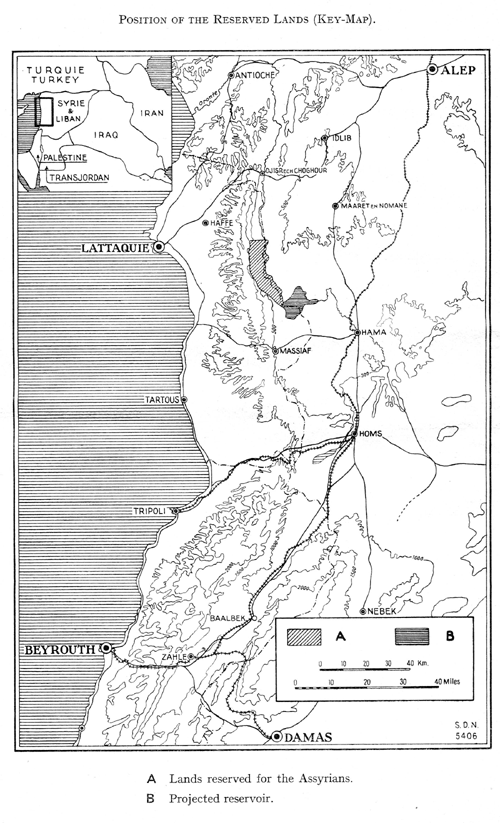
32
ANNEX 3.
REPORT DY MR. MARTIN HILL AND M. HENRI CUE'NOD.
At its last meeting in July 1935, the Committee of the Council, having decided to direct its efforts towards the realisation of the scheme for the settlement of the Assyrians in the plain of the Ghab, requested the French Government to furnish as soon as possible a detailed and complete plan relating to the settlement contemplated. It proposed, in order to save time and avoid unnecessary correspondence, to send two representatives to collaborate with the High Commission in Beirut in the preparation of this plan. This proposal having been accepted by the French Government, we were appointed to represent the Committee for the purpose indicated, in the capacity of financial expert and expert in the transfer of populations respectively.
We met in Beirut on August 1st and began work immediately with M. Burnier, representative of the Nansen office in the Levant States, who, in virtue of an arrangement between the Committee of the Council and the Nansen Office, has supervised the provisional settlement of Assyrians on the Khabur during the past year on behalf of the High Commission. On the following day, we established contact with Captain Dejoux, who had been entrusted by the High Commissioner with the preparation of the plan in collaboration with us, and the heads of the competent services of the High Commission. On the same day, we were also received by M. Lagarde, Acting High Commissioner, and, a few days later, had an interview with M. Schceffler, Governor of Latakia, in whose territory the area proposed for the Assyrian settlement lies.
The High Commission was good enough to arrange that Captain Duprez, representative of the commissioner for the settlement on the Khabur, should come to Beirut to assist in the work :of -.-preparing the plan' - - We considered it advisable, finally, to arrange that Major Wilson, of the Local Committee in Iraq, should also-join us for a few days in order that we might have the fullest possible information regarding the requirements of the Assyrians and the suitability of the arrangements which it was proposed to recommend.
The report of the High Commission was completed and dispatched to Paris on August 23rd. In the course of the following week, after completing the present complementary report and a number of special studies, we left Beirut for Geneva and Mosul respectively.
The greater part of our work was carried out in Beirut, in day-to-day consultation with the High Commission. We had the opportunity, however, of visiting the Ghab; on this visit we were accompanied by an engineer of the Public Works Department, who gave us on the spot the necessary information regarding the reclamation scheme, and by M. Burnier and Captain Duprez, with whom we examined the problems connected with the organisation of the provisional and the definitive installation.
We desire here to place on record our appreciation of the generous and efficient manner in which all the officials concerned with the preparation of the plan collaborated with us during our mission. We would mention in particular Captain Dejoux, who was responsible for the editing of the report, and M. Burnier and Captain Duprez, whose knowledge of the problems of refugee settlement in general, and Assyrian settlement in particular, was invaluable to us.
The work accomplished during our mission is in a large measure embodied in the report submitted to the Committee by the French Government. This report, which is as complete as it was possible to make it in the short time available, covers, we believe, the great majority of the questions on which the Committee of the Council and the Local Committee in Iraq desired information, and contains a comprehensive and, as far as possible, concrete plan for the proposed settlement operation. It contains, further, estimates of the expenses for which provision will have to be made together with the accounts of the settlement operation on the Khabur as at June I 30th, 1935. A brief descriptive note on the existing Khabur settlement is being communicated to the Committee separately.
To the above report we desire merely to add a few explanations and suggestions for the consideration of the Committee.
In the first place, one general observation: The concrete recommendations put forward, and in particular those relating to the disposal of the land to the Assyrians, are subject to important reservations. In regard to one of the essential factors of the situation-namely, the numbers for which to provide none but the vaguest information and- in the four years
Ill.
Having visited the Ghab, we share the view of the Committee that the area contemplated appears to offer great advantages as a place of permanent settlement for the Assyrians. Above all, and apart from the other advantages mentioned in the report, it is large enough for a compact settlement on a considerable scale. The settlement area is, in fact, far greater than the 15,ooo hectares of irrigated land in the plain to the east of the River Orontes. It includes in the first place wide tracts of mountain land. The High Commission was unable at the moment to make a definite statement regarding the possibilities of grazing for sheep on these mountains. As this is a question of great importance to certain of the Assyrian tribes, the Committee will doubtless wish to ask that further information should be furnished as soon as possible. The settlement area includes in the second place a zone of gentle slopes, rising from the plain, on which the villages are to be built. These slopes would also be suitable for certain forms of fruit gardening and other purposes. There exists, somewhat higher up the mountain-side, a forest of wild olive-trees, covering approximately 2,000 hectares. These olive-trees could, we were informed, be made fruitful by grafting and become a considerable source of revenue to the colony.
It is important that the rights over all the lands-and not only the irrigated area in the plain should be reserved to the Committee of Trustees.
The Committee is offered the option of increasing the area of irrigated land up to 20,000 hectares on payment of the cost of extending the irrigation and drainage systems. Such an extension of the irrigated area would not affect the engineering operations contemplated for the reclamation of the 15,ooo hectares and the Committee accordingly need not take a decision on this matter at present. It will, however, doubtless wish to reserve the right to avail itself of the High Commission's offer at a later date, should circumstances justify such a course. The additional land on the left bank of the Orontes would be, like the rest of the settlement area, in Alawite territory; the land on the right bank, which could be reclaimed at somewhat lower cost, lies in Syria, in the midst of a Sunnite Moslem population, and would therefore be less suitable on general grounds
A word may be added here regarding the principal communications with which the district will be served. A good track, capable of bearing motor traffic, at present links the Ghab with Hama, its natural market-town, some 45 kilometres distant. For the purpose of the reclamation work, the existing track running along the foot of the hills to the east of the Ghab will be improved and in due course extended northward to join the main road between Latakia and Aleppo. These towns are roughly 80 and 120 kilometres distant respectively from the northern end of the settlement area.
IV.
We believe that the various proposals put forward-in particular, those regarding the mode of settlement, both provisional and definitive, the conditions under which land may be acquired by the Assyrians, the religious status of the Assyrians, their political and civil status in the transitional period preceding their naturalisation, the administration of the settlement, the social services with which it is to be equipped and the form of liaison with the Council during the execution of the scheme-should be acceptable, not only to the Committee and the Governments and private organisations which may be willing to contribute to the realisation of the scheme, but also to the Assyrians themselves.
It will, however, be a disappointment to the Committee that no reduction on the provisional estimates of costs submitted by the High Commission in June has been found possible. In the case of the estimates relating to the settlement operations, indeed, a small increase over the earlier figures has been found necessary. The item relating to public health service has been considerably increased, and two new items-namely, administration and education-have been inserted. The reasons for these increases are indicated in the body of the report. Almost all the other items have, however, been reduced. In particular, those relating to subsistence and equipment have been appreciably modified in the light of the experience acquired on the Khabur and the information received concerning the material situation of the Assyrian community as a whole.
In the above estimates, provision has been made only for services which were considered to be essential and every effort made to eliminate unnecessary items of cost. In view of the many unknown factors in the situation, however, it was considered advisable to leave a small margin for unforeseen expenses and, in the case of certain items, to adopt conservative figures on which there is reason to hope that a saving may be realised. This refers, in particular, to the most important item-that relating to subsistence. The figure shown represents a minimum allowance of food to every Assyrian; it may be expected, however, that some proportion of the settlers will have the material means of providing for themselves from the beginning
V.
In considering the estimates for the reclamation scheme, it is useful to bear in mind the magnitude of the scale of operations contemplated, operations which, in view of the relative cheapness of labour, can be undertaken in Syria at considerably lower cost than in Western Europe. The diagram hereunder shows the extent of the proposed settlement area in comparison with the Lake of Geneva. The artificial lake will have a maximum area of 100 sq. km. (just short Of 39 sq. miles). The total length of the irrigation and drainage canals will amount to 227 kilometres (141 miles) and, in view of the rapidity of the current, the principal irrigation canals will be faced with concrete. The Acharne dam will be 2 1/2 kilometres (over 1 1/2 miles) long, and over a distance Of 30 kilometres (18 Y., miles) a new channel will be made for the River Orontes. A tunnel large enough for a standard-gauge train will be pierced through goo metres of basalt (over half a mile) and a vast chain of small bridges-the exact number is not yet fixed-will be required to link up the lands irrigated and drained by the network of canals.
B Area equivalent to that reserved for the Assyrians (15,000 hectares).
C Area equivalent to that contingently reserved for the Assyrians.
D Area equivalent to that of the land still to be reclaimed in the Ghab.
The Public Works Department considers that, for technical reasons, it is unlikely that the period of four years contemplated for the execution of the reclamation scheme could be reduced. If the studies necessary before the various operations are offered for tender can be begun before the rainy season this year-that is to say, before the middle of October-the work should be completed before otherwise may not br possible
VI.
It is proposed that the settlers should have the option of acquiring the titles to their land either by outright purchase or by means of fifteen equal annuities, calculated at a low rate of interest, which will be collected on behalf of the Committee of Trustees by the Executive Commission. According to the information available, these annuities would normally represent only a small proportion of the annual money yield of the products of the settlers' holdings. In order to facilitate the payment of these annuities from the first years of the definite settlement -in which, in spite of the assistance furnished by the Executive Commission, it is unlikely that the Assyrians will be able to exploit their lands and market their produce to the best advantage-the settlers will continue to be exempt from all taxation during these years. There is thus a reasonable hope that, in the absence of any large-scale disaster, such as the total destruction of the harvest, the repayments provided for may, in fact, be collected regularly. It is difficult, for obvious reasons, to envisage the raising of a loan, on a commercial basis, on the security of these future receipts. It -is hoped, however, that, in the present case, as in that of the settlement of the Armenian refugees in Syria, Governments, private organisations and individuals may see their way to make contributions which would be refundable as and when the repayments from the settlers were received.
(2) Undertakes to submit to the laws and regulations of his or her new country of residence as well as to the regulations arising out of the special position of the settlers;
(3) Undertakes to acquire Syrian nationality at such time a,; may be fixed;
- Agrees that, in addition to his or her mother tongue, the two languages officially taught in Syria (French and Arabic) shall be taught compulsorily in the Assyrian schools.
The transfer of Assyrians from Iraq to the Ghab region might begin in March 1936, as soon as possible after the heavy rains have stopped; convoys would continue to be moved in the course of the spring and summer as rapidly as the means of transport permit.
On the other hand, to refuse any contribution towards the cost of transport of animals would be an injustice in the case of those families possessing only a few animals and small pecuniary resources and, further, would be unjustifiable on financial grounds, the cost of providing each family in Syria with a minimum of farm animals being considerably greater than a reasonable contribution towards the transport of the same number of animals from Iraq. In the circumstances, we propose that 50% of the cost of the transport of one sheep per head, or the total cost of transport of two sheep per family, whichever is greater, should be borne by the Assyrian fund. Alternatively, half the cost of the transport of one cow per family might reasonably be drawn from this fund. The estimates for this item in the report of the High Commission have been based on the arrangement proposed above.
The other two posts, however, will require to be remunerated and should be filled in time for the necessary arrangements to be made for the transfer in the spring of the coming year. It has naturally been left to the Council to determine what salaries these posts should carry and no provision on this account has been included in the estimates submitted.
In August 1934, the 55o Assyrians who had taken refuge in Syria in August 1933 following the disturbances in Iraq were settled in the valley of the Upper Khabur at a point 40 kilometres above Hassetche. Shortly afterwards, in accordance with an agreement reached between the High Commissioner and the Iraqi Government, their wives, children and a few close relatives, making approximately 1,450 persons in all, were authorised to join them and were conveyed from Mosul to Hassetche by the Iraqi authorities.
At the request of the French Government and in accordance with an agreement between the Council Committee and the Nansen Office, M. Burnier, the representative of that Organisation in Syria, was instructed to take charge of the settlement of the Assyrian colony on the Khabur in close co-operation with Captain Duprez, representative of the High Commissioner.
In September and October 1934, three villages were built, one at Tell-Tamer and two at Tell-Oumrane, and, thanks to particularly favourable climatic conditions, it was possible to settle all the refugees in these places before the rainy season.
-The two-roomed, house placed at the disposal of each family is built of pise bricks (a mixture of clay and straw), the three villages being built by the Assyrians themselves with the assistance of a few local skilled hands.
At the end of June 1935 under an agreement between the Baghdad Government and the High Commission the President of the Council Committee had the 340 women, children and old men who were still at the camp at Mosul transferred to the same places of settlement, and the following month about 1,000 Assyrians taken, from among 'the poorest members of the Mosul community were similarly transferred.
The village of Tell-Tamer at present comprises a population of about 1200 During the first year lack of water made cultivation on a large scale impossible. A pumping-station with three 50-h.p. motors-the erection of which was terminated at the end of May 1935-makes it possible to irrigate an area of about 1000 hectares, which will be devoted to the cultivation of maize, sorgho, beans and sesame.
Immediately after their arrival, the Assyrians set about cultivating vegetable gardens along
the bank of the river and, thanks to the provision of a metal noria, they will very soon have at
their disposal a sufficient quantity of water to enable them to raise vegetables over an area of
10 hectares. For agricultural work, the villagers have 70 working oxen, while for food they have
20 cows and about 600 goats and sheep. ping-station erected
The two villages at Tell-Oumrane have a population of some 800 A pumping this year makes it possible to irrigate 500 hectares of very good land which should suffice to keep the two villages in cereals. Thanks to a noria which has been working since June 1935, the villagers are also able to cultivate 10 hectares of vegetable gardens. These gardens already produce an appreciable quantity of vegetables, melons and water-melons.
There is abundant pastumage for the flocks in the immediate vicinity.
Ever since their settlement on the Khabur, the Assyrians have had to be fed. Their rations include flour, meat four times a Week dried or fresh vegetables, sugar, tea, salt, soap, fat, wood, etc. This ration costs 1 French franc per head per day.
The Khabur district is very healthy and the villages can show a satisfactory bill of health. From the beginning of 1935 to August 15th, there were more than 200 births, including only three still-births. The health service consists of an army doctor and seven male and female nurses recruited from among the Assyrians themselves.
The chief tribes represented on the Khabur are the Tkhouma, the Haut-Tiari and the Diz. As among the Assyrians the tribe is the basis of social Organisation, the sections settled in Syria are anxious that those of their members who are still in Iraq, making a total Of 3,000 persons, should be authorised to join them. Such a measure would be likely to put an end to a certain feeling of instability which has been noted in the villages on the Khabur. It would also facilitate the settlement of the newcomers and their adaptation to local conditions, as they would be received and assisted by members of their own tribes.